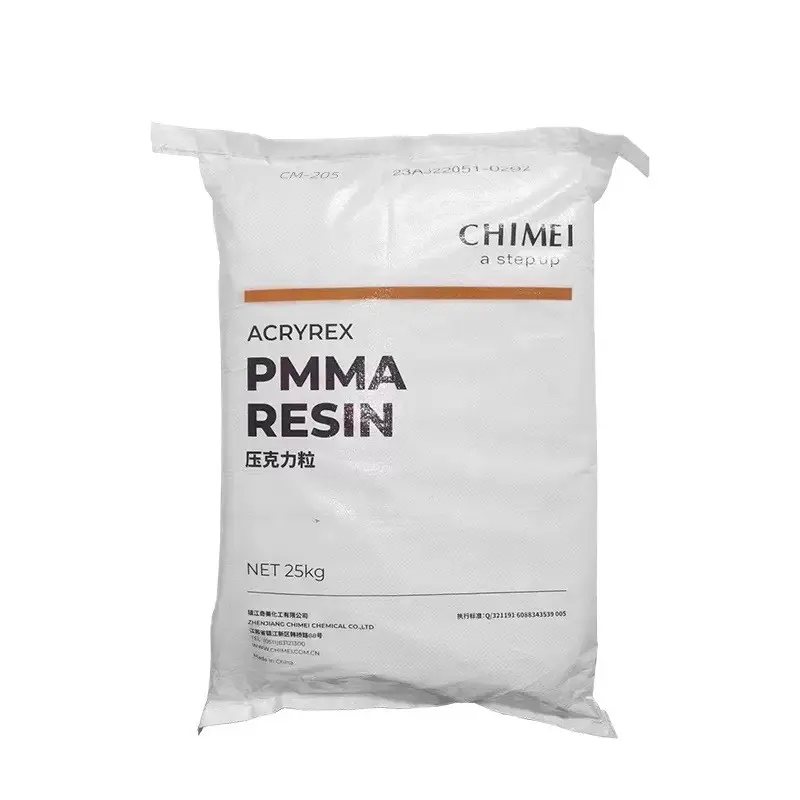
Product Overview & Key Features
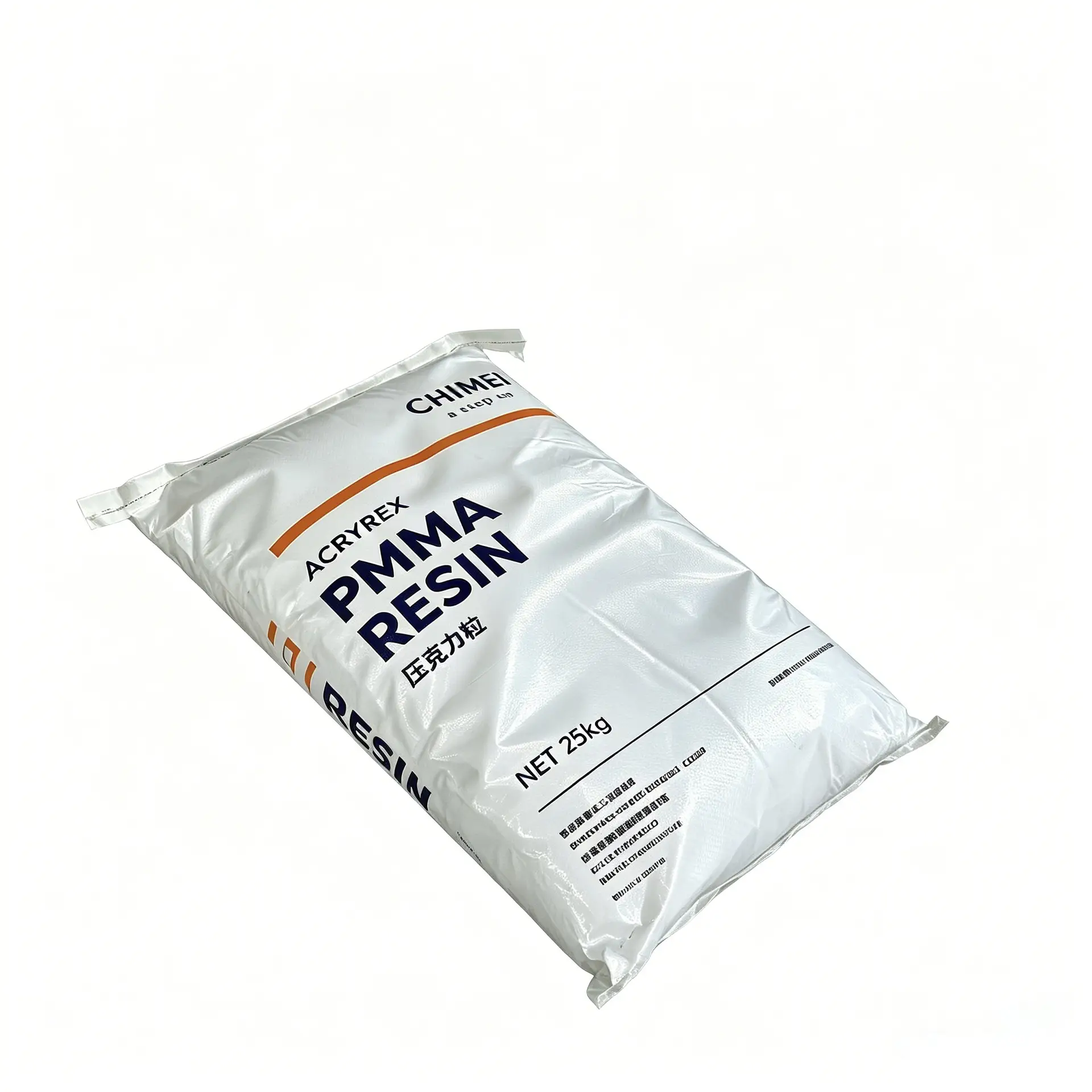
ACRYREX® CM-205 is a high-viscosity, heat-resistant, and high-strength grade of polymethyl methacrylate (PMMA) within the ACRYREX® series by ChiMei Corporation. Suitable for both injection molding and sheet/rod/tube extrusion, it is positioned as the “heat-resistant + high-strength + extrudable” tier within the ACRYREX® general-purpose series.
| Item | Details / Description |
| Manufacturer | ChiMei Corporation |
| Product Series | ACRYREX® PMMA Resin |
| Grade | CM-205 |
| Material Base Attribute | Polymethyl Methacrylate (PMMA), an amorphous thermoplastic engineering plastic, commonly known as acrylic or plexiglass |
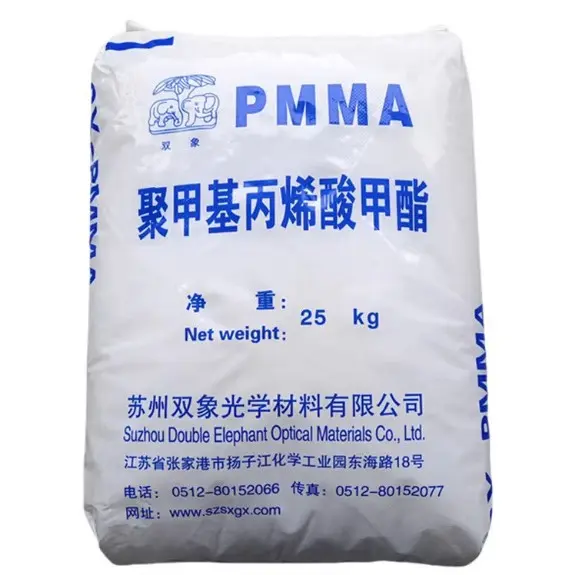
| Physical Appearance | Colorless, transparent granular pellets, conventionally packaged in 25 kg bags |
| Suitable Processing Methods | Injection molding; Sheet, rod, and tube extrusion |
Core Performance Advantages
- Clear Heat Resistance & Thermal Stability Positioning: Features a Vicat softening point of 115 °C (ISO 306/B120, 50 °C/h), making it a heat-resistant tier among general-purpose grades, ideal for transparent structural and optical parts subjected to medium-temperature environments over long periods.
- High Strength & High Rigidity: Tensile strength (break) of 68 MPa, flexural strength of 110 MPa, and flexural modulus of 3200 MPa (ISO 527 / ISO 178). It can withstand structural loads and assembly stresses, making it suitable as a transparent structural material replacing glass.
- Surface Hardness & Scratch Resistance: Rockwell hardness of M 95 (ASTM D785). It offers high molded surface hardness and excellent gloss retention, suitable for transparent parts requiring high exterior wear resistance.
- Transparency & Surface Gloss: PMMA is a highly transparent amorphous material. Combined with this grade’s good cleanliness and surface gloss characteristics, it is suited for aesthetic and optical components (refer to the manufacturer’s corresponding version of the specification sheet for light transmittance and other optical metrics).
- Moderate Flowability, Suitable for Extrusion and Thick-Walled Parts: Melt Volume-flow Rate (MVR) of 2.0 cm³/10 min (230 °C, 3.8 kg), representing a high-viscosity, medium-to-low flow tier with excellent melt strength. It is suitable for injection molding thick-walled aesthetic and optical parts, as well as extruding sheets, rods, and tubes.
- Dimensional Stability & Low Moisture Absorption: Density of 1.18 g/cm³ (23 °C, ISO 1183). The amorphous structure results in minimal dimensional fluctuation of parts in humid environments, which, combined with low shrinkage characteristics, facilitates precision assembly.
- Clean Formulation Unaffected in Hardness and Strength by Plasticizers: High material cleanliness makes it suitable for products sensitive to surface defects, black specks, and optical flaws.
- Flame Retardant Rating UL 94 HB (1.5 mm): Suitable for structural and exterior parts that do not mandate flame retardant certification; if end products are bound by UL 94 V-0 or glow-wire clauses, flame-retardant modified material systems should be used instead.
Technical Specifications
Physical Properties
| Physical Property | Test Value | Test Unit | Test Standard |
| Density23 °C | 1.18 | g/cm³ | ISO 1183 |
| Rockwell Hardness (M Scale) | 95 | — | ASTM D785 |
| Melt Volume-flow Rate (MVR)230 °C, 3.8 kg | 2 | cm³/10 min | ISO 1133 |
Mechanical Properties
| Mechanical Property | Test Value | Test Unit | Test Standard |
| Tensile Strength, Break50 mm/min | 68 | MPa | ISO 527 |
| Flexural Strength2 mm/min | 110 | MPa | ISO 178 |
| Flexural Modulus2 mm/min | 3200 | MPa | ISO 178 |
| Charpy Notched Impact Strength4 mm, 23 °C | 1.8 | kJ/m² | ISO 179 |
| Tensile Strain50 mm/min | 10 | % | ISO 527 |
Thermal Properties
| Thermal Property | Test Value | Test Unit | Test Standard |
| Vicat Softening Point50 °C/h | 115 | °C | ISO 306/B120 |
| Heat Deflection Temperature, Unannealed1.8 MPa | 84 | °C | ISO 75-2 |
| Flame Retardancy Rating1.5 mm | HB | — | UL 94 |
Notice: The technical specifications for ChiMei ACRYREX® CM-205 provided herein are compiled from data published by ChiMei or certified third-party testing laboratories. While prepared with professional diligence, these values serve as reference guidelines rather than absolute performance guarantees. Because molding and processing conditions vary significantly across operational environments, we recommend performing trial runs with ACRYREX® CM-205 under your actual manufacturing conditions prior to final material selection and mass production.
Applications & Processing Guidelines
Recommended Application Scenarios
- Automotive Lighting and Lens Covers: Headlamp and signal lamp outer optical lenses, lamp covers, lenses, and light-transmitting decorative parts. Materials must simultaneously possess heat resistance (higher temperatures near the light source) and a light-transmitting appearance; this grade’s 115 °C Vicat softening point and high-strength positioning match such working conditions.
- Optical Parts and Lenses: Lighting lenses, display and indicator panels, instrument windows, and other transparent parts with high clarity and surface quality requirements; high-viscosity characteristics help reduce flow marks and optical distortion.
- Home Appliances: Panels, viewing windows, transparent housings, refrigerator and dishwasher visible components, oven display panels, and other medium-temperature transparent structural components.
- Daily Consumer Goods: Sunglasses lenses and frame parts, digital watch cases, transparent decorative items, and other products requiring high exterior hardness and gloss retention.
- Extruded Profiles: Sheet, rod, and tube extrusion for subsequent machining or secondary forming; melt strength and stable viscosity characteristics support continuous extrusion.
- Electrical & Electronic Components (Non-Mandatory Flame Retardant Occasions): Instrument housings, mechanical structural components, and panels; flame retardancy rating is UL 94 HB (1.5 mm).
- Unsuitable Scenarios: Structural parts subjected to long-term high loads and high temperatures (approaching or exceeding the heat deflection temperature); components bound by UL 94 V-0 or glow-wire clauses; transparent parts exposed to long-term outdoor ultraviolet radiation without protective coatings.
Processing Guidelines (Subject to manufacturer’s official process guide and live machine trial molding)
Drying Treatment (Crucial Pre-step): PMMA has distinct hygroscopicity; moisture causes the melt to generate bubbles and silver streaks while significantly reducing transparency. Drying is mandatory prior to molding.
- Drying temperature: 85–90 °C; Drying time: approx. 4 h (adjusted according to initial moisture content of raw material and dryer type).
- It is recommended to use a dehumidifying dryer, controlling the moisture content below 0.1%; stricter requirements apply to optical-grade and aesthetic parts.
- Materials left unpacked for long periods, water-cooled/water-ring pelletized raw materials, and regrind must be dried before use and stored hermetically after drying.
Temperature Settings (Reference Range):
- Feed zone: 185–205 °C
- Compression/Metering zone: 220–240 °C
- Nozzle: 210–230 °C
- Mold temperature: 50–70 °C (higher mold temperatures help improve flow marks, enhance surface gloss, and transparency, but will extend the molding cycle).
Injection and Plasticization Adjustment:
- Injection pressure: Belonging to the high-viscosity tier, the required injection pressure is higher than that of high-flow grades. It is advisable to set higher pressure within equipment capacity to ensure mold filling.
- Injection speed: Medium-low speed is recommended. Aesthetic and thick-walled parts should adopt multi-stage injection (slow-fast-slow) to reduce internal stress, flow marks, and weld lines.
- Screw speed and back pressure: Medium-low screw speed and moderate back pressure. Rely on melt temperature rather than high speed to improve flowability, avoiding yellowing and decomposition caused by shear overheating.
- Barrel residence time: Avoid prolonged high-temperature retention; empty the barrel or lower the temperature prior to shutdown.
Mold and Gate Design:
- High-viscosity grades require larger gate cross-sections and smooth runners. Excessively small gates cause shear overheating and insufficient mold filling.
- Aesthetic surfaces should avoid direct confrontation with the gate; use sub-gates or fan gates when necessary to improve appearance.
- PMMA is notch-sensitive; sharp corners on parts and runners should be designed with fillets (recommended R ≥ 0.5 mm) to avoid stress concentration and cracking.
- Draft angles and ejection area must be sufficient to prevent internal stress introduced by forced demolding.
Dimensions and Internal Stress: PMMA is an amorphous material with low molding shrinkage. Parts can be annealed at 70–80 °C for 2–4 hours (time adjusted according to wall thickness) to reduce internal stress and late-stage cracking risks.
Regrind and Purging: Virgin materials are recommended for aesthetic and optical parts; if regrind must be blended, it must be thoroughly dried and verified progressively by proportion to avoid gloss reduction and black specks.
Common Defects and Troubleshooting Directions:
| Common Defect Phenomenon | Main Cause Analysis | Adjustment and Solution Direction |
| Silver Streaks / Bubbles / Reduced Transparency | Insufficient drying, excessive melt temperature leading to degradation | Strengthen raw material drying, lower melt temperature, shorten barrel residence time |
| Pronounced Flow Marks / Weld Lines | Low mold temperature, undersized gate, improper injection speed | Raise mold temperature, enlarge gate cross-section, optimize multi-stage injection curve (slow-fast-slow) |
| Part Cracking / Stress Whitening | Excessive internal stress, overly aggressive demolding, insufficient corner fillets | Perform annealing treatment, optimize ejection mechanism, increase structural corner fillets |
| Yellowing | Melt overheating or excessively long residence time in the barrel | Lower melt temperature, shorten molding cycle, completely empty the barrel prior to shutdown |
Grade Comparison & Selection Guide
Series Differential Comparison (ACRYREX® General-Purpose Series)
| Grade | Manufacturer Positioning | Flowability / Viscosity Positioning | Typical Applications | Suitable Processing |
| CM-205 | Heat-resistant / High-strength / Extrudable | High viscosity (MVR 2.0 cm³/10 min) | Automotive lamps & lenses, appliance parts, optical components | Injection + Extrusion |
| CM-207 | Medium strength / Balanced | Medium viscosity (General-purpose) | Daily consumer goods, home appliances, electronic panels, mechanical parts | Injection |
| CM-211 | High flow / Good processability | Low viscosity (High flow) | Daily consumer goods, home appliances, electronic panels, complex/hard-to-fill decorative parts | Injection |
| CM-205G | Optical grade, low melt index | Low flow (Optical grade) | Optical extrusion products, such as light guide plates (LGP) | Extrusion-dominated |
Engineer Selection Recommendations
- Select by Wall Thickness and Flow Length Ratio: For thick-walled parts (wall thickness ≥ 2.5 mm), aesthetic parts, and optical parts, prioritize CM-205. The higher melt strength brought by high viscosity helps reduce flow marks, sink marks, and optical distortion while balancing heat resistance and strength requirements.
- Select by Mechanical Load and Heat Resistance Requirements: For parts bearing assembly stress, long-term loads, or operating in medium-temperature conditions (e.g., areas adjacent to light sources, appliance heating zones), prioritize CM-205—its official positioning in the ACRYREX® general-purpose series is the heat-resistant and high-strength tier, corresponding to the measured data of a 115 °C Vicat softening point and a 3200 MPa flexural modulus in this document.
- Select by Processing Method: When simultaneous injection molding and extrusion (sheet, rod, tube) capabilities are required, CM-205 is the designated grade covering this combination within the general-purpose series.
Frequently Asked Questions (FAQs)
Q1: Is drying required before injection molding ACRYREX® CM-205? What are the recommended conditions?
Yes, it is required. PMMA has distinct hygroscopicity, and moisture causes bubbles and silver streaks in the melt while decreasing transparency. It is recommended to dry at 85–90 °C for about 4 hours using a dehumidifying dryer to control moisture content below 0.1%; optical and high-appearance requirements demand stricter drying standards. Materials stored unpacked for extended periods, water-cooled/water-ring pelletized materials, and regrind must be re-dried. They should be stored hermetically after drying and protected from prolonged high-temperature retention in the barrel.
Q2: What does a melt volume-flow rate of 2.0 cm³/10 min signify? How should adjustments be made during processing?
This value (230 °C, 3.8 kg) indicates that CM-205 belongs to a high-viscosity, medium-to-low flow tier. Processing should improve mold filling through “increasing melt temperature + enlarging gate + raising injection pressure” rather than drastically increasing screw speed to forcefully enhance flowability—the latter introduces shear overheating, yellowing, and internal stress issues. For thick-walled and aesthetic parts, a slow-fast-slow multi-stage injection profile combined with higher mold temperatures is recommended to achieve a smoother surface and lower residual stress.
Q3: How should CM-205, CM-207, and CM-211 be selected?
The core differences among the three lie in viscosity and strength positioning: CM-205 features high viscosity, heat resistance, and high strength with extrusion support, suitable for automotive lenses, thick-walled appearance parts, and optical components; CM-207 is a medium-viscosity general-purpose grade suitable for conventional shapes and medium-strength daily and appliance parts; CM-211 is a high-flow grade suitable for thin-walled, long-flow, or complex hard-to-fill products.