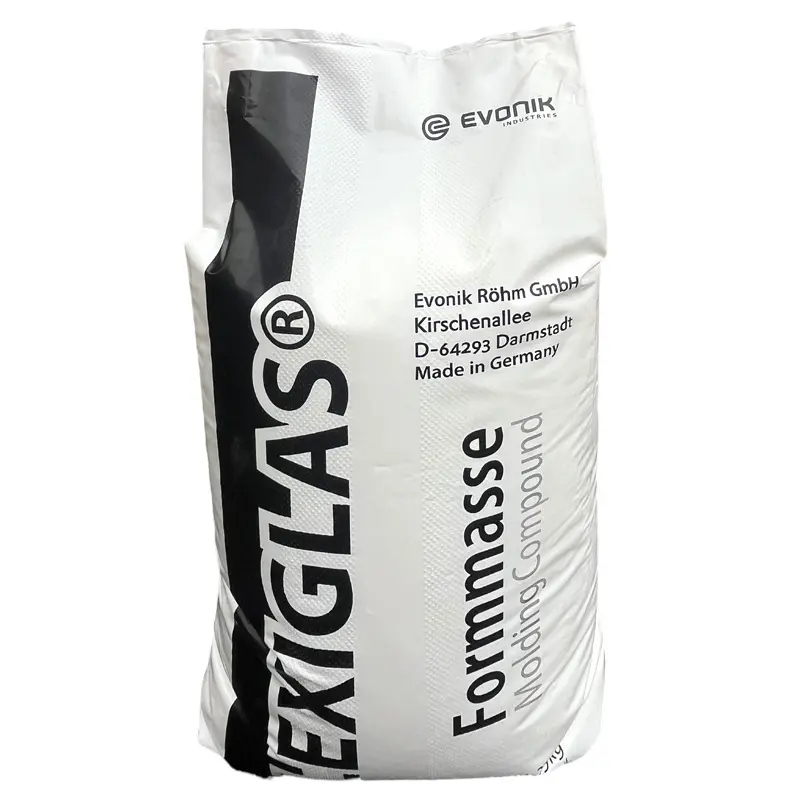
Product Overview & Key Features
- Manufacturer: Roehm (Formerly Evonik)
- Product Line: PLEXIGLAS®
- Grade: 8N
- Material Category: Polymethyl Methacrylate (PMMA, Acrylic)
Roehm PLEXIGLAS® 8N is a general-purpose injection molding grade PMMA available in natural, transparent pellets. It features excellent visible light transmittance, low haze, good surface hardness, stable weather resistance, and outstanding anti-ultraviolet performance, preventing yellowing during long-term outdoor use. This grade offers moderate fluidity and good thermal stability, making it compatible with mainstream thermoplastic processing technologies. It is widely used in industrial components and consumer goods that require high transparency and premium aesthetic textures.
Core Performance Advantages:
- High visible light transmission, low haze, and exceptional surface gloss on molded parts.
- Good weather resistance and anti-UV aging performance, making it suitable for outdoor applications.
- Balanced rigidity and surface hardness, exhibiting scratch-resistance superior to most general-purpose transparent plastics.
- Excellent thermal processing stability with stable dimensional performance post-molding.
- Recommended Processing Technology: Injection molding; high-speed extrusion is not recommended.
Technical Specifications
Physical Properties
| Property | Test Condition | Value | Unit | Test Standard |
| Melt Volume-Flow Rate (MVR) | 230℃/3.8kg | 2 | cm³/10min | ISO 1133 |
| Density | 23℃ | 1.19 | g/cm³ | ISO 1183‑1 |
Mechanical Properties
| Property | Test Condition | Value | Unit | Test Standard |
| Charpy Impact Strength (Unnotched) | 23℃ | 16 | kJ/m² | ISO 179‑1 |
| Charpy Impact Strength (Notched) | 23℃ | 1.8 | kJ/m² | ISO 179‑1 |
Thermal Properties
| Property | Test Condition | Value | Unit | Test Standard |
| Vicat Softening Temperature (Vicat B50) | — | 108 | ℃ | ISO 306 |
| Heat Deflection Temperature (HDT A, 1.8MPa) | — | 95 | ℃ | ISO 75‑2 |
Optical Properties
| Property | Test Condition | Value | Unit | Test Standard |
| Transmittance | 3mm test specimen | 92 | % | ISO 13468‑2 |
| Haze | 3mm test specimen | 0.8 | % | ISO 14782 |
| Rockwell Hardness (M-scale) | — | 94 | — | ISO 2039‑2 |
Disclaimer: The technical specifications for Roehm PLEXIGLAS® 8N presented herein are derived from data issued by Roehm (Formerly Evonik) or certified third‑party testing institutions. While we have made every effort to ensure the accuracy of the information provided, we assume no liability for any consequences arising from the use of PLEXIGLAS® 8N based on these data. Given the variables involved in processing conditions, we strongly recommend conducting thorough trials of PLEXIGLAS® 8N under your specific operational environment prior to final material selection.
Applications & Processing Guidelines
Typical Applications
- Optical & Appearance Parts: Indoor and outdoor lighting housings, lamp shades, light diffusion accessories.
- Consumer Electronics: Instrument windows, display protection panels, decorative transparent parts.
- Daily Use & Advertising: Signs, indicator lamp covers, handicrafts, transparent decorative housings.
- Industrial Components: Weather-resistant transparent protective covers, non-load-bearing optical components.
Key Processing Guidelines
- Drying Treatment: PMMA easily absorbs moisture and must be dried prior to injection molding. Recommended drying conditions: 80–85℃ for 2–4 hours, keeping residual moisture under 0.05% to avoid surface silver streaks and bubbles in molded articles.
- Injection Temperature Range: Barrel temperature of 220–250℃; mold temperature recommended at 60–80℃. Higher mold temperatures enhance surface gloss and reduce internal stress.
- With an MVR of 2.0, this grade has medium fluidity and is not suitable for ultra-thin or extra-long runner parts. Gate design must ensure smooth melt filling to minimize internal stress.
- Shutdown Maintenance: Maintain barrel temperature during short-term shutdowns. For long-term shutdowns, purge the barrel to prevent thermal degradation and yellowing of the material.
Logistics, Packaging & Compliance
- Packaging Specification: Original factory standard 25kg moisture-proof sealed paper-plastic composite bags.
- Hazardous Classification: General plastic pellets, non-hazardous materials suitable for standard cargo transportation.
- Delivery Lead Time: Spot inventory available for short-cycle dispatch; regular delivery schedules for overseas booking orders depend on shipping line arrangements, supporting full container load (FCL) and less than container load (LCL) ocean freight.
- Documentation Support: Original factory TDS, MSDS, and batch COA (Certificate of Analysis) reports can be provided.
- Compliance Certifications: Complies with REACH and RoHS regulations, meeting entry requirements for most European consumer-grade products.
- ESG Environmental Statement: This grade is a thermoplastic PMMA that can be recycled and reprocessed under suitable conditions. Exhaust gas collection and treatment should be implemented during processing to prevent high-temperature thermal cracking.
TaiKuo New Materials acts solely as a raw material distributor without altering the intrinsic chemical composition of the product. All compliance attributes are subject to the original manufacturer’s data from Roehm.
Frequently Asked Questions (FAQs)
Q1: Is drying strictly necessary before processing PLEXIGLAS® 8N?
A: Yes, drying is mandatory. PMMA has high hygroscopicity, and moisture absorbed by the pellets will cause surface bubbles, silver streaks, flow lines, and other defects during injection molding. It is recommended to dry at 80–85℃ for 2–4 hours and process promptly to prevent reabsorption.
Q2: How should I choose between 8N and other PMMA grades?
A: 8N is a medium-flow, general-purpose weather-resistant injection molding grade focused on high light transmittance and outdoor anti-yellowing performance. Thinner parts require a higher MVR grade, while higher impact toughness requires impact-modified PMMA grades. Small-scale trial runs are recommended before final mass production.
Q3: Is this grade suitable for sheet extrusion?
A: PLEXIGLAS® 8N is designed for injection molding with a relatively low MVR, making it non-preferred for sheet extrusion. Sheet manufacturing calls for dedicated extrusion grades from Roehm.
Q4: How can internal stress be reduced in molded PLEXIGLAS® 8N parts?
A: Prioritize raising the mold temperature to 70–80℃, reducing injection speed, lowering holding pressure, and minimizing gate residual stress. For high-demand transparent components, an annealing process (holding at 80℃ for 1–2 hours followed by slow cooling) can effectively eliminate internal stress and minimize the risk of later cracking.