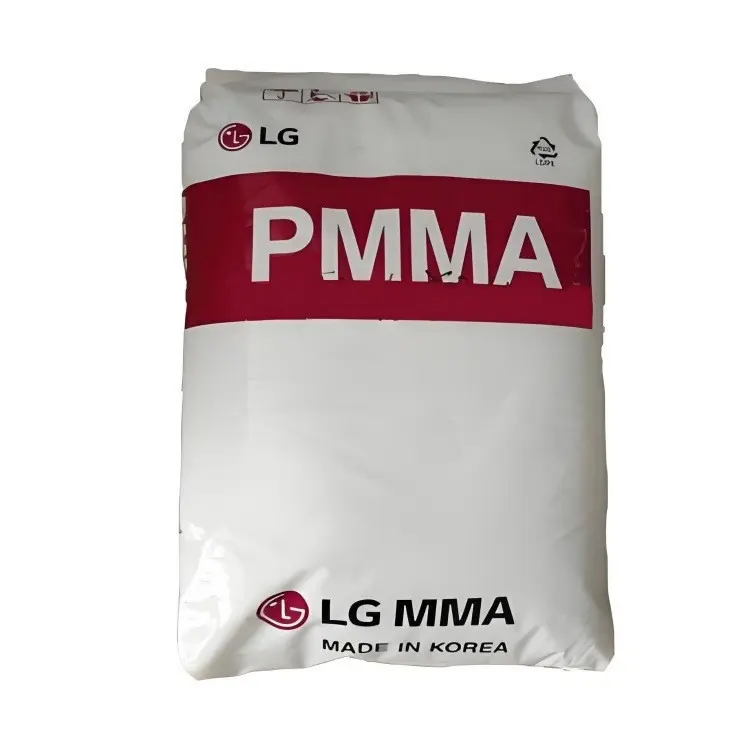
Product Overview & Key Features
- Manufacturer: LG Chem
- Product Series: IF Series (High-Flow Injection Molding Grade Series)
- Material Category: PMMA (PolyMethyl MethAcrylate / Acrylic)
- Physical Appearance: High-transparency colorless pellets (Transparent Pellets)
- Primary Processing Method: Injection Molding
Core Performance Profile
LG Chem PMMA IF850 is a high-flowability polymethyl methacrylate resin produced by LG Chem using a continuous suspension/bulk polymerization process. While maintaining the inherent high light transmittance (reaching 93%) and superior gloss of acrylic materials, this grade optimizes high-molecular-weight distribution to achieve a significantly enhanced melt mass-flow rate (MFR reaches 12.5 g/10 min at 230°C / 3.8kg). Designed specifically for complex structures, thin-wall molding, and long-flow-length injection molded parts, IF850 effectively lowers injection filling resistance and residual internal stress in molded parts, while combining excellent weatherability, mechanical rigidity (flexural modulus of 32,000 kg/cm²), and surface scratch resistance.
Technical Specifications
Physical Properties
| Property | Test Condition | Value | Unit | Test Method |
| Water Absorption | 24h | 0.3 | % | ASTM D570 |
| Melt Mass-Flow Rate (MFR) | 230°C, 3.8kg | 12.5 | g/10 min | ASTM D1238 |
| Density | — | 1.18 | g/cm³ | ASTM D792 |
| Molding Shrinkage | — | 0.2–0.6 | % | ASTM D955 |
Mechanical Properties
| Property | Test Condition | Value | Unit | Test Method |
| Rockwell Hardness | — | 89 | M Scale | ASTM D785 |
| Flexural Modulus | — | 32000 | kg/cm² | ASTM D790 |
| Tensile Strength | — | 690 | kg/cm² | ASTM D638 |
| Flexural Strength | — | 1220 | kg/cm² | ASTM D790 |
| Izod Impact Strength, Notched | Izod Notched | 1.6 | kg·cm/cm | ASTM D256 |
| Elongation at Break | — | 3.0 | % | ASTM D638 |
Thermal Properties
| Property | Test Condition | Value | Unit | Test Method |
| Heat Deflection Temperature (HDT) | 18.5 kg/cm² (1.82 MPa) | 90 | °C | ASTM D648 |
| Heat Capacity | — | 0.35 | cal/(g·°C) | Internal Method |
| Thermal Conductivity | — | 5×10⁻⁴ | cal/s/cm/°C | ASTM D177 |
| Coefficient of Linear Thermal Expansion (CLTE) | — | 6×10⁻⁵ | 1/°C | ASTM D696 |
| Vicat Softening Point | 1kg | 90 | °C | ASTM D1525 |
Electrical Properties
| Property | Test Condition | Value | Unit | Test Method |
| Dielectric Strength | 4kV/s | 20 | kV/mm | ASTM D149 |
| Power Factor | 60Hz | 0.05 | — | ASTM D150 |
| Dielectric Constant | 60Hz | 4 | — | ASTM D150 |
| Volume Resistivity | — | >1×10¹⁵ | ohm·m | ASTM D257 |
Flammability
| Property | Test Condition | Value | Unit | Test Method |
| Flammability Rating | 1/8″, 1/16″ | HB | — | UL 94 |
Optical Properties
| Property | Test Condition | Value | Unit | Test Method |
| Refractive Index | — | 1.49 | — | ASTM D542 |
| Luminous Transmittance (Clarity) | 3.2mm | 93 | % | ASTM D1003 |
Notice: The technical specifications for LG Chem PMMA IF850 provided herein are compiled from data published by LG Chem or certified third-party testing laboratories. While prepared with professional diligence, these values serve as reference guidelines rather than absolute performance guarantees. Because molding and processing conditions vary significantly across operational environments, we recommend performing trial runs with IF850 under your actual manufacturing conditions prior to final material selection and mass production.
Features & Benefits
- Superior Optical Transmittance & Clarity: Achieves up to 93% light transmittance at 3.2mm thickness with a refractive index of 1.49. Delivers a crystal-clear visual effect comparable to optical glass, maintaining resistance to yellowing and discoloration over long-term use, thereby elevating the aesthetic quality of end products.
- High Melt Flowability & Low Molding Residual Stress: Features an MFR of 12.5 g/10 min at 230°C / 3.8kg. Excellent melt flow characteristics allow rapid filling of complex or thin-walled mold cavities, reducing clamping force requirements on equipment while effectively minimizing internal stress concentration and optical birefringence caused by difficult filling.
- High Surface Hardness & Scratch Resistance: Reaches a Rockwell hardness of 89 M Scale, endowing injection molded parts with excellent surface hardness and mechanical rigidity (tensile strength of 690 kg/cm² and flexural strength of 1220 kg/cm²), making them capable of withstanding daily friction and handling without requiring additional protective surface coatings.
- Low Shrinkage & Dimensional Stability: Maintains a low molding shrinkage rate within 0.2%–0.6%, ensuring uniform melt cooling and crystallization. This minimizes warpage in long-dimension, large-area light-transmitting panels or precision structural parts after molding, sustaining consistent assembly tolerances.
- Stable Electrical Insulation & Weatherability: Features a volume resistivity greater than 1×10¹⁵ ohm·m. Combined with the inherent UV resistance of PMMA resin, it ensures that components maintain stable physical properties under ambient electrical conditions and outdoor light exposure.
Applications & Processing Guidelines
Recommended Applications
- Optical & Display Panels: Light guide plates (LGP) for TVs and monitors, transparent indicator panels for home appliances, instrument glass/covers, LED linear lenses, and optical lampshades.
- Automotive Components: Automotive display covers, interior instrument cluster covers, door ambient light guides, and taillight covers requiring optical clarity and weatherability.
- Consumer Electronics & Daily Goods: High-end cosmetic container housings, transparent consumer electronic enclosures, audio equipment transparent parts, display stands, and premium stationery.
Processing Guidelines
- Drying Treatment (Mandatory): PMMA exhibits a 24-hour water absorption rate of 0.3%. Pre-drying is essential prior to processing to prevent moisture splay, bubbles, or thermal hydrolysis degradation during injection molding. Drying in a hot air circulating oven or desiccant dryer at 75°C–80°C for 3–4 hours is recommended, keeping the hopper sealed.
- Barrel Temperature Settings: The recommended melt processing temperature range is 210°C–240°C.
- Rear (Feed Zone): 190°C–210°C
- Middle Zone: 210°C–230°C
- Front / Nozzle Zone: 220°C–240°C (Note: Prolonged melt exposure above 260°C should be avoided to prevent thermal degradation resulting in yellowing or bubbles)
- Mold Temperature: Recommended mold temperature range is 50°C–70°C. Moderately higher mold temperatures facilitate better surface gloss and lower internal stress in finished parts.
- Injection Pressure & Speed: Due to the high flow characteristics of IF850, injection pressure can be set between 50–100 MPa. A medium to moderately fast injection speed combined with appropriate holding pressure (approximately 50%–70% of injection pressure) is recommended to prevent sink marks and eliminate flow lines.
Frequently Asked Questions (FAQs)
Q1: Is pre-drying mandatory when processing LG Chem PMMA IF850?
Yes, pre-drying prior to injection molding is strongly recommended. Although PMMA’s water absorption rate (0.3% / 24h) is lower than that of engineering plastics such as PA or PBT, even trace amounts of moisture during high-temperature injection molding can cause PMMA molecular chain hydrolysis or melt gasification, leading to splay marks, flow lines, or micro-bubbles on transparent parts. Standard drying parameters are 75°C–80°C for 3–4 hours.
Q2: What are the main differences between LG Chem PMMA IF Series and IH Series during material selection?
The core difference lies in the trade-off between flowability and heat resistance / mechanical strength:
- IF Series (e.g., IF850): Focuses on high flowability (MFR 12.5 g/10 min), designed for thin-walled, long-flow-length, or complex-shaped parts, offering a wide processing window and low internal stress.
- IH Series (e.g., IH830): Focuses on high heat resistance and mechanical strength (heat deflection temperatures typically reach 95°C–100°C or higher), making it suitable for components with higher operating ambient temperature requirements, thick walls, or higher deformation resistance needs.
Q3: How can internal stress or cracking issues be mitigated when injection molding transparent thick-walled parts with IF850?
Although IF850 is a high-flow grade with a relatively low tendency for internal stress, the following optimization techniques are recommended for thick-walled or high-transparency parts:
- Control Mold Temperature: Stable elevation of mold temperature to 65°C–75°C slows down the melt cooling rate, allowing sufficient molecular chain relaxation;
- Optimize Holding Pressure: Apply multi-stage holding pressure to avoid excessive and prolonged pressure concentration near the gate;
- Post-Processing (Annealing): If parts will contact solvents or endure mechanical stress after assembly, anneal them in an oven at 70°C–75°C for 2–4 hours to thoroughly eliminate residual stress.