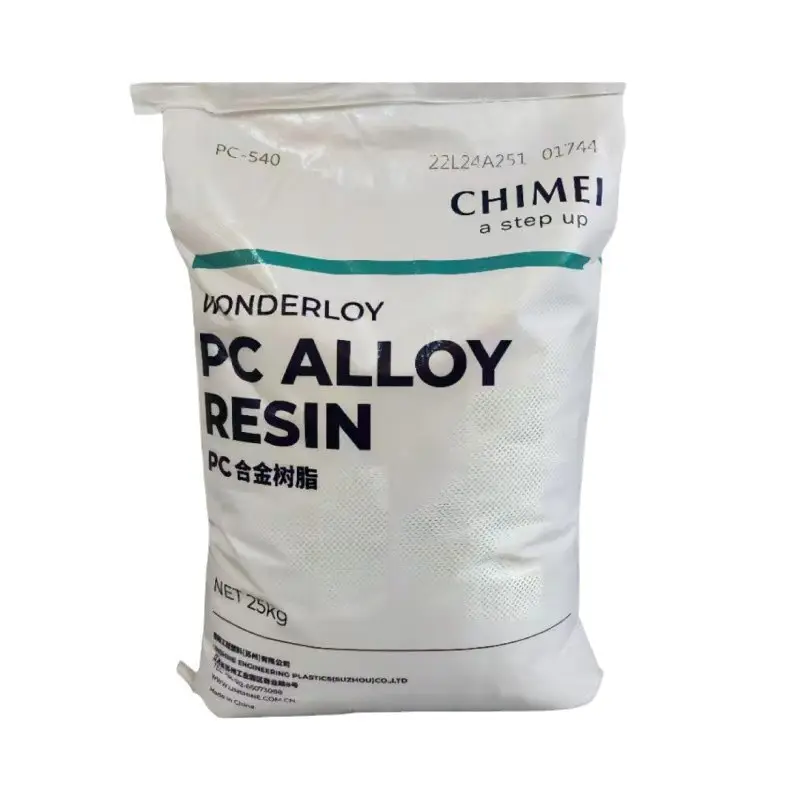
Product Overview & Key Features
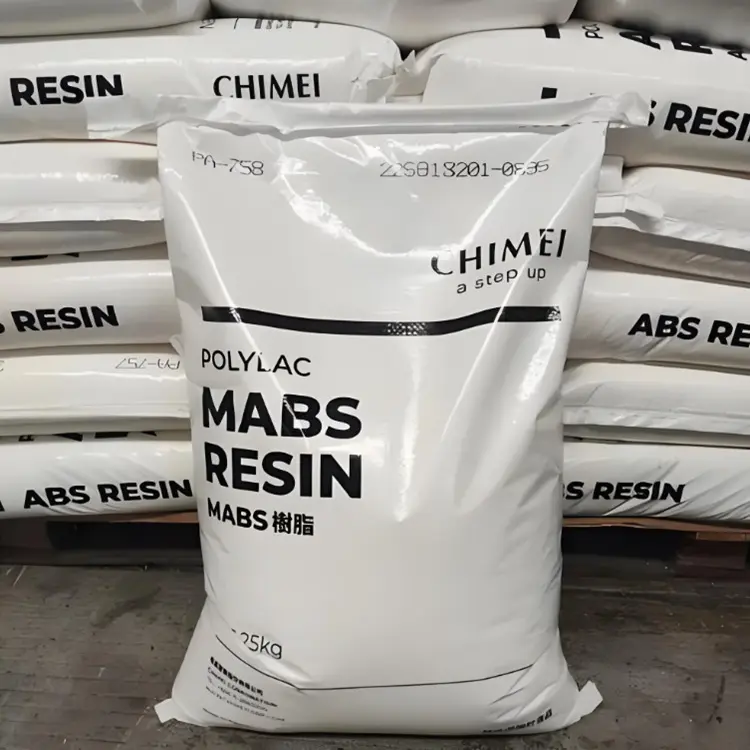
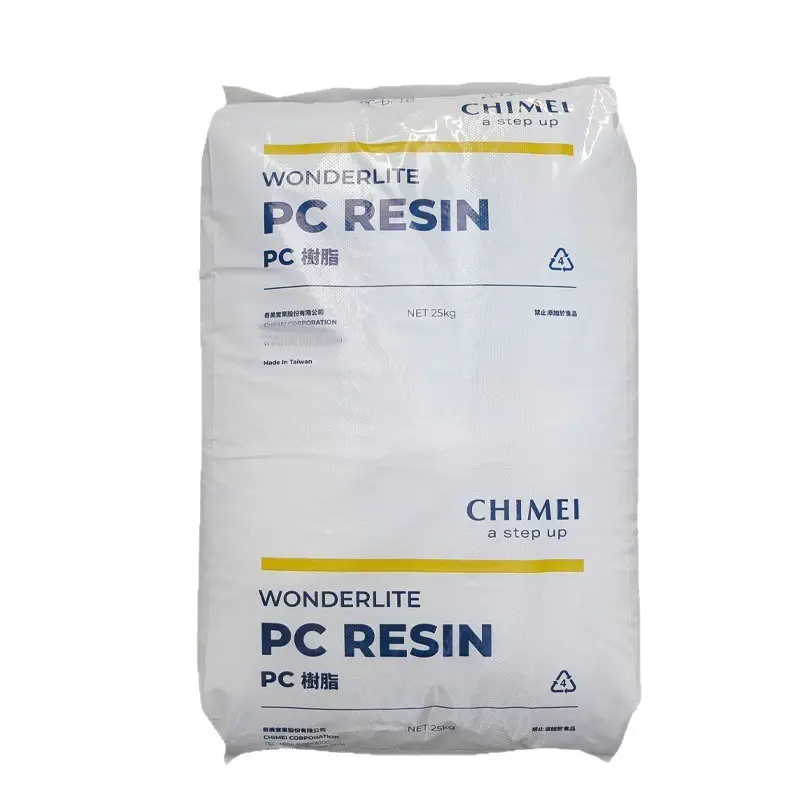
Manufacturer: ChiMei Corporation
Product Series: WONDERLOY®
Product Grade: PC-540
Material Category: PC/ABS Alloy (Polycarbonate / Acrylonitrile-Butadiene-Styrene Alloy)
Appearance: Natural or custom-colored pellets with a smooth surface and good fluidity, representing a typical injection-molding grade engineering plastic alloy.
ChiMei WONDERLOY® PC-540 is an injection-molding grade PC/ABS alloy combining the high rigidity and heat resistance of PC with the high fluidity and easy processability of ABS. It features a volume melt flow rate (260°C/2.16kg) of 20 cm³/10min, a spiral flow length of 40 cm (260°C/2mm), notched Charpy and Izod impact strengths of 40 kJ/m² (23°C, 3.2mm), and a UL 94 V-0 flame rating at a 1.5mm thickness, making it a well-balanced grade characterized by high fluidity, high toughness, and flame retardancy.
Within the WONDERLOY® product portfolio, PC-540 is tailored for thin-wall injection molding applications that demand high standards for appearance, dimensional precision, impact resistance, and electrical safety. For overseas buyers, structural engineers, and module makers, its core value lies in ChiMei’s comprehensive and reliable original data, consistent batch quality, and a wide processing window, making it ideal for standard mass production of electronic and electrical housings, automotive interior parts, and premium consumer product casings.
Technical Specifications
Physical Properties
| Property | Condition / Unit | Value / Unit | Test Method |
| Density | 23 °C | 1.18 g/cm³ | ISO 1183 |
| Melt Volume Flow Rate (MVR) | 260 °C, 2.16 kg | 20 cm³/10 min | ISO 1133 |
| Spiral Flow Length | 260 °C, 2 mm | 40.0 cm | Internal Method |
| Molding Shrinkage | — | 0.4–0.6 % | ISO 2577 |
Mechanical Properties
| Property | Condition / Unit | Value / Unit | Test Method |
| Tensile Stress, Yield | 50 mm/min | 60 MPa | ISO 527-2/50 |
| Tensile Stress, Break | 50 mm/min | 55 MPa | ISO 527-2/50 |
| Tensile Strain, Break | 50 mm/min | 120 % | ISO 527-2/50 |
| Flexural Modulus | 2 mm/min | 2,500 MPa | ISO 178 |
| Flexural Strength | 2 mm/min | 90 MPa | ISO 178 |
| Charpy Impact Strength, Notched | 23 °C, 3.2 mm | 40 kJ/m² | ISO 179 |
| Izod Impact Strength, Notched | 23 °C, 3.2 mm | 40 kJ/m² | ISO 180 |
Thermal Properties
| Property | Condition / Unit | Value / Unit | Test Method |
| Heat Deflection Temperature, Unannealed | 1.8 MPa | 83.0 °C | ISO 75-2/A |
| Vicat Softening Temperature | 50 °C/h, 1 kg | 107 °C | ISO 306/A50 |
| Vicat Softening Temperature | 50 °C/h, 5 kg | 101 °C | ISO 306/B50 |
| Coefficient of Linear Thermal Expansion (CLTE), Parallel | — | 8.0E-5 cm/cm/°C | ISO 11359-2 |
| Flame Rating | 1.5 mm | V-0 | UL 94 |
| Flame Rating | 2 mm | 5VB | UL 94 |
| Flame Rating | 3 mm | 5VA | UL 94 |
Electrical Properties
| Property | Condition / Unit | Value / Unit | Test Method |
| Surface Resistivity | — | 2.9E+17 ohms | IEC 60093 |
| Volume Resistivity | — | 3.9E+19 ohms·cm | IEC 60093 |
| Dielectric Constant | 1.0e+6 Hz | 3.1 | IEC 60250 |
Notice: The technical specifications for WONDERLOY® PC-540 provided herein are compiled from data published by ChiMei or certified third-party testing laboratories. While prepared with professional diligence, these values serve as reference guidelines rather than absolute performance guarantees. Because molding and processing conditions vary significantly across operational environments, we recommend performing trial runs with PC-540 under your actual manufacturing conditions prior to final material selection and mass production.
Features & Benefits
- High Fluidity & Long-Flow Filling (MFR 20 cm³/10min, spiral flow length 40 cm): Suitable for thin-walled, deep-cavity, and multi-cavity molds, reducing injection pressure and cycle times while improving yield rates for complex housings.
- High Notched Toughness (40 kJ/m² across dual standards): Stable room-temperature notched impact performance provides components with drop and impact resistance during assembly, transportation, and use, reducing breakage defects.
- Balance of Rigidity and Ductility (Flexural modulus 2,500 MPa, elongation at break 120%): Maintains shell stiffness while avoiding the stress cracking risks associated with the excessive rigidity of pure PC.
- Dual Flame Retardancy and Electrical Safety (UL 94 V-0 / 5VB / 5VA classifications): Meets fire safety requirements for electronic and electrical housings, while high insulation resistance accommodates low-voltage control components.
- Dimensional Stability & Low Shrinkage (Shrinkage 0.4–0.6%): Controllable mold allowance reserves, making it ideal for precision snaps, keycaps, and multi-component assembly structures.
Applications
- Electronic & Electrical Housings: Adapter shells, router/switch enclosures, smart meter casings, industrial control panels, relay and circuit breaker housings.
- Consumer Electronics: Laptop shell components, monitor bezels, keyboard frames, charging device structural parts, audio equipment panels.
- Automotive Interiors & Electrical Parts: Dashboard covers, air vent frames, door panel structures, automotive controller housings, wire harness connector bases (non-exterior weatherable parts).
- Home Appliance Appearance Parts: Vacuum cleaner shells, coffee machine panels, hair dryer housings, small appliance control boxes, washing machine control covers.
- Office & Industrial Equipment: Printer housings, projector structural parts, non-contact medical instrument casings, equipment observation window frames.
- Communication & Energy Storage Auxiliary Parts: 5G small base station internal structures, BMS non-load-bearing brackets, internal control box assemblies for charging piles.
Selection Boundary: PC-540 heat resistance (HDT 83°C @ 1.8 MPa) is suitable for routine electrical temperature rises, but it is not recommended for long-term high-temperature or outdoor UV exposure scenarios; outdoor parts require weatherable PC/ABS or a UV-stabilized system.
Frequently Asked Questions (FAQs)
Q1: Must PC-540 be dried before processing? What are the recommended conditions?
A1: Yes, it must be dried. High-temperature processing of PC/ABS after moisture absorption easily causes splay, bubbles, hydrolytic degradation, and impact strength reduction. Dehumidifying drying at 90–100°C for 3–4 hours is recommended, targeting a moisture content of ≤0.04%. Regrind materials must be redried, and a virgin material ratio of ≥80% is recommended.
Q2: How to choose between PC-540, pure PC, and pure ABS?
A2:
- vs. Pure PC: PC-540 offers better fluidity, lower cost, and lower internal stress, though its heat resistance and rigidity are slightly lower; pure PC is better suited for high-heat, high-transparency, or high-strength transparent parts.
- vs. Pure ABS: PC-540 outperforms pure ABS across strength, heat resistance, flame retardancy, and impact resistance, but at a higher cost; ABS is suitable for general appearance parts and low-load structures.
- Selection Logic: For “easy injection + impact resistance + flame retardancy” → PC-540; for “high transparency / high heat resistance” → PC; for “low-cost general-purpose parts” → ABS.
Q3: How should flame-retardant classifications be understood? How are documents provided during procurement?
A3: PC-540 achieves V-0 at 1.5mm, 5VB at 2mm, and 5VA at 3mm; thicker walls yield higher flame retardancy ratings. TDS, SDS, and COA can be provided with each shipment. UL Yellow Cards and RoHS/REACH SVHC declarations are available upon request. Final end-product certifications are always subject to actual part thickness and original manufacturer certification.
Q4: How should processing temperatures and regrind materials be controlled?
A4: Barrel temperatures are typically set between 240–270°C with the nozzle slightly higher, and mold temperatures of 60–80°C favor appearance and strength; avoid prolonged residence times above 290°C to prevent thermal degradation of PC. Regrind materials must be dried before use, and color and flame-retardant systems may fluctuate depending on the regrind ratio; chromatic aberration and impact retesting are recommended prior to mass production.