Product Overview & Key Features
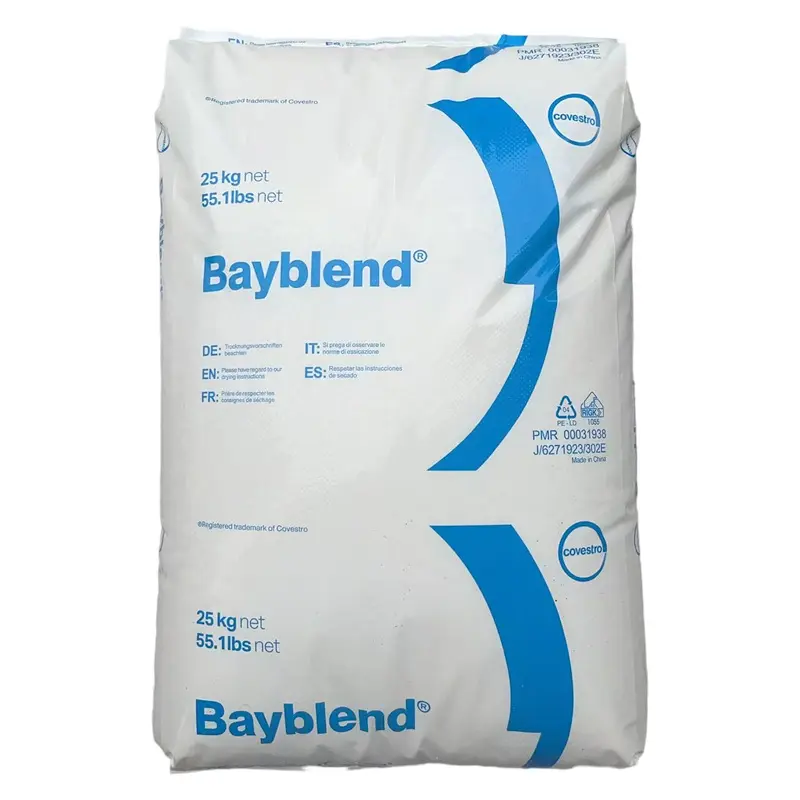
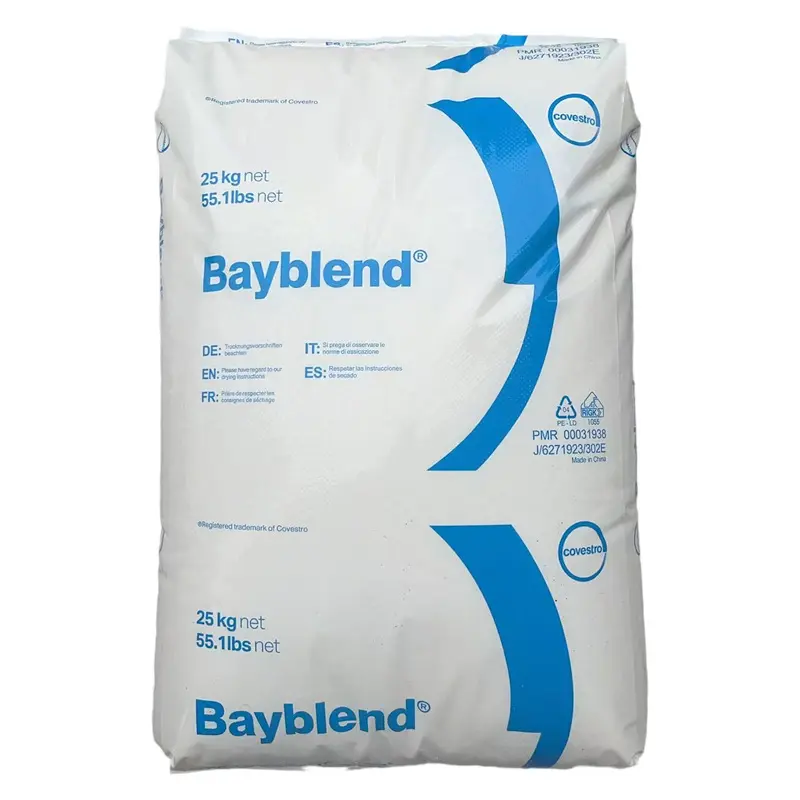
Bayblend® FR3013 is an unreinforced, impact-modified, easy-flow flame-retardant PC/ABS alloy injection molding grade introduced by Covestro AG, positioned as a dedicated material for “Information Technology / office and communication equipment housings”. The material consists of opaque pellets based on a blend of polycarbonate (PC) and ABS, achieving UL 94 V-0 and 5VB (at 1.5 mm) via a halogen-free flame retardant system, with an oxygen index of 31% (ISO 4589-2). Core Performance:
- Easy Flow: MVR of 26 cm³/10 min (240 ℃ / 5 kg, ISO 1133), melt viscosity of 155 Pa·s (240 ℃ / 1000 s⁻¹), suitable for rapid mold filling of complex housings with multiple ribs, snaps, and internal bosses;
- Impact Modification: Notched Charpy impact strength of 37 kJ/m² and notched Izod impact strength of 34 kJ/m² at 23 ℃, maintaining 8 kJ/m² at -30 ℃, unnotched “No Break”, with assembly drop and snap-fit fracture risks lower than ordinary flame-retardant PC/ABS;
- Moderate Rigidity: Tensile modulus of 2650 MPa, flexural modulus of 2600 MPa, yield strength of 61 MPa, capable of supporting medium-load structures such as IT housings, monitor bezels, and printer front covers;
- Good Electrical Insulation: Surface resistivity of 5.0E+17 Ω, volume resistivity of 2.0E+16 Ω·cm, suitable for low-voltage electrical housings and internal support components;
- Moderate Heat Resistance: Vicat/B120 of 95 ℃, HDT/A of 78 ℃, covering thermal operating conditions of office equipment, communication terminals, and home appliance control boxes, though it is not a high-heat-resistance grade.
The industry position of FR3013 is “easy-flow, impact-modified, flame-retardant PC/ABS for IT and business machine housings”—it does not pursue the highest heat resistance, ultra-thin walls, or extrusion molding.
Technical Specifications
Physical Properties
| Item | Test Value | Test Unit | Test Standard |
| Density (23 ℃) | 1.19 | g/cm³ | ISO 1183 |
| Melt Volume Flow Rate (240 ℃, 5 kg) | 26 | cm³/10 min | ISO 1133 |
| Mold Shrinkage, Vertical (2 mm, 60x60x2mm 0) | 0.4–0.6 | % | ISO 294-4 |
| Mold Shrinkage, Vertical (3 mm, 150x105x3mm 0) | 0.4–0.6 | % | ISO 2577 |
| Melt Viscosity (240 ℃, 1.0e+3 s⁻¹) | 155 | Pa·s | ISO 11443 |
Mechanical Properties
| Item | Test Value | Test Unit | Test Standard |
| Tensile Modulus (1 mm/min) | 2650 | MPa | ISO 527-1,-2 |
| Tensile Strength, Yield (50 mm/min) | 61 | MPa | ISO 527-1,-2 |
| Tensile Strength, Break (50 mm/min) | 44 | MPa | ISO 527-1,-2 |
| Tensile Strain, Yield (50 mm/min) | 4 | % | ISO 527-1,-2 |
| Tensile Strain, Break (50 mm/min) | 30 | % | ISO 527-1,-2 |
| Charpy Impact Strength, Notched (23 ℃) | 37 | kJ/m² | ISO 179 1eA |
| Izod Impact Strength, Notched (-30 ℃) | 8 | kJ/m² | ISO 180/1A |
| Izod Impact Strength, Notched (23 ℃) | 34 | kJ/m² | ISO 180/1A |
| Izod Impact Strength, Unnotched (23 ℃) | No Break | — | ISO 180 |
Thermal Properties
| Item | Test Value | Test Unit | Test Standard |
| Heat Deflection Temperature, Unannealed (0.45 MPa) | 86 | ℃ | ISO 75-2/B |
| Heat Deflection Temperature, Unannealed (1.8 MPa) | 78 | ℃ | ISO 75-2/A |
| Vicat Softening Temperature | 89 | ℃ | ISO 306/B50 |
| Vicat Softening Temperature | 95 | ℃ | ISO 306/B120 |
| Coefficient of Linear Thermal Expansion (CTE), Parallel (23 – 55 ℃) | 7.50E-05 | cm/cm/℃ | ISO 11359-2 |
| Coefficient of Linear Thermal Expansion (CTE), Vertical (23 – 55 ℃) | 7.60E-05 | cm/cm/℃ | ISO 11359-2 |
| Flame Retardancy Rating (1.5 mm) | V-0-5VB | — | UL 94 |
| Oxygen Index, Procedure A | 31 | % | ISO 4589-2 |
Electrical Properties
| Item | Test Value | Test Unit | Test Standard |
| Surface Resistivity | 5.00E+17 | ohms | IEC 60093 |
| Volume Resistivity | 2.00E+16 | ohms·cm | IEC 60093 |
Disclaimer: The technical specifications for Covestro Bayblend® FR3013 presented herein are derived from data issued by Covestro AG or certified third-party testing institutions. While we have made every effort to ensure the accuracy of the information provided, we assume no liability for any consequences arising from the use of FR3013 based on these data. Given the variables involved in processing conditions, we strongly recommend conducting thorough trials of FR3013 under your specific operational environment prior to final material selection.
Applications & Processing Guidelines
Recommended Applications:
- IT and Office Equipment: Printer/scanner housings, monitor front and rear bezels, computer peripheral housings, server management module faceplates, copier operation panels;
- Communication and Low-Voltage Electricals: Router/switch housings, fiber optic terminal boxes, internal support parts for electricity meter boxes, circuit breaker faceplates, industrial HMI housings;
- Home Appliance Electrical Controls: Home appliance control panels, washing machine/refrigerator electronic control boxes, small appliance flame-retardant housings, smart appliance display bezels;
- Commercial Machines: POS machine housings, self-service terminal faceplates, receipt printer mechanism parts;
- Auxiliary Structural Parts: Internal brackets, wire ducts, terminal block housings, and fan frames requiring UL 94 V-0 but without high heat resistance requirements.
Boundary Reminders: FR3013 has a Vicat/B120 of 95 ℃ and HDT/A of 78 ℃, making it unsuitable for long-term high-temperature scenarios near transformers, power devices, or lamp reflectors; thin-wall 0.75 mm flame-retardant applications should look at FR3020; extruded sheets should look at FR3030; high heat resistance should look at FR3011.
Processing Guidelines:
- Drying (Mandatory): Covestro specifies dry air at 80 ℃ for 4 h, with a molding moisture content ≤ 0.02%; PC/ABS injection molding after moisture absorption will produce silver streaks, bubbles, and a drop in notched impact strength.
- Barrel Temperature: Zone 1 220–230 ℃ / Zone 2 225–235 ℃ / Zone 3 230–240 ℃ / Nozzle 255–265 ℃; melt temperature window 240–270 ℃, long-term temperatures > 280 ℃ carry risks of PC degradation and flame retardant decomposition.
- Mold Temperature: 60–80 ℃ (typical sample 80 ℃). Higher mold temperatures reduce internal stress, improve weld lines, and reduce surface haze; lower mold temperatures shorten cycle times but increase stress cracking risks.
- Injection and Packing: Back pressure 5–15 MPa, typical injection speed 240 mm/s, packing pressure set to 50–75% of injection pressure; shot volume should occupy 30–70% of barrel capacity to prevent prolonged thermal residence caused by an excessively long dosing zone.
- Venting: Vent depth 0.025–0.075 mm; flame-retardant PC/ABS is sensitive to trapped air, which can easily cause burning/yellowing, blistering, and impact degradation at gas traps.
- Regrind: Clean runner scrap can be recycled, starting with a virgin-to-regrind ratio of 3:1, with batch-by-batch testing of MVR, impact strength, and appearance; mixing different flame-retardant systems (halogen-free/brominated) is strictly prohibited.
Grade Comparison & Selection Guide
Comparison with 5 main Bayblend® grades:
| Grade | Process / Reinforcement | Vicat/B120 | UL 94 (1.5 mm) | Core Orientation | Typical Scenarios |
| FR3013 | Injection / Unreinforced | 95 ℃ | V-0 / 5VB | Easy Flow + Impact Modification | IT housings, office equipment, communication terminals |
| FR3010 | Injection / Unreinforced | 110 ℃ | V-0 | Moderate Heat Resistance + Chemical/Environmental Stress Crack Resistance | Control boxes, EV charger internal parts, stress-resistant parts |
| FR3011 | Injection / Unreinforced | 118 ℃ | V-0 | High Heat Resistance + Light Stability | High-temperature appliances, industrial controllers, outdoor surveillance housings |
| FR3020 | Injection / 5% Mineral | 103 ℃ | V-0 @0.75 mm | Thin Wall + Low Smoke | Thin-wall communication parts, new energy thin-wall components |
| FR3030 | Extrusion/Injection / Unreinforced | 115 ℃ | V-0 | Halogen-Free + Extrudable/Vacuum Formable | Flame-retardant boards, sheets, large thin-wall housings |
Position of FR3013 in the matrix: It does not pursue maximum heat resistance, ultra-thin walls, or extrusion molding; it simply focuses on stable “easy mold filling + impact resistance + V-0 flame retardancy”.
Engineer Selection Recommendations:
- Wall thickness 1.5–3.0 mm, multi-snap-fit and multi-rib, office equipment dry-area housings → FR3013: MVR 26 makes mold filling easy, and impact modification reduces assembly breakage rates.
- Long-term heat exposure of 90–110 ℃, contact with cleaning agents/greases/battery fluids → FR3010: Higher heat resistance, better environmental stress crack resistance and chemical resistance.
- Temperature control devices, industrial screens, outdoor electrical control boxes → FR3011: Vicat 118 ℃, better light stability.
- Wall thickness ≤ 1.0 mm ultra-thin communication/consumer electronics → FR3020: V-0 at 0.75 mm, low smoke density.
- Flame-retardant sheets, vacuum-formed interior panels, sheet extrusion → FR3030: FR3013 is an injection molding grade and is not suitable for primary extrusion processes.
- High rigidity and low warpage → Do not choose FR3013; switch to FR3021 (15% mineral) or glass fiber reinforced PC/ABS.
Frequently Asked Questions (FAQs)
Q1: Must FR3013 be dried? What happens if it is used without drying?
A1: Drying is mandatory. Covestro specifies dry air at 80 ℃ for 4 h and moisture content ≤ 0.02%. Injection molding without drying or after moisture regain will cause silver streaks, flow marks, internal micro-voids, a significant drop in Charpy/Izod impact strength, and potentially abnormal combustion behavior in flame retardant testing due to bubbles and embrittlement. Southern plum rain seasons, packaging open for more than 4 hours, or exposed storage of regrind all require re-drying treatment.
Q2: How to choose between FR3013 and FR3010? Both are flame-retardant PC/ABS.
A2: Look at heat resistance and environmental media — ① Heat Resistance: FR3013 Vicat/B120 is 95 ℃, FR3010 is 110 ℃; control boxes containing power devices should select FR3010. ② Chemical / Stress Cracking: FR3010 has improved chemical and environmental stress crack resistance, making it more stable when exposed to greases, cleaning agents, or weak chemical media; FR3013 leans toward IT office equipment dry areas. ③ Flow and Impact: FR3013 has an MVR of 26 and stronger impact modification, making it suitable for housing parts with many snaps and high drop risks; FR3010 has slightly lower flow but better comprehensive durability. Rule of thumb: Office equipment/communication housings → FR3013; New energy/charging piles/humid electricals → FR3010.
Q3: Can FR3013 be used for 0.75 mm ultra-thin flame-retardant housings?
A3: Not recommended. It is very stable at V-0/5VB in 1.5 mm, but Covestro offers dedicated grades for ultra-thin wall scenarios (FR3020 achieves V-0 at 0.75 mm). FR3013 performs best at 1.2–1.5 mm; forcing 0.75 mm may lead to short shots, whitening at weld lines, and lower pass rates for flame retardant test bars.
Q4: How to configure TDS / MSDS / COA / UL Yellow Card during procurement? How to confirm RoHS and REACH?
A4: TaiKuo provides TDS and SDS (MSDS) with each batch of FR3013 deliveries, and COAs are issued according to grade, lot number, and origin. UL 94 V-0 / 5VB is a grade-level certification, and buyers should verify whether the manufacturer, grade, color, and thickness on the UL Yellow Card match the order. RoHS / REACH declarations are provided by the supplier according to shipping batches; if the end product is exported to Proposition 65, PoHS, or PFAS restricted areas, “free of Sb/Br/Cl flame retardant system / PFAS declaration” should be explicitly written in the purchase order, rather than relying solely on the grade name.