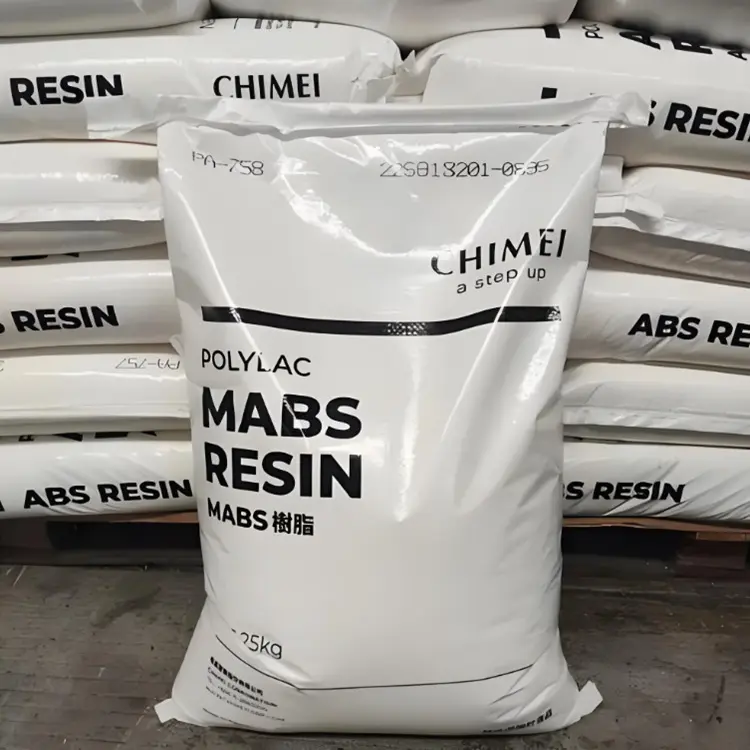
Product Overview & Key Features
Chimei POLYLAC® ABS PA-758 is a high-performance transparent grade acrylonitrile-butadiene-styrene copolymer (Transparent ABS Resin) developed and manufactured by Taiwan’s Chimei Corporation. While retaining the excellent mechanical strength, impact resistance, and dimensional processing stability of traditional ABS, this grade achieves an optical light transmittance of up to 89% through precise refractive index matching between the polymer matrix and the rubber phase. It serves as an ideal engineering plastic solution for industrial products requiring high transparency.
- Manufacturer: Chimei Corporation (Taiwan)
- Product Series: POLYLAC® ABS
- Base Material Property: Transparent / Clear Grade Acrylonitrile-Butadiene-Styrene Copolymer
- Key Performance Advantages:
- Exceptional Optical Clarity: Light transmittance of up to 89%, offering outstanding visual clarity and surface gloss, making it a cost-effective alternative to PMMA or PC.
- Balanced Mechanical Strength: Features well-rounded impact strength (Izod Impact Strength 12–15 kg-cm/cm) and flexural rigidity, overcoming the brittle nature of acrylic (PMMA).
- Excellent Processing Melt Flow: Melt Flow Rate (MFR) of 3.0 g/10 min ensures stable melt flow and low residual stress, facilitating the molding of complex structural components.
- Dimensional Stability & Chemical Resistance: Low molding shrinkage with good resistance to salts, dilute acids, and alkaline solutions.
- Suitable Processing Methods: Primarily designed for Injection Molding, but also applicable to Extrusion and profile processing.
Technical Specifications
Physical Properties
| Property | Test Condition | Value | Unit | Test Method |
| Melt Flow Rate (MFR) | 200°C × 5kg | 3.0 | g/10 min | ASTM D1238 |
| Density | 23°C | 1.07 | g/cm³ | ASTM D792 |
Mechanical Properties
| Property | Test Condition | Value | Unit | Test Method |
| Flexural Modulus | 1/4″, 2.8mm/min | 20,000 | kg/cm² | ASTM D790 |
| Tensile Strength | 1/8″, 6mm/min | 430 | kg/cm² | ASTM D638 |
| Flexural Strength | 1/4″, 2.8mm/min | 600 | kg/cm² | ASTM D790 |
| Izod Impact Strength | 1/4″, 23°C | 12 to 15 | kg-cm/cm | ASTM D256 |
Thermal Properties
| Property | Test Condition | Value | Unit | Test Method |
| Heat Deflection Temperature | 1/4″, 120°C/hr | 87 | °C | ASTM D648 |
| Heat Deflection Temperature | 1/4″, 120°C/hr | 189 | °F | ASTM D648 |
| Vicat Softening Point | 1/8″, 50°C/hr | 219 | °F | ASTM D1525 |
| Vicat Softening Point | 1/8″, 50°C/hr | 104 | °C | ASTM D1525 |
Flammability
| Property | Test Condition | Value | Unit | Test Method |
| Flame Rating | 1/16″ | HB | – | UL 94 |
Optical Properties
| Property | Test Condition | Value | Unit | Test Method |
| Light Transmittance | 1/8″ | 89 | % | ASTM D1003 |
| Haze | 1/8″ | 5.0 | % | ASTM D1003 |
Notice: The technical specifications for Chimei POLYLAC® ABS PA-758 provided herein are compiled from data published by Chimei Corporation or certified third-party testing laboratories. While prepared with professional diligence, these values serve as reference guidelines rather than absolute performance guarantees. Because molding and processing conditions vary significantly across operational environments, we recommend performing trial runs with PA-758 under your actual manufacturing conditions prior to final material selection and mass production.
Key Advantages & Performance Highlights
- High Optical Transmittance (89%) Comparable to PMMA: Through precise polymerization and refractive index matching technologies, PA-758 overcomes the opacity of conventional ABS, achieving a light transmittance of up to 89% and keeping haze within 5.0%. It delivers a crystal-clear visual appearance close to acrylic (PMMA) while eliminating PMMA’s susceptibility to cracking under stress due to poor toughness.
- Superior Balance of Impact Resistance and Toughness: Compared to transparent PC or PMMA, PA-758 retains the inherent mechanical toughness of the ABS matrix while maintaining high clarity, achieving an Izod impact strength of 12–15 kg-cm/cm. This provides excellent resistance against drops, assembly stresses, or daily impacts, significantly reducing breakage rates in finished products.
- Low Internal Stress and High Surface Finish: Featuring a melt flow rate of 3.0 g/10 min (200°C × 5kg) and uniform molecular weight distribution, the melt front advances smoothly during injection molding, resulting in extremely low internal stress in molded parts. This minimizes optical birefringence, flow marks, and silver streaks, while substantially reducing the risk of cracking during secondary operations (such as painting, ultrasonic welding, or hot stamping).
- Energy-Efficient Moldability and Cost Advantage over PC:Compared to Polycarbonate (PC), PA-758 processes at lower temperatures (210°C–240°C), boasts better melt fluidity, and offers shorter molding cycles, significantly reducing energy consumption and mold wear for injection molders. Furthermore, it delivers a substantial raw material cost advantage while fulfilling medium-to-high strength transparent housing requirements.
- Good Chemical Resistance and Secondary Processing Adaptability:Exhibits good resistance to daily detergents, dilute acids, dilute alkalis, and salt solutions. It supports various post-processing techniques, including ultrasonic welding, solvent bonding, screen printing, and hot stamping, making it highly suitable for assembling complex structural components.
Applications & Processing Guidelines
Recommended Applications
- Electronics & Home Appliances: Display windows, calculator panels, control panels, transparent housings, and indicator lens covers.
- Office Automation & Stationery: Transparent printer accessories, premium pen barrels, desktop organizers, and stationery casings.
- Medical & Consumer Goods: Non-invasive medical device transparent housings, toy parts, cosmetic container lids, and storage boxes.
Practical Processing Guidelines
- Drying Treatment: ABS resin is hygroscopic and requires thorough drying prior to processing. It is recommended to use a hot-air circulating dryer or dehumidifying dryer at 80°C–85°C for 2–4 hours to reduce moisture content below 0.05%, preventing silver streaks or bubbles on the part surface.
- Melt Temperature: Recommended injection processing temperature is 210°C–240°C. Avoid prolonged exposure above 250°C to prevent thermal degradation, discoloration, or a drop in light transmittance.
- Mold Temperature: Mold temperature should be set between 40°C and 70°C. Higher mold temperatures help improve surface gloss, reduce internal stress, and minimize silver streaks and cold slugs.
- Injection Pressure & Speed: Moderate to high injection pressure combined with medium injection speed is recommended to ensure uniform mold filling and prevent flow marks or air traps in transparent parts.
Frequently Asked Questions (FAQs)
Q1: Is drying mandatory for Chimei POLYLAC® PA-758 ABS prior to processing?
A: Yes. As a transparent grade ABS resin, PA-758 is highly sensitive to moisture. Excessive moisture in the raw material vaporizes during high-temperature injection molding, leading to silver streaks, bubbles, and reduced light transmittance on the part surface. Predrying at 80°C–85°C for 2–4 hours is required to bring moisture content below 0.05%.
Q2: Why choose transparent ABS (PA-758) over transparent PC or PMMA?
A: It depends on the specific operational requirements of the product:
- VS. PMMA (Acrylic): PA-758 offers significantly higher impact toughness and shatter resistance, making it better suited for components subject to drops or mechanical stress.
- VS. PC (Polycarbonate): PA-758 features lower processing temperatures, better melt flow, reduced energy consumption, and a clear cost advantage. While PC retains superiority in extreme high-temperature resistance and ultra-high impact requirements, PA-758 serves as the optimal balance between transparency, toughness, and cost.
Q3: How can internal stress and flow marks be minimized when injection molding PA-758 transparent parts?
A: Optimizing the following process parameters is recommended:
- Increase mold temperature appropriately (50°C–70°C recommended) and extend cooling time to promote stress relaxation in polymer chains;
- Implement multi-stage injection control—use medium speed at the start of filling to prevent jetting, then adjust holding pressure appropriately after gate pass;
- Ensure adequate drying to eliminate micro-moisture in the melt that causes irregular light refraction.
Q4: What is the flame retardancy rating of PA-758? Is it suitable for applications with fire rating requirements?
A: According to UL 94 testing standards, PA-758 carries a flame rating of HB. It is a standard clear resin formulated without halogenated flame retardants. If your end application strictly requires a UL 94 V-0 flame rating, please consult our technical team to evaluate flame-retardant resin alternatives.