Product Overview & Key Features
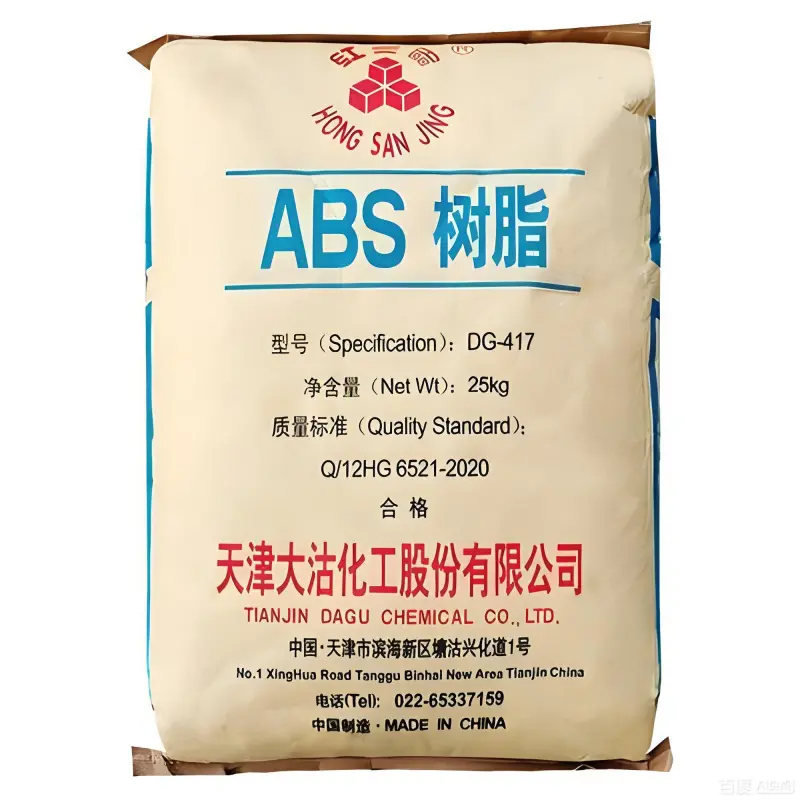
- Manufacturer: Tianjin Dagu Chemical Co., Ltd.
- Series: DG Series Acrylonitrile-Butadiene-Styrene Copolymer (ABS Resin)
- Base Property: DG-417 is a general-purpose, extrusion and injection molding grade ABS thermoplastic resin. Supplied in uniform milky-white pellet form, it exhibits balanced mechanical strength and superior impact resistance.
As a major domestic chemical and petrochemical manufacturer in China, Tianjin Dagu Chemical’s DG series ABS enjoys an outstanding reputation for cost-effectiveness and supply stability across Chinese and international industrial plastics markets. Serving as a classic grade in this series, DG-417 maintains high impact strength (Izod notched impact of 200 J/m) while offering excellent processing rheology and dimensional stability, making it exceptionally well-suited for industrial extruded pipes, extruded sheets, home appliance structural housings, and daily consumer product injection molding.
Technical Specifications
Physical Properties
| Property | Value / Unit | Test Standard |
| Melt Mass-Flow Rate (MFR) | ||
| 220 °C, 10 kg | 20 g/10 min | ASTM D1238 |
Mechanical Properties
| Property | Value / Unit | Test Standard |
| Tensile Stress | ||
| 50 mm/min | 47 MPa | ASTM D638 |
| Flexural Strength | ||
| 2 mm/min | 65 MPa | ASTM D790 |
| Flexural Modulus | ||
| 2 mm/min | 2265 MPa | ASTM D790 |
| Izod Notched Impact Strength | ||
| 23 °C, 3.2 mm | 200 J/m | ASTM D256 |
Thermal Properties
| Property | Value / Unit | Test Standard |
| Vicat Softening Temperature | ||
| 50 °C/h, 50 N | 101 °C | ASTM D1525 |
Notice: The technical specifications for Dagu Chemical DG-417 ABS provided herein are compiled from data published by Tianjin Dagu Chemical Co., Ltd. or certified third-party testing laboratories. While prepared with professional diligence, these values serve as reference guidelines rather than absolute performance guarantees. Because molding and processing conditions vary significantly across operational environments, we recommend performing trial runs with DG-417 under your actual manufacturing conditions prior to final material selection and mass production.
Features & Benefits
- High Impact Resistance: Achieves an Izod notched impact strength of 200 J/m (ASTM D256), effectively absorbing external impact energy to impart exceptional drop and collision resistance to end products, significantly lowering the risk of impact cracking.
- High Stiffness & Flexural Strength: Features a flexural strength of 65 MPa and a flexural modulus of 2265 MPa, providing solid structural support for injection-molded or extruded components to ensure long-term resistance against warping and deformation.
- Good Heat Resistance: Reaches a Vicat softening temperature of 101 °C (ASTM D1525, 50N), allowing the material to maintain excellent morphological stability under standard industrial operating conditions or home appliance heat generation.
- Excellent Rheological & Processing Behavior: Displays a melt flow rate of 20 g/10 min at 220 °C/10 kg. Its moderate and stable flowability satisfies cavity-filling requirements for large thin-walled injection molding while meeting the melt strength demands of continuous extrusion molding.
Applications & Processing Guidelines
Typical Applications
- Pipes & Industrial Fittings: Industrial drainage pipes, cable conduit jackets, chemical transportation pipe fittings, and other products requiring high pressure resistance and impact strength.
- Extruded Sheets & Profiles: Cold storage liner boards, luggage vacuum-forming sheets, building decoration profiles, and other extruded thermoformed articles.
- Home Appliance & Electronics Housings: Washing machine control panels, TV back covers, printer enclosures, and small appliance structural components.
- Consumer Goods & Sporting Supplies: Impact-resistant toys, safety helmets, luggage shells, and tool handles.
Processing Guidelines
- Drying Treatment: ABS is a hygroscopic resin that readily absorbs moisture from the air. Pre-drying is strictly required before processing to prevent surface silver streaks, bubbles, and degradation of mechanical properties. Pre-drying using a desiccant hot-air dryer at 80 °C – 85 °C for 2 – 4 hours is recommended to maintain moisture content below 0.05%.
- Processing Temperatures:
- Barrel Temperature: Rear zone 190 °C – 210 °C, middle zone 210 °C – 230 °C, front zone 220 °C – 240 °C, nozzle temperature 210 °C – 230 °C. The recommended melt temperature is between 220 °C – 240 °C.
- Mold Temperature: Recommended setting is 40 °C – 70 °C. Higher mold temperatures help enhance surface gloss and reduce residual internal stress in molded parts.
- Injection & Screw Speed: Medium injection speeds and moderate back pressure (5 – 10 bar) are recommended, with screw speed maintained at 40 – 70 rpm to prevent material thermal degradation from excessive shear.
Frequently Asked Questions (FAQs)
Q1: Is pre-drying mandatory before processing Tianjin Dagu DG-417 ABS? What happens if drying is insufficient?
A1: Yes, pre-drying is mandatory. Due to the moisture-absorbing nature of acrylonitrile units in the ABS polymer chain, processing wet pellets causes moisture to vaporize inside the high-temperature barrel. This leads to silver streaks (gas marks), reduced surface gloss, internal voiding, and a significant drop in tensile and impact strength caused by thermal hydrolysis. Strict pre-drying at 80 °C – 85 °C for 2 – 4 hours is strongly advised.
Q2: Is DG-417 suitable for extrusion or injection molding? How does its Melt Flow Index (MFI) perform?
A2: DG-417 is a versatile general-purpose grade designed for both injection molding and extrusion processes. Its Melt Mass-Flow Rate (MFR) is 20 g/10 min at 220 °C / 10 kg. This rheological profile provides sufficient melt strength to maintain profile stability during pipe and sheet extrusion while delivering adequate flowability to fill conventional injection mold cavities smoothly.
Q3: What are the key mechanical performance advantages of DG-417 ABS compared to standard general-purpose ABS?
A3: While retaining the easy processing characteristics of general-purpose ABS, DG-417 places strong emphasis on optimizing the balance between impact toughness and structural rigidity. It delivers an Izod notched impact strength of 200 J/m (ASTM D256), a tensile stress of 47 MPa, and a Vicat softening temperature of 101 °C, making it an outstanding candidate for structural components demanding comprehensive impact resistance, load-bearing rigidity, and thermal stability.