In the procurement and application of plastic raw materials, you may often hear the terms “homopolymer” and “copolymer.” These two concepts directly impact the performance characteristics and final application effects of plastic products. This article will provide an in-depth analysis of the fundamental differences between homopolymer and copolymer plastics from three dimensions: molecular structure, performance characteristics, and application scenarios, helping you make more informed choices in actual procurement.
What is a Homopolymer Plastic?
A homopolymer plastic refers to a polymer formed by the polymerization of a single type of monomer unit. Simply put, the entire polymer chain consists of identical molecular units connected repeatedly.
Characteristics of Homopolymer Plastics
- Simple molecular structure: All monomer units on the chain are completely identical.
- Stable performance: Due to single-component composition, performance parameters are relatively stable and reliable.
- High rigidity: Typically possesses higher hardness and modulus.
- Relatively low production costs: Simplified process flow.
Common Types of Homopolymer Plastics
Common homopolymer plastics include homopolymer polypropylene (PP), polyethylene (PE), polyvinyl chloride (PVC), and homopolymer polyoxymethylene (POM-H). Among them, homopolymer PP is widely used in automotive parts, appliance housings, and rigid containers due to its high rigidity and good temperature resistance.
What is a Copolymer Plastic?
A copolymer plastic refers to a polymer formed by the polymerization of two or more different monomer units in a specific proportion. These different monomer units are combined in various arrangement patterns along the polymer chain, forming new materials with unique properties.
Characteristics of Copolymer Plastics
- Complex molecular structure: There are two or more different monomer units on the chain.
- Adjustable performance: Performance can be adjusted by changing the monomer ratio and arrangement pattern.
- Better flexibility: Typically exhibits higher impact strength and elongation compared to homopolymer plastics.
- Superior low-temperature performance: Maintains better flexibility in low-temperature environments.
Common Types of Copolymer Plastics
The most common copolymer plastics include copolymer polypropylene (PP copolymer), linear low-density polyethylene (LLDPE), and copolymer polyoxymethylene (POM-C). Among them, LLDPE has become an ideal material for films, hoses, and flexible packaging due to its excellent flexibility and puncture strength while maintaining a certain degree of stiffness.
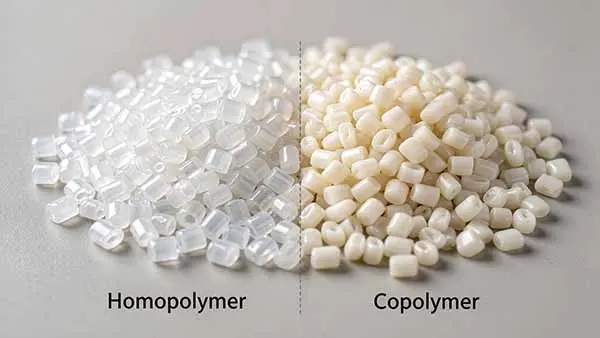
Core Differences Between Homopolymers and Copolymers
| Performance Metric | Homopolymer Plastics | Copolymer Plastics |
| Molecular Structure | Single monomer, regular arrangement | Multiple monomers, flexible arrangement |
| Rigidity / Hardness | High | Medium to low |
| Low-Temperature Impact Strength | Average (prone to embrittlement) | Excellent (maintains flexibility) |
| Elongation | Low (5%-15%) | High (100%-400%+) |
| Temperature Resistance Range | Wide (superior high-temperature performance) | Moderate (superior low-temperature performance) |
| Stiffness Modulus | Relatively high | Relatively low |
| Cost | Relatively low | Relatively high |
| Transparency | Usually better | Varies by type |
Detailed Analysis of Key Differences
1. Rigidity and Hardness
Because their molecular structures are regular and compact, homopolymer plastics possess high rigidity and hardness. This makes homopolymer PP and homopolymer PE particularly suitable for applications that need to withstand pressure and maintain shape, such as rigid containers and structural parts. In contrast, copolymer plastics have “defect” monomers in their molecular chains, which weaken the intermolecular interactions and thereby reduce rigidity.
2. Impact Strength and Low-Temperature Performance
This is the most significant difference between homopolymers and copolymers. Homopolymer plastics become brittle and prone to cracking at low temperatures. Conversely, copolymer plastics can still maintain good flexibility and impact resistance in low-temperature environments. This is because the introduction of comonomers disrupts the order of the crystal structure and lowers the glass transition temperature of the material.
3. Processing Performance
Homopolymer plastics have a narrow melting temperature range and a relatively strict processing window. Due to their complex molecular structures, copolymer plastics have a relatively wider melting range, offering greater tolerance to processing conditions and making the processing process easier to control.
4. Cost Differences
The production process of homopolymer plastics is relatively simple, and costs are typically lower than those of copolymer plastics. However, in practical applications, the choice of plastics should be based on performance requirements rather than cost alone.
Application Scenario Analysis
Best Application Fields for Homopolymer Plastics
- Rigid Containers and Packaging: Food containers, beverage bottle caps, pharmaceutical packaging, etc., requiring rigidity and good transparency.
- Automotive Components: Instrument panels, intake manifolds, radiator water tanks, etc., requiring high temperature resistance and dimensional stability.
- Electrical and Electronic Appliances: Appliance housings and electrical accessories, requiring good insulation and rigidity.
- High-Temperature Applications: Cookware handles and internal oven parts, requiring sustained high-temperature performance.
Best Application Fields for Copolymer Plastics
- Flexible Packaging: Cling films, plastic bags, flexible hoses, requiring excellent elongation and puncture strength. LLDPE is the preferred material for such applications due to its exceptional flexibility and film strength.
- Low-Temperature Environments: Cold storage containers and frozen food packaging, requiring flexibility to be maintained at low temperatures.
- Impact-Vulnerable Parts: Drop-proof materials and shock-absorbing gaskets, requiring high impact resistance.
- Industrial Hoses and Pipelines: Conveying flexible pipelines, requiring both a certain degree of rigidity and flexibility.
- Consumer Electronics: Phone protective cases and data cable sheaths, requiring cushioning and impact resistance.
How to Choose: Key Decision Factors
1. Application Working Environment
- High-temperature environment: Prioritize homopolymer plastics.
- Low-temperature environment: Prioritize copolymer plastics.
- Room-temperature application: Both are applicable; decide based on other factors.
2. Mechanical Performance Requirements
- High rigidity and hardness needed: Choose homopolymer plastics.
- High flexibility and impact resistance needed: Choose copolymer plastics.
- Balanced performance needed: Specific grades of copolymer plastics can be selected.
3. Processing Technology
- Injection molding: Both are applicable, but copolymer plastics offer a wider processing window.
- Extrusion blow molding: Copolymer plastics (especially LLDPE) show clear advantages.
- Film blowing: LLDPE and other copolymer materials are strongly recommended.
4. Cost Budget
- Strict cost control: Consider homopolymer plastics first.
- Premium acceptable: Copolymer plastics may provide better comprehensive cost-effectiveness.
5. Supply Chain Stability
As a raw material buyer, supplier stability should be considered. As a professional plastic raw material supplier, TaiKuo provides high-quality plastic raw materials in various specifications, including HDPE and LLDPE, ensuring a stable supply guarantee for your production.