Product Overview & Key Features
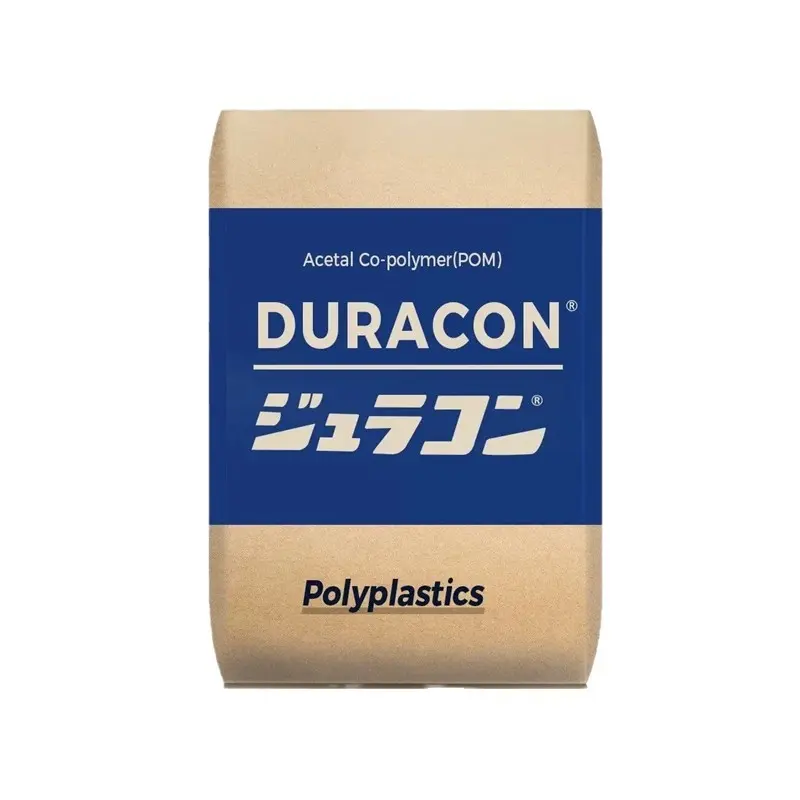
DURACON® M90-44 is an injection-grade copolymer polyoxymethylene (POM) resin produced by Polyplastics Co., Ltd., belonging to the classic DURACON® M series. This material appears as milky-white opaque to translucent crystalline pellets and is Polyplastics’ standard general-purpose copolymer POM benchmark grade, which has long held a dominant position in the global POM market. Its core performance advantages include: a density of 1.41 g/cm³, a melt mass-flow rate (MFR) of 9.0 g/10min (ISO 1133, 190 °C / 2.16 kg), combining moderate melt fluidity with excellent molding stability; a tensile modulus of 2700 MPa, a flexural modulus of 2500 MPa, and a tensile stress of 62 MPa, providing high-rigidity structural support; a Charpy notched impact strength of 6 kJ/m² (ISO 179 1eA), maintaining usable toughness among rigid engineering plastics; a dynamic friction coefficient (against steel) of 0.40–0.46 (JIS K7218) with a wear factor as low as < 1.0 × 10⁻⁸ mm³/N·m, featuring exceptional wear resistance and low-friction characteristics; a heat deflection temperature of 95 °C (ISO 75-2/A, 1.8 MPa), a volume resistivity of 1.0 × 10¹⁴ Ω·cm, and a surface resistance of 1.0 × 10¹⁶ Ω, meeting general electrical insulation requirements; a UL 94 HB flame retardant rating; and mold shrinkage rates of 2.1% in the transverse direction and 2.3% in the parallel direction (ISO 294-4), ensuring good dimensional stability. Designed specifically for injection molding, this grade is widely used in automotive precision gears, electronic and electrical sliding components, industrial bearings, sanitary valve cores, and office equipment structural parts, making it universally recognized as the “universal standard grade” in the copolymer POM sector.
Technical Specifications
Physical Properties
| Property | Value | Unit | Test Standard |
| Density | 1.41 | g/cm³ | ISO 1183 |
| Melt Index, Mass (190 ℃, 2.16 kg) | 9 | g/10min | ISO 1133 |
| Melt Index, Volume (190 ℃, 2.16 kg) | 8 | cm³/10 min | ISO 1133 |
| Mold Shrinkage, Perpendicular (2 mm) | 2.1 | % | ISO 294-4 |
| Mold Shrinkage, Parallel (2 mm) | 2.3 | % | ISO 294-4 |
| Water Absorption (24 h, 23 ℃) | 0.5 | % | ISO 62 |
| Rockwell Hardness M | 80 | — | ISO 2039-2 |
Mechanical Properties
| Property | Value | Unit | Test Standard |
| Tensile Modulus | 2700 | MPa | ISO 527-1 |
| Tensile Stress | 62 | MPa | ISO 527-2 |
| Nominal Tensile Strain at Break | 35 | % | ISO 527-2 |
| Flexural Modulus | 2500 | MPa | ISO 178 |
| Flexural Strength | 87 | MPa | ISO 178 |
| Dynamic Friction Coefficient (vs. M90-44, 0.06 MPa, 15 cm/s) | 0.37 | — | JIS K7218 |
| Dynamic Friction Coefficient (vs. Steel, 0.98 MPa, 30 cm/s) | 0.4 | — | JIS K7218 |
| Dynamic Friction Coefficient (vs. Steel, 0.49 MPa, 30 cm/s) | 0.46 | — | JIS K7218 |
| Wear Factor (0.49 MPa, vs. C-Steel, Steel Side, 0.3 m/s) | < 1.0 | 10^-8mm³/N·m | JIS K7218 |
| Wear Factor (0.98 MPa, vs. C-Steel, Steel Side, 0.3 m/s) | < 1.0 | 10^-8mm³/N·m | JIS K7218 |
| Wear Factor (0.98 MPa, vs. C-Steel, Material Side, 0.3 m/s) | 30 | 10^-8mm³/N·m | JIS K7218 |
| Wear Factor (0.49 MPa, vs. C-Steel, Material Side, 0.3 m/s) | 65 | 10^-8mm³/N·m | JIS K7218 |
| Charpy Notched Impact Strength (23 ℃) | 6 | kJ/m² | ISO 179 1eA |
Thermal Properties
| Property | Value | Unit | Test Standard |
| Heat Deflection Temperature (Unannealed, 1.8 MPa) | 95 | ℃ | ISO 75-2/A |
| Coefficient of Linear Thermal Expansion (CTE), Parallel (23 – 55 ℃) | 1.20E-04 | cm/cm/℃ | Internal Method |
| Coefficient of Linear Thermal Expansion (CTE), Perpendicular (23 – 55 ℃) | 1.20E-04 | cm/cm/℃ | Internal Method |
| Flame Retardant Rating | HB | — | UL 94 |
Electrical Properties
| Property | Value | Unit | Test Standard |
| Surface Resistivity | 1.00E+16 | Ohms | IEC 60093 |
| Volume Resistivity | 1.00E+14 | ohms·cm | IEC 60093 |
| Dielectric Strength (3 mm) | 19 | kV/mm | IEC 60243-1 |
Notice: The technical specifications for Polyplastics M90-44 provided herein are compiled from data published by Polyplastics or certified third-party testing laboratories. While prepared with professional diligence, these values serve as reference guidelines rather than absolute performance guarantees. Because molding and processing conditions vary significantly across operational environments, we recommend performing trial runs with M90-44 under your actual manufacturing conditions prior to final material selection and mass production.
Applications & Processing Guidelines
Typical Applications
Thanks to its exceptional wear resistance, high rigidity, dimensional stability, and electrical insulation properties, M90-44 is primarily targeted at the following application scenarios:
- Automotive Industry: Fuel system components (fuel tank floats, accelerator pedal sliders), door lock mechanism gears, window regulator gears, wiper linkage bushings, air conditioner vent thumbwheels, and seatbelt buckles—resistant to gasoline, diesel, and lubricating oils, with a low friction coefficient to reduce squeaks.
- Electronics & Electrical: Relay housings, switch sliders, connector clips, timer gears, printer/copier transmission gears, and scanner guide rails—high rigidity ensures dimensional accuracy, while electrical insulation meets low-voltage electrical requirements.
- Industrial Machinery: Bearing cages, sliders, cams, guide rollers, pump impellers, and valve spools—superior wear resistance, enabling long-term operation under oil-free or boundary-lubricated conditions.
- Sanitary & Hardware: Faucet valve cores, shower head swivel mechanisms, toilet tank accessories, and shower universal balls—resistant to hot water (≤80 °C) and weak acids/bases, maintaining dimensional stability during long-term immersion.
- Office Equipment: Fax machine paper feed rollers, printer pickup rollers, shredder gears, and projector focusing gears—low noise, wear-resistant, and dimensionally stable.
- Consumer Goods: Zipper sliders, spectacle frame hinges, lighter structural parts, and toy gears—high rigidity, fatigue resistance, and a smooth tactile feel.
Processing Guidelines
- Drying Pretreatment: POM has relatively low moisture absorption (water absorption of 0.5%), but pre-drying is recommended in high-humidity environments or after long-term storage following package opening. Recommended conditions: hot air drying at 80–90 °C for 2–4 hours to ensure a moisture content of ≤ 0.1%. Insufficiently dried POM may generate bubbles, silver streaks, or surface defects during processing, compromising part strength.
- Injection Molding Parameters: Recommended barrel temperature is 180–210 °C (copolymer POM has better thermal stability than homopolymer, though it may still decompose above 220 °C), with a mold temperature of 60–90 °C. Higher mold temperatures help reduce internal stress, increase crystallinity, and improve dimensional stability; lower mold temperatures can shorten the molding cycle but may increase internal stress. Injection speed should range from medium to fast, holding pressure at 60–80% of the injection pressure, and back pressure at 0.5–1.5 MPa. Screw speed should be maintained at 50–100 rpm to prevent material degradation caused by excessive shear. The recommended mold venting depth is 0.02–0.04 mm to prevent gas trapping that leads to burning or short shots.
- Post-Processing: For high-precision gears or bearings, annealing is recommended to eliminate internal stress: hold in hot air at 120–140 °C for 1–2 hours, then cool slowly to room temperature. This significantly enhances dimensional stability and long-term service performance.
- Regrind Usage: Clean runner scrap can be recycled and reused. Because POM is sensitive to thermal history, it is recommended to maintain a virgin-to-regrind ratio of 3:1 or 4:1, and regularly test MFR, tensile strength, and impact strength to ensure consistent product performance. Avoid mixing different POM grades to prevent performance fluctuations.
Logistics, Packaging & Compliance
- Packaging Specifications: Standard packaging is supplied in 25 kg moisture-proof composite bags lined with an aluminum-plastic composite film, providing excellent moisture barrier and isolation properties. Ton bags (Big Bags, typically 500 kg or 1000 kg) are also available upon customer request to accommodate the continuous feeding requirements of automated injection molding production lines.
- Supply Attributes: DURACON® M90-44 is classified as a non-dangerous good (Non-DG) and complies with standard general cargo transportation standards. It supports both 20-foot full container load (FCL) and less than container load (LCL) ocean and land shipping, requiring no special hazardous material transport qualifications or vehicles. Note that POM releases formaldehyde gas at processing temperatures, so storage environments should be kept well-ventilated and away from high heat and open flames.
- Delivery Lead Time: Backed by TaiKuo New Materials’ ready stock at major ports and inland hubs, standard orders can be fulfilled with a rapid response. Specific delivery lead times depend on Incoterms and destination port logistics conditions, typically arranged for dispatch after order confirmation.
- Compliance & Documentation Support: Each batch of product is accompanied by complete quality management documentation, including Technical Data Sheets (TDS), Material Safety Data Sheets (MSDS/SDS), and Certificates of Analysis (COA). The product complies with RoHS directive and REACH regulation restrictions on hazardous substances. Yellow card copies can be provided for the UL 94 HB flame retardant rating.
- ESG & Environmental Statement: As a recyclable thermoplastic engineering plastic, POM possesses a mature pathway for physical recycling (crushing and regranulation). We support circular economy practices and encourage customers to classify and recycle runner scrap and unqualified parts during processing. Concurrently, we are committed to driving the green transformation of our supply chain to ensure controllable environmental impacts throughout the product’s lifecycle, aligning with global sustainable development trends. Special caution: POM combustion produces toxic gases such as formaldehyde; waste disposal must comply with local environmental regulations, prioritizing energy recovery or professional chemical recycling methods.
FAQs
Q1: What are the differences in performance and processing between M90-44 and homopolymer POM (such as DuPont Delrin®)?
A1: The core differences lie in thermal stability and chemical resistance. M90-44 is a copolymer POM containing C-O-C bonds in its molecular chain, giving it better thermal stability than homopolymer POM (which contains C-O bonds), a wider processing window (less prone to decomposition), and superior alkali and hot-water resistance. However, its rigidity, hardness, and melting point are slightly lower than those of homopolymer POM. Regarding processing, copolymer POM is less sensitive to temperature fluctuations, making it better suited for multi-cavity molds and long production runs; homopolymer POM is more temperature-sensitive and requires more precise temperature control. Selection rule: Choose M90-44 (copolymer) for processing stability and chemical resistance; choose homopolymer when ultimate rigidity, wear resistance, and controllable processing conditions are prioritized.
Q2: This grade has a melt flow rate (MFR) of 9.0 g/10min. What wall thicknesses is it suitable for?
A2: With an MFR of 9.0, M90-44 falls into the medium-flow POM category and can stably injection mold precision structural parts with wall thicknesses of 1.5–4.0 mm. For thin-walled parts (< 1.5 mm), it is recommended to raise the mold temperature to 80–90 °C, set the injection speed to fast, and optimize gate locations to minimize weld lines. For thick-walled parts (> 4.0 mm), attention must be paid to packing compensation and sink mark control by extending the holding time, reducing injection speed if necessary to lower internal stress. Due to POM’s high crystallinity, thick-walled parts cool slowly and require extended cooling times to ensure distortion-free demolding.
Q3: M90-44 has a UL 94 HB flame retardant rating. Can it be used for electronic and electrical enclosures?
A3: UL 94 HB is the lowest horizontal burning rating, making it suitable for general internal structural parts in electronics and electrical appliances (such as gears, sliders, and brackets), but it does not meet scenarios with mandatory V-0 or V-2 requirements (such as charger housings, power socket panels, or parts close to fire sources). If end products require V-0 certification, it is recommended to select Polyplastics’ DURACON® flame-retardant series (such as halogenated or non-halogenated flame-retardant grades like M90-71 or M270-71). Furthermore, since POM releases formaldehyde when burned, it should be avoided in electrical components subject to electric arcs or high temperatures during design.
Q4: How can flash and sticking be avoided when processing M90-44?
A4: POM melts have low viscosity and excellent fluidity, making them prone to flash and sticking to the mold. Key control points include: ① High mold manufacturing precision with tightly matched parting lines and venting depths controlled at 0.02–0.04 mm; ② Keeping injection pressure moderate, setting holding pressure to 60–80% of the injection pressure to avoid overfilling; ③ Controlling mold temperatures between 60–90 °C (too low risks cold slugs blocking the gate, while too high causes sticking); ④ Recommending a draft angle of ≥ 1° with additional ejector pins or mold release agents for complex structures; ⑤ Regularly inspecting mold wear for timely maintenance. If sticking occurs, barrel temperatures can be appropriately lowered or mold temperatures raised, while verifying the proper use of mold release agents.