Product Overview & Key Features
- Manufacturer: Yunnan Yuntianhua Co., Ltd. (YUNTIANHUA®)
- Product Series: YUNCON® Polyoxymethylene Copolymer Series
- Material Classification: Polyoxymethylene Copolymer (POM Copolymer / Acetal Copolymer), Standard Flow Grade Engineering Plastics
- Physical Appearance: Natural (White) Cylindrical Pellets
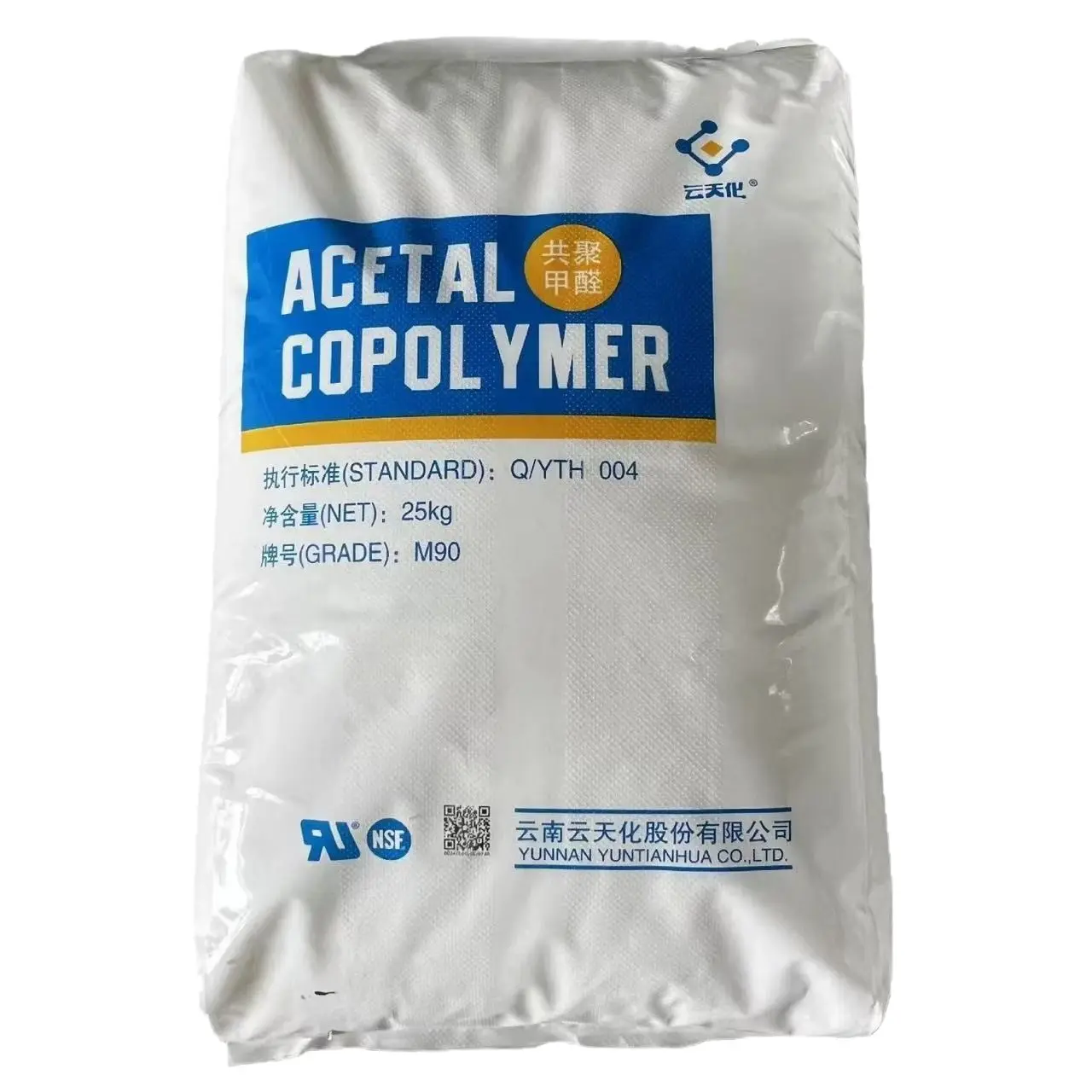
YUNTIANHUA® M90 is a standard-flow acetal copolymer grade developed by Yuntianhua, featuring low mold deposit and high rigidity. Backed by a copolymer formulation, this material exhibits excellent thermal stability and chemical resistance, along with the inherent self-lubricating and wear-resistant properties of POM resins. It offers superior dimensional stability after molding and is suitable for both injection molding and extrusion processes. It is widely used in automotive parts, electrical and electronic devices, industrial wear parts, and precision transmission structures, making it a cost-effective engineering plastic choice for general industrial applications.
Technical Specifications
Physical Properties
| Physical Properties | Test Condition | Property Value | Unit | Test Standard |
| Density | — | 1.41 | g/cm³ | ISO 1183 |
| Melt Mass-Flow Rate (MFR) | 190 °C, 2.16 kg | 9 | g/10min | ISO 1133 |
| Water Absorption | 24 h, 23 °C | 0.6 | % | ISO 62 |
Mechanical Properties
| Mechanical Properties | Test Condition | Property Value | Unit | Test Standard |
| Tensile Strength | — | 60 | MPa | ISO 527-2 |
| Tensile Modulus | — | 2600 | MPa | ISO 527-2 |
| Tensile Strain at Break | — | 35 | % | ISO 527-2 |
| Flexural Strength | — | 88 | MPa | ISO 178 |
| Flexural Modulus | — | 2500 | MPa | ISO 178 |
| Charpy Notched Impact Strength | — | 6 | kJ/m² | ISO 179/1eA |
Thermal Properties
| Thermal Properties | Test Condition | Property Value | Unit | Test Standard |
| Heat Deflection Temperature (Unannealed) | 1.8 MPa | 110 | °C | ISO 75 |
| Flammability Rating | — | HB | — | UL 94 |
Notice: The technical specifications for YUNTIANHUA M90 provided herein are compiled from data published by Yunnan Yuntianhua Co., Ltd. or certified third-party testing laboratories. While prepared with professional diligence, these values serve as reference guidelines rather than absolute performance guarantees. Because molding and processing conditions vary significantly across operational environments, we recommend performing trial runs with M90 under your actual manufacturing conditions prior to final material selection and mass production.
Features & Benefits
- High Structural Rigidity and Strength: Tensile strength reaches 60 MPa and flexural modulus reaches 2,500 MPa, providing excellent load-bearing capability. It can replace certain non-ferrous metals for small structural parts, reducing component weight and overall cost while maintaining mechanical integrity.
- Balanced Processing Fluidity: Melt flow index is 9.0 g/10min (190 °C / 2.16 kg), belonging to the standard flow grade suitable for conventional injection molding equipment and extrusion production lines. Its low mold deposit feature reduces mold cleaning frequency, extends continuous production cycles, and lowers maintenance costs.
- Good Dimensional Stability: 24-hour water absorption rate is 0.6%, resulting in minimal dimensional variation upon moisture uptake. Combined with stable molding shrinkage, it maintains excellent part accuracy, making it ideal for precision industrial components with strict tolerance requirements.
- Wear Resistance, Self-Lubrication, and Chemical Resistance: The POM copolymer matrix possesses inherent self-lubricating characteristics and displays good resistance to organic solvents, greases, weak acids, and weak bases. It is well-suited for friction components such as gears and bearing bushings, as well as environments with routine chemical exposure.
- Stable Electrical Insulation Performance: Demonstrates consistent electrical insulation across a wide frequency range. Its basic flammability rating reaches UL 94 HB, satisfying the requirements for general industrial electrical components and low-voltage insulation parts.
Applications & Processing Guidelines
Typical Applications
- Automotive Industry: Door lock transmission gears, window regulator components, fuel system small structural parts, interior clips, and mounting bases, leveraging its wear resistance, grease resistance, and dimensional stability.
- Electronics & Electrical: Connector housings, switch bases, relay structural parts, appliance transmission gears, and internal charger accessories, capitalizing on its stable electrical insulation and batch-to-batch molding consistency.
- Industrial Machinery: Precision gears, bearing bushings, valve seats, pump impellers, and conveyor chain parts, utilizing its self-lubricating wear resistance and chemical corrosion resistance to extend component service life.
- Hardware & Building Materials: Door lock drive components, bathroom shower valve cores, stationery gears, and curtain rail accessories, balancing performance and manufacturing costs for mass production.
- Extruded Products: Small solid rods, profiles, and thin-walled tubes, which can be formed via extrusion and subsequently secondary-machined through turning or milling.
Processing Guidelines
- Drying Treatment: POM resin has extremely low water absorption; fresh material in intact moisture-proof packaging generally requires no drying before processing. If the packaging is damaged or high ambient humidity causes surface moisture uptake, pre-drying at 80–90 °C for 2–3 hours is recommended to prevent silver streaks or bubbles in the molded parts.
- Melt Temperature Settings: Barrel temperatures should be controlled in zones: Rear 160–180 °C, Middle 170–200 °C, Front 190–210 °C, Nozzle 180–210 °C. The melt temperature should be maintained within 180–210 °C to prevent thermal degradation caused by prolonged residence at high temperatures.
- Mold Temperature: 60–90 °C is recommended for general products; for precision-dimension parts, mold temperature can be raised to 90–120 °C to promote uniform crystallization, improving dimensional stability and surface finish.
- Process Parameters: Screw speed should be controlled at 50–120 rpm, injection pressure at 50–100 MPa, and holding pressure at 30–80 MPa. Back pressure should be kept at 0–0.5 MPa to avoid excessive shear heating.
FAQs
Q1: Is pre-drying mandatory before processing Yuntianhua M90 POM? What are the recommended drying parameters?
A: M90 raw material in intact sealed packaging usually does not require drying prior to processing. Pre-drying is only necessary when the material is improperly stored, becomes damp, or is exposed to humid environments for an extended period. The recommended drying condition is hot-air drying at 80–90 °C for 2–3 hours.
Q2: What are the core differences between M90 POM copolymer and POM homopolymer? How to select between them?
A: The two material categories emphasize different performance characteristics:
- POM Copolymer (M90): Offers superior thermal stability, hydrolysis resistance, and resistance to acids and bases, with less mold deposit during processing and better long-term mass production stability. It is suitable for parts in continuous chemical contact or humid heat environments.
- POM Homopolymer: Features slightly higher rigidity, hardness, and surface wear resistance, but lower thermal stability and chemical resistance compared to copolymer, and is more prone to mold deposits during processing.
- Selection Principle: Choose M90 copolymer for general industrial parts, chemical resistance requirements, and long-term mass production scenarios; select POM homopolymer for applications requiring extreme hardness and wear resistance under mild operating conditions.
Q3: What is the flammability rating of Yuntianhua M90? Does it comply with RoHS environmental requirements?
A: The basic flammability rating of this grade is UL 94 HB, which is a slow-burning rating and cannot be directly used for electrical safety components requiring high flame retardancy. The material complies with EU RoHS restrictions on hazardous substances, and relevant compliance declaration documents can be provided to support export to mainstream markets such as the European Union.
Q4: Is M90 suitable for ultra-thin wall injection molding?
A: M90 is a standard-flow POM with a melt flow index of 9.0 g/10min, which accommodates injection molded products with standard wall thicknesses. For ultra-thin wall or long-flow path parts with a wall thickness under 1 mm, mold filling difficulty and production risks increase; choosing a higher-flow POM grade is recommended to ensure complete mold filling and production efficiency.