Product Overview & Key Features
Manufacturer: Dow
Product Series: DOWLEX
Material Classification: Linear Low-Density Polyethylene (LLDPE), film extrusion grade resin Physical Appearance: Milky white, translucent plastic pellets; uniform and clean particles free from burnt particles and foreign impurities.
DOWLEX 2045G is an LLDPE grade developed by Dow for industrial and consumer film applications, offering good processing adaptability on conventional LLDPE blown film equipment. Finished films possess balanced toughness, puncture resistance, and tear resistance, making them widely applicable in various heavy-duty packaging film scenarios.
Core Performance Advantages:
- Excellent film puncture and tear resistance
- Good low-temperature toughness
- Wide processing window, adaptable to general LLDPE blown film equipment
- General chemical corrosion resistance
- Applicable Processing Technology: Blown film extrusion
Technical Specifications
Physical Properties
| Property | Test Value | Test Unit | Test Standard |
| Density | 0.92 | g/cm³ | — |
| Thickness | 50.8 | microns | — |
| Melt Index, Mass | 1 | g/10min | ASTM D1238 |
Mechanical Properties
| Property | Test Value | Test Unit | Test Standard |
| Tensile Strength, Yield, Parallel, Film | 10.89 | MPa | ASTM D882 |
| Tensile Strength, Yield, Perpendicular, Film | 12.29 | MPa | ASTM D882 |
| Tensile Strength, Break, Parallel, Film | 55.11 | MPa | ASTM D882 |
| Tensile Strength, Break, Perpendicular, Film | 49.81 | MPa | ASTM D882 |
| Tensile Strain, Break, Parallel, Film | 827 | % | ASTM D882 |
| Tensile Strain, Break, Perpendicular, Film | 889 | % | ASTM D882 |
| Secant Modulus, Parallel | 194.4 | MPa | ASTM D882 |
| Secant Modulus, Perpendicular | 232.6 | MPa | ASTM D882 |
| Impact Strength | 235 | — | Dow Method |
| 4176 | — | ASTM D882 | |
| 4241 | — | ASTM D882 | |
| Elmendorf Tear Strength, Parallel | 902 | g | ASTM D1922 |
| 17.8 | g/micron | ASTM D1922 | |
| Elmendorf Tear Strength, Perpendicular | 1200 | g | ASTM D1922 |
| 23.6 | g/micron | ASTM D1922 | |
| Dart Drop Impact | 288 | g | ASTM D1709A |
Thermal Properties
| Property | Test Value | Test Unit | Test Standard |
| Melting Point, DSC | 122 | ℃ | Dow Method |
| Vicat Softening Point | 108 | ℃ | ASTM D1525 |
Optical Properties
| Property | Test Value | Test Unit | Test Standard |
| Haze | 10 | % | ASTM D1003 |
| Gloss, 45° | 60 | % | ASTM D2457 |
Disclaimer: The technical specifications for Dow DOWLEX 2045G presented herein are derived from data issued by Dow or certified third-party testing institutions. While we have made every effort to ensure the accuracy of the information provided, we assume no liability for any consequences arising from the use of DOWLEX 2045G based on these data. Given the variables involved in processing conditions, we strongly recommend conducting thorough trials of DOWLEX 2045G under your specific operational environment prior to final material selection.
Applications & Processing Guidelines
Recommended Applications
- Heavy-duty transport packaging bags, industrial heavy-duty packaging films
- Agricultural films
- Shrink films, general industrial films
- Consumer shopping bags, grocery bags
- Food packaging films (verify original manufacturer food-contact compliance documents before use)
Processing Operation Essentials
- Pre-drying of pellets is unnecessary under normal storage conditions; if the material is damp or surface condensation occurs, short-term drying at 60-70 ℃ can be applied.
- Extrusion processing temperature reference range: 190-240 ℃, with process fine-tuning based on screw design and film thickness.
- This grade has a relatively high melt viscosity, requiring strict control over screw speed and back pressure to avoid thermal degradation caused by excessive shear. The blow-up ratio should be set according to film design requirements.
- Equipment, film thickness, and cooling conditions will significantly alter final film performance; trial runs must be completed to verify product indicators prior to formal mass production.
Logistics, Packaging & Compliance
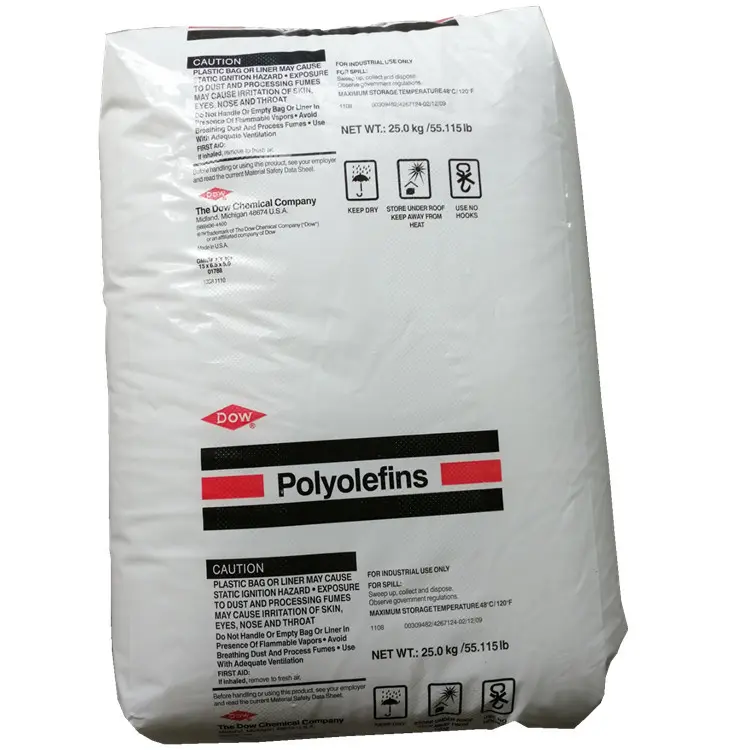
- Packaging Specifications: Standard 25kg moisture-proof polypropylene woven bag packaging.
- Hazardous Material Attributes: Not classified as a hazardous chemical; transported via sea and land as regular plastic pellets.
- Delivery Lead Time: Combined with inventory and shipping schedules, regular delivery lead time is 2-4 weeks, supporting full-container and LCL export businesses.
- Supporting Documents: TDS, MSDS, and corresponding batch COA factory inspection reports can be provided.
- Compliance: Meets REACH and RoHS regulatory requirements; for export projects, please check the original manufacturer’s corresponding batch compliance documents.
- ESG Environmental Description: This material belongs to thermoplastic LLDPE and possesses recycling and reprocessing attributes; disposal of waste materials must comply with local plastic waste management regulations.
FAQs
Q1: Is drying treatment required before processing DOWLEX 2045G?
A: Drying is unnecessary under normal storage environments. When pellets exhibit dampness or surface condensation, drying at 60-70 ℃ prior to production is recommended.
Q2: All film performances in the TDS are based on 50.8-micron samples. Will actual production film performances be identical?
A: All mechanical and optical indicators are test results from 50.8-micron standard samples. Actual production film thickness, cooling processes, and blow-up ratios will alter finished product performance, meaning TDS values cannot be directly copied and trial production verification is mandatory.
Q3: What processing parameters require key attention during film blowing of 1.0 melt index DOWLEX 2045G?
A: This grade possesses a relatively high melt viscosity. Key focus should be placed on controlling shear heat to prevent material thermal degradation, alongside reasonably controlling back pressure to ensure uniform and thorough melt plasticization.
Q4: Can DOWLEX 2045G be blended and processed with LDPE?
A: Yes, it can be blended with LDPE to adjust processing fluidity. However, film tear, impact, and optical indicators will change after blending, and molding and final product performance verification must be performed once the blend ratio is altered.