Product Overview & Key Features
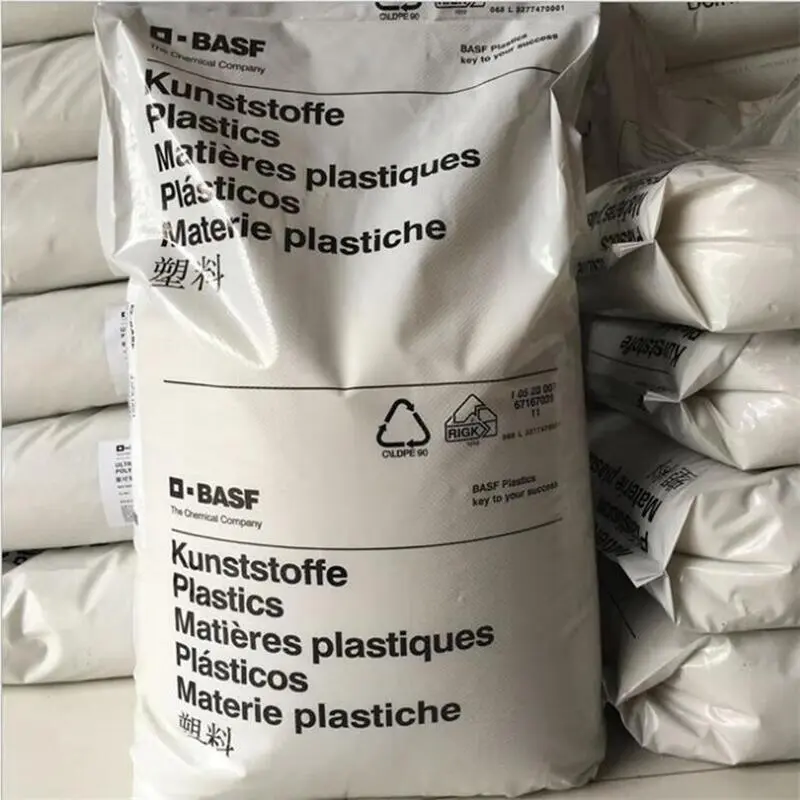
BASF Ultramid® A3UG5 PA66 is a high-performance flame-retardant, glass fiber-reinforced nylon 66 (polyamide 66) engineering plastic resin manufactured by BASF. Its polymer abbreviation is PA66-GF25 FR, featuring a base material uniformly compounded with 25% glass fiber reinforcement and equipped with an efficient flame-retardant system.
Core Performance Advantages:
- Exceptional Mechanical Strength and Rigidity: Thanks to 25% glass fiber reinforcement, its tensile and flexural moduli in the dry state reach as high as 9500 MPa, with a tensile stress at break of 145 MPa, enabling it to withstand rigorous structural loads.
- Outstanding Flame Retardancy and Fire Safety: It exhibits exceptional flame-retardant performance, with a Glow Wire Flammability Index (GWFI) of up to 960 °C at a thickness of 0.75 mm, a limiting oxygen index (LOI) of 32%, and compliance with relevant railway and smoke toxicity safety standards.
- Electrical Insulation and Arc Resistance: The volume resistivity in the dry state is up to 1.0×10^16 ohms·cm, and the Comparative Tracking Index (CTI) reaches 600 V, providing superior electrical reliability.
- Thermal Stability: It features a melting temperature of approximately 260 °C, an unannealed deflection temperature under load (1.8 MPa) of 245 °C, and excellent long-term maximum service temperature performance.
Mainstream Processing Methods: Suitable for standard high-pressure injection molding processes.
Technical Specifications
Physical Properties
| Physical Properties | Test Value | Test Unit | Test Standard |
| Density, dry | 1.39 | g/cm³ | ISO 1183 |
| Bulk Density (Apparent Density) | 0.7 | g/cm³ | No Standard |
| Melt Volume-Flow Rate, dry (275 °C, 5 kg) | 25 | cm³/10 min | ISO 1133 |
| Molding Shrinkage, vertical, dry | 1.2 | % | ISO 294-4 |
| Molding Shrinkage, parallel, dry | 0.4 | % | ISO 294-4 |
| Water Absorption, saturation (23 °C) | 4.0-4.6 | % | ISO 62 |
| Water Absorption, equilibrium (50% RH, 23 °C) | 1.1-1.5 | % | ISO 62 |
| Viscosity Number, 96% sulfuric acid (96% H2SO4) | 165 | cm³/g | ISO 307 |
| Molding Shrinkage, dry (1.5 mm) | 0.4 | % | — |
Mechanical Properties
| Mechanical Properties | Test Value | Test Unit | Test Standard |
| Tensile Modulus, dry | 9500 | MPa | ISO 527-2 |
| Tensile Modulus, moist | 6100 | MPa | ISO 527-2 |
| Tensile Strength, break, dry | 145 | MPa | ISO 527-2 |
| Tensile Strength, break, moist | 90 | MPa | ISO 527-2 |
| Tensile Strain, break, dry | 3 | % | ISO 527-2 |
| Tensile Strain, break, moist | 5 | % | ISO 527-2 |
| Flexural Modulus, dry | 9500 | MPa | ISO 178 |
| Flexural Modulus, moist | 6100 | MPa | ISO 178 |
| Flexural Strength, dry | 230 | MPa | ISO 178 |
| Flexural Strength, moist | 160 | MPa | ISO 178 |
| Charpy Impact Strength, notched, dry (23 °C) | 7.5 | kJ/m² | ISO 179 1eA |
| Charpy Impact Strength, notched, moist (23 °C) | 9 | kJ/m² | ISO 179 1eA |
| Charpy Impact Strength, unnotched, dry (-30 °C) | 63 | kJ/m² | ISO 179 1eU |
| Charpy Impact Strength, unnotched, dry (23 °C) | 65 | kJ/m² | ISO 179 1eU |
| Charpy Impact Strength, unnotched, moist (23 °C) | 65 | kJ/m² | ISO 179 1eU |
Thermal Properties
| Thermal Properties | Test Value | Test Unit | Test Standard |
| Deflection Temperature Under Load, dry, unannealed (0.45 MPa) | 260 | °C | ISO 75-2/B |
| Deflection Temperature Under Load, dry, unannealed (1.8 MPa) | 245 | °C | ISO 75-2/A |
| Melting Temperature, dry | 260 | °C | ISO 11357-3 |
| Temp. of Deflection Under Load, tensile strength, dry (2.0e+4 h) | 130 | °C | IEC 60216 |
| Temp. of Deflection Under Load, tensile strength, dry (5.0e+3 h) | 155 | °C | IEC 60216 |
| Glow Wire Flammability Index (GWFI), dry (0.75 mm) | 960 | °C | IEC 60695-2-12 |
| Glow Wire Ignition Temperature (GWIT), dry (> 2 mm) | 775 | °C | IEC 60695-2-13 |
| Oxygen Index, dry | 32 | % | ISO 4589-2 |
| French Railway Standard – Fire and Smoke Classification | I3/F2 | — | NF F16-101 |
| Smoke Density – Max. Ds (2 mm, 20 min, 25kW/m²) | 250 | — | ISO 5659-2 |
| Smoke Toxicity (CIT NLP acc. to CEN/TS 45545-2) | 0.38 | — | NF X70-100 |
Electrical Properties
| Electrical Properties | Test Value | Test Unit | Test Standard |
| Surface Resistivity, moist | 1.00E+15 | ohms | IEC 60093 |
| Volume Resistivity, dry | 1.00E+16 | ohms · cm | IEC 60093 |
| Volume Resistivity, moist | 1.00E+13 | ohms · cm | IEC 60093 |
| Relative Permittivity, dry (1.0e+6 Hz) | 3.8 | — | IEC 60250 |
| Relative Permittivity, moist (1.0e+6 Hz) | 4.6 | — | IEC 60250 |
| Dissipation Factor, dry (1.0e+6 Hz) | 0.017 | — | IEC 60250 |
| Dissipation Factor, moist (1.0e+6 Hz) | 0.1 | — | IEC 60250 |
| Comparative Tracking Index (CTI), Solution A, dry | 600 | V | IEC 60112 |
Other Properties
| Other Properties | Test Value | Test Unit | Test Standard |
| Polymer Abbreviation (Dry) | PA66-GF25 FR | — | — |
Disclaimer: The technical specifications for BASF Ultramid® A3UG5 PA66 material presented herein are derived from data issued by BASF or certified third-party testing institutions. While we have made every effort to ensure the accuracy of the information provided, we assume no liability for any consequences arising from the use of A3UG5 based on these data. Given the variables involved in processing conditions, we strongly recommend conducting thorough trials of A3UG5 under your specific operational environment prior to final material selection.
Applications & Processing Guidelines
Recommended Application Conditions & End-Use Products:
- Electrical & Electronics: High-demand electrical switch housings, circuit breaker components, relay bases, and insulation connectors.
- Automotive Industry: Heat-resistant and flame-retardant components around the engine compartment, sensor housings, and high-voltage electrical brackets.
- Industrial Automation: Industrial structural components required to withstand high mechanical loads and strict fire safety ratings.
Practical Processing Guidelines:
- Melt and Mold Characteristics: This grade has a melting temperature of 260 °C, with a molding shrinkage of 0.40% in the parallel direction and 1.2% in the perpendicular direction. Due to the 25% glass fiber content, mold design should account for its anisotropic shrinkage and abrasive nature on mold steels (wear-resistant alloy steels are recommended).
- Drying Treatment Tips: PA66 is hygroscopic and must undergo strict drying treatment prior to processing (typically recommended at 80–95 °C for 2–4 hours) to maintain moisture content below 0.1%, preventing bubbles, surface silver streaks, and molecular weight degradation during injection molding.
Logistics, Packaging & Compliance
- Packaging Specifications: Standard export moisture-proof packaging, utilizing 25kg/bag composite moisture-proof paper bags or aluminum foil woven bags, stacked on international standard fumigation-free pallets.
- Hazardous Materials Attribute: This product belongs to non-hazardous chemicals, with smooth compliance for regular ocean, land, and air transportation.
- Lead Time and LCL/FCL: Routine spot orders can be arranged for warehouse dispatch within 3-7 business days; supporting global ocean and land transportation for FCL (Full Container Load) and LCL (Less than Container Load) mixed shipping.
- Compliance & Environmental Certifications:
- Complete official Technical Data Sheets (TDS), Material Safety Data Sheets (MSDS), and Certificates of Analysis (COA) can be provided with the shipment.
- Complies with the requirements of the EU REACH regulation and RoHS environmental directive.
- Meets ESG and environmental declaration standards for modern industrial green supply chains.
Frequently Asked Questions (FAQs)
Q1: Does BASF Ultramid® A3UG5 require drying prior to injection molding? What are the consequences of excessive moisture?
A: Yes, drying is mandatory. PA66 is a hygroscopic engineering plastic. If the moisture content exceeds limits, moisture will cause hydrolytic degradation of the polymer during high-temperature injection (above 260 °C), which will not only form silver streaks, bubbles, or surface defects on the molded part but also severely lead to a sharp decline in mechanical strength (such as tensile and flexural moduli).
Q2: Does this grade containing 25% glass fiber and flame retardants impose special requirements on mold manufacturing and injection molding screws?
A: Due to the 25% glass fiber content, the melt will cause relatively strong wear and corrosion on mold cavities, injection screws, and check rings. It is recommended that customers use screws and barrels treated with hardening or bimetallic wear-resistant and anti-corrosive treatments, while high-quality imported mold steel (such as H13 or SKD61 with quenching treatment) is suggested for mold steels.
Q3: What is the fundamental difference in application selection between A3UG5 and general unreinforced PA66?
A: General unreinforced PA66 features high toughness and self-lubricating properties, but its rigidity, load-bearing capacity, and heat resistance are limited. In contrast, A3UG5 incorporates 25% glass fiber and an efficient flame-retardant system, multiplying its tensile and flexural moduli, offering a higher deflection temperature under load, and providing an extremely high fire safety rating (GWFI 960 °C), specifically designed for structural parts subjected to high mechanical loads and strict fire safety standards.