Product Overview & Key Features
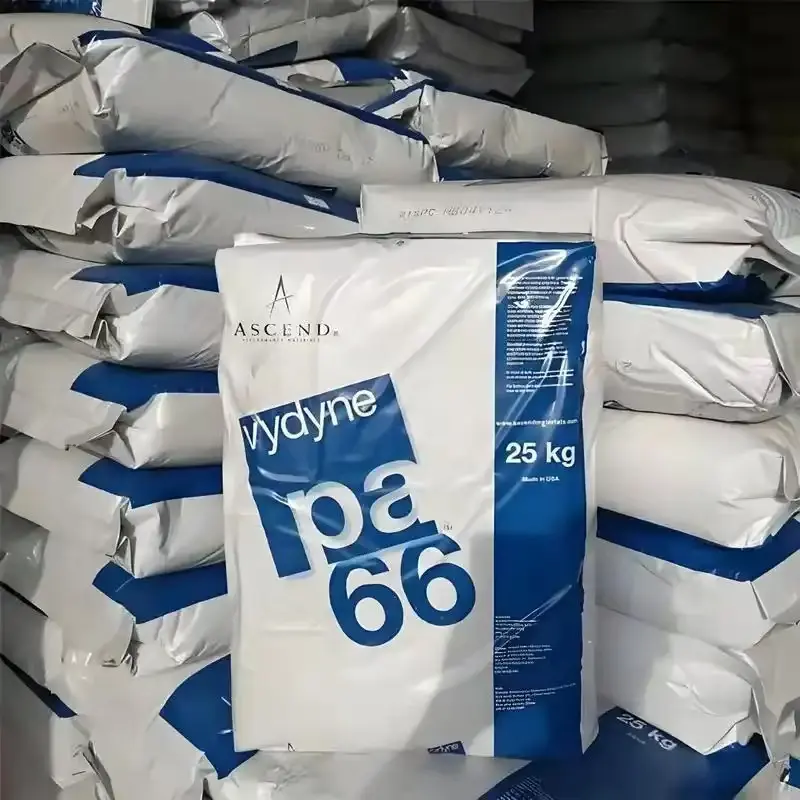
Manufacturer & Product Series: Unreinforced polyamide 66 (PA66) base resin grade manufactured by Ascend Performance Materials.
Basic Material Properties: This grade is a standard base-tier nylon 66 raw material with a basic physical density of 1.14 g/cm³, maintaining excellent comprehensive mechanical strength and structural durability under both ambient and conditioned states.
Core Performance Advantages:
- Features a balanced mechanical toughness and rigidity profile. Its tensile and bending moduli remain stable in both conditioned and dry states, with dry-state tensile strain at break reaching 23% and conditioned-state strain reaching 87%.
- Exhibits excellent impact resistance, showing favorable notched and unnotched impact performance under both low-temperature (-30 °C) and room-temperature (23 °C) environments (e.g., conditioned Charpy notched impact strength at room temperature reaches 20 kJ/m², while unnotched impact shows “No Break”).
- Features sound thermal performance with a deflection temperature under load (0.45 MPa) of 200 °C, a melting temperature of 260 °C, and a flammability rating complying with the UL 94 V-2 standard (0.4 mm – 3 mm).
- Demonstrates reliable electrical insulation performance with a volume resistivity of 1.0e+11 ohms·cm and a dielectric strength of 26 kV/mm.
Compatible Processing Methods: Suitable for conventional thermoplastic processing techniques such as injection molding and extrusion.
Technical Specifications
Physical Properties
| Physical Properties | Test Value | Test Unit | Test Standard |
| Density | 1.14 | g/cm³ | ISO 1183 |
| Molding Shrinkage, Parallel2 mm, 23 °C | 1.7 | % | ISO 294-4 |
| Molding Shrinkage, Normal2 mm, 23 °C | 1.8 | % | ISO 294-4 |
| Water Absorption24 hr, 23 °C | 1.2 | % | ISO 62 |
| Moisture Absorption23°C, 50% RH | 2.4 | % | ISO 62 |
Mechanical Properties
| Mechanical Properties | Test Value | Test Unit | Test Standard |
| Tensile Modulus, Conditioned23°C | 1800 | MPa | ISO 527-2 |
| Tensile Stress, Yield, Conditioned23°C | 56 | MPa | ISO 527-2 |
| Tensile Stress, Break, Conditioned23°C | 46 | MPa | ISO 527-2 |
| Tensile Strain, Yield, Conditioned23°C | 22 | % | ISO 527-2 |
| Tensile Strain, Break, Conditioned23°C | 87 | % | ISO 527-2 |
| Flexural Modulus, Conditioned23°C | 1500 | MPa | ISO 178 |
| Flexural Strength, Conditioned23°C | 50 | MPa | ISO 178 |
| Tensile Modulus, Dry23°C | 2800 | MPa | ISO 527-2 |
| Tensile Stress, Yield, Dry23°C | 86 | MPa | ISO 527-2 |
| Tensile Stress, Break, Dry23°C | 56 | MPa | ISO 527-2 |
| Tensile Strain, Yield, Dry23°C | 4.8 | % | ISO 527-2 |
| Tensile Strain, Break, Dry23°C | 23 | % | ISO 527-2 |
| Flexural Modulus, Dry23°C | 2900 | MPa | ISO 178 |
| Flexural Strength, Dry23°C | 80 | MPa | ISO 178 |
| Charpy Notched Impact Strength, Dry-30°C | 5 | kJ/m² | ISO 179/1eA |
| Charpy Notched Impact Strength, Conditioned-30°C | 7 | kJ/m² | ISO 179/1eA |
| Charpy Notched Impact Strength, Dry23°C | 6 | kJ/m² | ISO 179/1eA |
| Charpy Notched Impact Strength, Conditioned23°C | 20 | kJ/m² | ISO 179/1eA |
| Charpy Unnotched Impact Strength, Dry-30°C | No Break | — | ISO 179/1eU |
| Charpy Unnotched Impact Strength, Dry23°C | No Break | — | ISO 179/1eU |
| Izod Notched Impact Strength, Dry-30°C | 5 | kJ/m² | ISO 180/1A |
| Izod Notched Impact Strength, Conditioned-30°C | 7 | kJ/m² | ISO 180/1A |
| Izod Notched Impact Strength, Dry23°C | 6 | kJ/m² | ISO 180/1A |
| Izod Notched Impact Strength, Conditioned23°C | 20 | kJ/m² | ISO 180/1A |
Thermal Properties
| Thermal Properties | Test Value | Test Unit | Test Standard |
| Deflection Temperature Under Load, 0.45 MPa | 200 | °C | ISO 75-2/B |
| Deflection Temperature Under Load, 1.8 MPa | 70 | °C | ISO 75-2/A |
| Vicat Softening Temperature | 260 | °C | ISO 306/B |
| Melting Temperature | 260 | °C | ISO 3146 |
| Coefficient of Linear Thermal Expansion (CTE), Parallel23 – 55°C, 2.00 mm | 1.00E-04 | cm/cm/°C | ISO 11359-2 |
| Coefficient of Linear Thermal Expansion (CTE), Normal23 – 55°C, 2.00 mm | 1.00E-04 | cm/cm/°C | ISO 11359-2 |
| Flammability Rating, 0.4 mm | V-2 | — | UL 94 |
| Flammability Rating, 0.71 mm | V-2 | — | UL 94 |
| Flammability Rating, 1.5 mm | V-2 | — | UL 94 |
| Flammability Rating, 3 mm | V-2 | — | UL 94 |
| Oxygen Index | 25 | % | ASTM D2863 |
| Relative Temperature Index (RTI) – Tensile, 0.4 mm | 75 | °C | UL746 |
| Relative Temperature Index (RTI) – Tensile, 0.71 mm | 85 | °C | UL746 |
| Relative Temperature Index (RTI) – Tensile, 1.5 mm | 85 | °C | UL746 |
| Relative Temperature Index (RTI) – Tensile, 3 mm | 85 | °C | UL746 |
| Relative Temperature Index (RTI) – Impact, 0.4 mm | 75 | °C | UL746 |
| Relative Temperature Index (RTI) – Impact, 0.71 mm | 75 | °C | UL746 |
| Relative Temperature Index (RTI) – Impact, 1.5 mm | 75 | °C | UL746 |
| Relative Temperature Index (RTI) – Impact, 3 mm | 75 | °C | UL746 |
| Relative Temperature Index (RTI) – Electrical, 0.4 mm | 130 | °C | UL746 |
| Relative Temperature Index (RTI) – Electrical, 0.71 mm | 130 | °C | UL746 |
| Relative Temperature Index (RTI) – Electrical, 1.5 mm | 130 | °C | UL746 |
| Relative Temperature Index (RTI) – Electrical, 3 mm | 130 | °C | UL746 |
| Glow Wire Flammability Index (GWFI), 0.4 mm | 960 | °C | IEC 60695-2-12 |
| Glow Wire Flammability Index (GWFI), 0.71 mm | 960 | °C | IEC 60695-2-12 |
| Glow Wire Flammability Index (GWFI), 1.5 mm | 960 | °C | IEC 60695-2-12 |
| Glow Wire Flammability Index (GWFI), 3 mm | 960 | °C | IEC 60695-2-12 |
| Glow Wire Ignition Temperature (GWIT), 0.4 mm | 825 | °C | IEC 60695-2-13 |
| Glow Wire Ignition Temperature (GWIT), 0.71 mm | 850 | °C | IEC 60695-2-13 |
| Glow Wire Ignition Temperature (GWIT), 1.5 mm | 850 | °C | IEC 60695-2-13 |
| Glow Wire Ignition Temperature (GWIT), 3 mm | 850 | °C | IEC 60695-2-13 |
Electrical Properties
| Electrical Properties | Test Value | Test Unit | Test Standard |
| Volume Resistivity, 1 mm | 1.00E+11 | ohms·cm | IEC 60093 |
| High-Voltage Arc Tracking Rate (HVTR) / Arc Resistance, 3 mm | 5 | — | ASTM D495 |
| Dielectric Strength, 1 mm | 26 | kV/mm | IEC 60243-1 |
| High Voltage Arc Tracking Index (HVTI), 3 mm | PLC 0 | — | UL 746 |
| High Current Arc Ignition (HCI), 0.4 mm | PLC 1 | — | UL 746 |
| High Current Arc Ignition (HCI), 0.71 mm | PLC 0 | — | UL 746 |
| High Current Arc Ignition (HCI), 1.5 mm | PLC 0 | — | UL 746 |
| High Current Arc Ignition (HCI), 3 mm | PLC 0 | — | UL 746 |
| Hot Wire Ignition (HWI), 0.4 mm | PLC 4 | — | UL 746 |
| Hot Wire Ignition (HWI), 0.71 mm | PLC 4 | — | UL 746 |
| Hot Wire Ignition (HWI), 1.5 mm | PLC 3 | — | UL 746 |
| Hot Wire Ignition (HWI), 3 mm | PLC 2 | — | UL 746 |
Disclaimer: The technical specifications for Ascend Vydyne® 21SPC PA66 presented herein are derived from data issued by Ascend Performance Materials or certified third-party testing institutions. While we have made every effort to ensure the accuracy of the information provided, we assume no liability for any consequences arising from the use of 21SPC based on these data. Given the variables involved in processing conditions, we strongly recommend conducting thorough trials of 21SPC under your specific operational environment prior to final material selection.
Applications & Processing Guidelines
- Recommended Operating Conditions & End-Use Products:
- Electrical & Electronic Sector: Connector housings, switch components, insulating brackets, and electronic parts meeting UL 94 V-2 flammability requirements.
- Automotive Industry: Engine peripheral structural components, interior parts, and electrical support components.
- Industrial & Consumer Goods: High-strength mechanical structural parts, wear-resistant bearing cages, and various general hardware accessories.
- Practical Processing Key Points:
- Drying Treatment: Given the moisture-absorbing nature of PA66 (water absorption rate of 1.2% and moisture absorption rate of 2.4%), thorough drying is mandatory prior to injection molding or extrusion. It is recommended to use a dehumidifying dryer at 80 °C to 90 °C for 4 to 6 hours to control moisture content below 0.2%, preventing surface silver streaks, bubbles, or molecular weight degradation.
- Temperature and Mold Settings: Melt temperature is recommended between 270 °C and 290 °C; mold temperature should be maintained between 60 °C and 80 °C to ensure uniform crystallization and good surface finish.
Logistics, Packaging & Compliance
- Packaging Specifications: Standard industrial packaging utilizes 25kg/bag moisture-proof composite paper bags or aluminum-foil liner bags. Jumbo bags can also be provided according to customer requirements, and all pallets comply with international export quarantine standards.
- Hazardous Material Classification: This product is classified as a non-hazardous general polymer material, complying with standard international marine (IMDG) and land transportation regulations.
- Lead Time: Regular stock orders can be dispatched within 3-7 business days; custom or bulk futures orders are typically delivered within 2-4 weeks depending on production scheduling.
- Shipping & Multimodal Transport Description: Supports Full Container Load (FCL), Less than Container Load (LCL), and multimodal land-sea transport. Moisture-proofing, rain-proofing, and sun-protection measures are required during transit.
- Compliance Certification & Support: Complete manufacturer Technical Data Sheets (TDS), Material Safety Data Sheets (MSDS), and Certificates of Analysis (COA) can be provided along with the shipment. Compliant with EU RoHS directives and REACH regulations, meeting global supply chain ESG and environmental compliance declarations.
Frequently Asked Questions (FAQs)
Q1: Is strict drying mandatory for Ascend Vydyne® 21SPC prior to injection molding?
A1: Yes. Because PA66 readily absorbs moisture from the air, failing to conduct thorough drying (recommended at 80–90 °C for 4–6 hours) will cause hydrolytic degradation of the material under high-temperature melt conditions, leading to reduced mechanical strength, surface silver streaks, or bubble defects.
Q2: How does this grade compare in electrical and flame-retardant performance relative to other general-purpose nylon 66 resins?
A2: Vydyne® 21SPC meets the UL 94 V-2 flammability standard (0.4mm-3mm) while demonstrating excellent electrical insulation performance (volume resistivity of 1.0e+11 ohms·cm, dielectric strength of 26 kV/mm). Furthermore, it performs exceptionally well in high-current arc ignition indexes (HCI) and glow wire tests (GWFI up to 960 °C), making it highly suitable for industrial applications with strict electrical safety demands.
Q3: How can I request samples of this grade for laboratory testing or trial runs?
A3: We support B2B purchasers and engineers with genuine project requirements by providing small sample quantities (typically 1kg-5kg) for preliminary mold-trial evaluations. You can directly submit your company background, application project, and specific specification requirements through our independent website’s inquiry system, and our technical and sales team will process your sample request within 24 hours.