Product Overview & Key Features
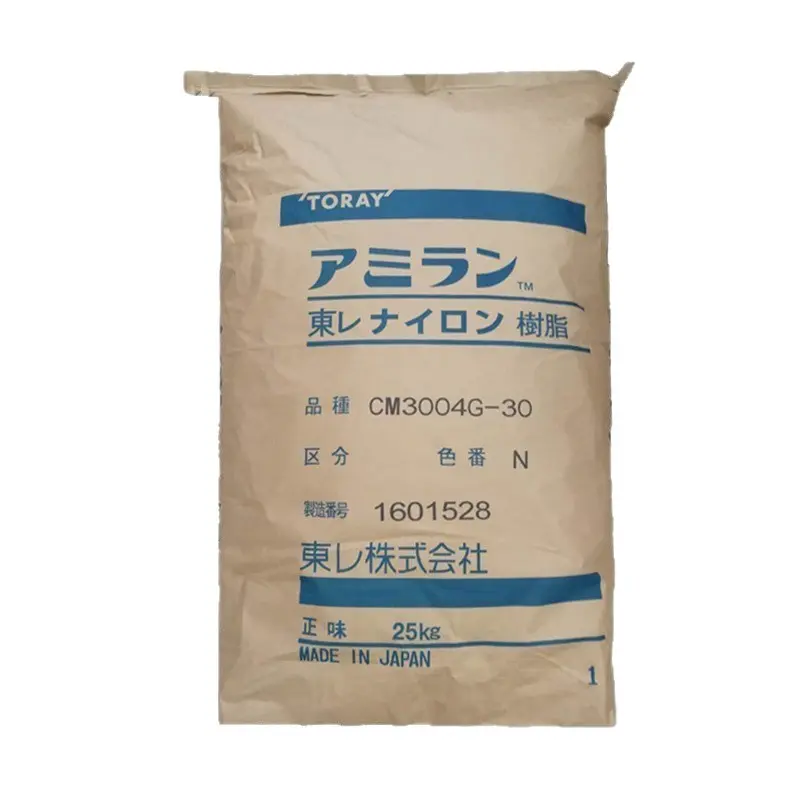
Toray Amilan® CM3004G-30 is a high-performance 30% glass fiber reinforced flame-retardant polyamide 66 (PA66 / Nylon 66) engineering plastic pellet developed by Toray Industries, Inc. As a benchmark flame-retardant structural grade in the Amilan® resin series, this material combines the inherent high mechanical strength of PA66 with the directional reinforcement of 30% chopped glass fibers, while delivering UL94 V-0 high-efficiency flame retardancy.
Specifically designed to withstand demanding mechanical and thermal service conditions, its core advantages include:
- High Rigidity and Tensile Strength: Features a flexural modulus of up to 9,300 MPa and a tensile strength of 165 MPa in the dry state, offering exceptional yield resistance and load-bearing capacity.
- Superior Heat Deflection Capability: Demonstrates excellent heat deflection temperature (reaching 251 °C at 0.45 MPa) and melting point (265 °C), capable of withstanding high-temperature environments in electrical/electronic devices and automotive engine compartments.
- High-Safety Flame Retardant Protection: Achieves UL94 V-0 flame retardancy rating even at a thin wall of 0.4 mm, meeting stringent electrical and electronic safety regulations.
- Wear Resistance and Chemical Resistance: Exhibits good inertness to oils, organic solvents, and various industrial chemicals, along with a low abrasion loss (only 26 mg per ISO 9352).
Recommended Processing Method: Featuring good melt flowability and anisotropic shrinkage control, this material is suitable for high-efficiency injection molding of complex geometries, thin-walled parts, and high-precision structural components using standard screw injection molding machines.
Technical Specifications
Physical Properties
| Item | Property Value | Unit | Test Standard |
| Dry: Density (23 °C) | 1.59 | g/cm³ | ISO 1183 |
| Dry: Mold Shrinkage, Normal (3 mm, 80x80x3mm) | 0.6-0.9 | % | Internal Method |
| Dry: Mold Shrinkage, Parallel (3 mm, 80x80x3mm) | 0.2-0.5 | % | Internal Method |
| Dry: Water Absorption (24 h, 23 °C) | 0.6 | % | ISO 62 |
| Dry: Water Absorption, Saturation (23 °C) | 4 | % | ISO 62 |
| Rockwell Hardness R, Dry (23 °C) | 121 | — | ISO 2039-2 |
Mechanical Properties
| Item | Property Value | Unit | Test Standard |
| Tensile Strength, Dry (-40 °C) | 190 | MPa | ISO 527-2 |
| Tensile Strength, Dry (23 °C) | 165 | MPa | ISO 527-2 |
| Tensile Strength, Conditioned (23 °C) | 135 | MPa | ISO 527-2 |
| Tensile Strength, Dry (80 °C) | 110 | MPa | ISO 527-2 |
| Tensile Strain at Break, Dry (-40 °C) | 2.5 | % | ISO 527-2 |
| Tensile Strain at Break, Dry (23 °C) | 3 | % | ISO 527-2 |
| Tensile Strain at Break, Conditioned (23 °C) | 3 | % | ISO 527-2 |
| Tensile Strain at Break, Dry (80 °C) | 4.5 | % | ISO 527-2 |
| Flexural Modulus, Dry (-40 °C) | 10200 | MPa | ISO 178 |
| Flexural Modulus, Dry (23 °C) | 9300 | MPa | ISO 178 |
| Flexural Modulus, Conditioned (23 °C) | 6500 | MPa | ISO 178 |
| Flexural Modulus, Dry (80 °C) | 5500 | MPa | ISO 178 |
| Flexural Strength, Dry (-40 °C) | 275 | MPa | ISO 178 |
| Flexural Strength, Dry (23 °C) | 250 | MPa | ISO 178 |
| Flexural Strength, Conditioned (23 °C) | 200 | MPa | ISO 178 |
| Flexural Strength, Dry (80 °C) | 150 | MPa | ISO 178 |
| Taber Abrasion Resistance (1.0e+3 Cycles) | 26 | mg | ISO 9352 |
| Charpy Notched Impact Strength, Dry (-40 °C) | 7 | kJ/m² | ISO 179 |
| Charpy Notched Impact Strength, Dry (23 °C) | 9.5 | kJ/m² | ISO 179 |
| Charpy Notched Impact Strength, Conditioned (23 °C) | 14 | kJ/m² | ISO 179 |
| Charpy Unnotched Impact Strength, Dry (23 °C) | 65 | kJ/m² | ISO 179 |
| Charpy Unnotched Impact Strength, Conditioned (23 °C) | 70 | kJ/m² | ISO 179 |
Thermal Properties
| Item | Property Value | Unit | Test Standard |
| Heat Deflection Temperature, Dry, Unannealed (0.45 MPa) | 251 | °C | ISO 75-2/B PNG |
| Melting Temperature, Dry | 265 | °C | DSC PNG |
| Dry: Coefficient of Linear Thermal Expansion (CTE), Parallel | 2.0E-5 | cm/cm/°C | ISO 11359-2 PNG |
| Flammability Rating, Dry (0.4 mm) | V-0 | — | UL 94 PNG |
| Flammability Rating, Conditioned (0.4 mm) | V-0 | — | UL 94 PNG |
Electrical Properties
| Item | Property Value | Unit | Test Standard |
| Volume Resistivity, Dry | 1.0E+13 | ohms · cm | IEC 60093 |
| Volume Resistivity, Conditioned | 1.0e+11 | ohms · cm | IEC 60093 |
| Electric Strength, Dry | 38 | kV/mm | IEC 60243-1 |
| Electric Strength, Conditioned | 33 | kV/mm | IEC 60243-1 |
| Dielectric Constant, Dry (1.0e+3 Hz, 60% RH, 23 °C) | 4.0 | — | IEC 60250 |
| Dissipation Factor, Dry (60% RH, 1.0e+6 Hz, 23 °C) | 0.010 | — | IEC 60250 |
| Comparative Tracking Index (Tungsten Electrode), Dry | 70 | sec | UL 746 |
| Dry: CTI | 200 | V | UL 746 |
Notice: The technical specifications for Toray Amilan® CM3004G-30 PA66 provided herein are compiled from data published by Toray or certified third-party testing laboratories. While prepared with professional diligence, these values serve as reference guidelines rather than absolute performance guarantees. Because molding and processing conditions vary significantly across operational environments, we recommend performing trial runs with CM3004G-30 under your actual manufacturing conditions prior to final material selection and mass production.
Features & Benefits
- Outstanding Flame Retardant Safety (UL94 V-0): Achieves UL94 V-0 flame retardancy standard even at thicknesses as low as 0.4 mm, making it suitable for structural electrical/electronic components with rigorous fire safety requirements.
- High Rigidity and Mechanical Strength: Supported by 30% chopped glass fibers, it achieves a flexural modulus of 9,300 MPa (dry state) and a tensile strength of 165 MPa, effectively resisting stress-induced bending and deformation.
- Good Dimensional Stability: Mold shrinkage is controlled within 0.2–0.5% in the parallel direction and 0.6–0.9% in the normal/perpendicular direction, effectively minimizing warpage and dimensional deviations during injection molding.
- Superior Thermal and Wear Performance: Features a high melting point of 265 °C and a heat deflection temperature of 251 °C (0.45 MPa), alongside a low Taber abrasion loss of only 26 mg (ISO 9352), performing reliably under frictional loads and elevated temperatures.
- Good Electrical Insulation Properties: Offers an electric strength of 38 kV/mm in the dry state, paired with a Comparative Tracking Index (CTI) of 200 V, providing reliable electrical protection for high-voltage circuit components.
Applications & Processing Guidelines
Recommended Applications
Driven by its “30% glass fiber reinforced + UL94 V-0 flame retardant” profile, Toray Amilan® CM3004G-30 is widely used in end-use products demanding exceptional mechanical properties and high fire ratings:
- Electronics & Electrical (E&E): High-voltage circuit breaker housings, terminal blocks, relay bases, coil bobbins, and internal insulation components of power transformers.
- Industrial Automation & Power Tools: High-load switch assemblies, motor end covers, gearbox casings, and industrial connector housings.
- Automotive Electronics & Electrical Systems: Automotive high-voltage power distribution boxes, load-bearing structural parts inside charging guns, automotive relays, and sensor brackets.
Injection Molding Guidelines
- Pre-Drying (Mandatory): PA66 is hygroscopic. Thorough pre-drying is mandatory prior to injection molding; it is recommended to use a desiccant dryer at 80 °C – 90 °C for 4 – 6 hours to ensure the resin moisture content is controlled below 0.05% – 0.10%, preventing hydrolytic degradation that causes silver streaks, bubbles, and loss of mechanical strength.
- Processing Temperature Settings:
- Nozzle Temperature: 275 °C – 285 °C
- Front Zone (Metering): 280 °C – 290 °C
- Middle Zone (Compression): 275 °C – 285 °C
- Rear Zone (Feed): 265 °C – 275 °C
- Mold Temperature: Mold temperature should ideally be maintained at 70 °C – 90 °C. Higher mold temperatures promote higher crystallinity, improve surface gloss (reducing glass fiber knit/sinking lines), and minimize internal stress.
- Injection Pressure and Speed: Medium-to-high injection pressure (80 – 120 MPa) and medium/high injection speed are recommended to ensure uniform glass fiber distribution and prevent short shots; screw backpressure should be set to 0.3 – 1.0 MPa.
FAQs
Q1: Is pre-drying mandatory before injection molding Amilan® CM3004G-30? What are the consequences of skipping it?
Yes, strict pre-drying is mandatory. PA66 readily absorbs moisture from the ambient air. If heated and molded without sufficient drying, moisture reacts with the polymer melt inside the high-temperature barrel via hydrolysis, causing a drastic drop in molecular weight, surface silver streaks, bubbles, and significant degradation in tensile strength and toughness.
Q2: What are the main application selection differences between this grade (CM3004G-30) and standard unretardant 30% glass fiber reinforced PA66?
The core difference lies in flame retardancy and certification compliance. CM3004G-30 incorporates a flame retardant system achieving a UL94 V-0 rating (0.4 mm), specifically designed for electrical/electronic and high-voltage applications with strict fire safety codes; standard unretardant GF30 PA66 typically has an HB flame rating and focuses primarily on pure mechanical structural parts (e.g., transmission gears, mechanical brackets).
Q3: How do the mechanical properties of this material change under conditioned (moisture-absorbed) states?
Polyamides undergo a plasticizing effect upon moisture absorption. As shown in the data, conditioning reduces tensile strength from 165 MPa to 135 MPa and flexural modulus from 9,300 MPa to 6,500 MPa; however, Charpy notched impact strength increases from 9.5 kJ/m² to 14 kJ/m². In other words, stiffness and strength slightly decrease after moisture absorption, while toughness and impact resistance improve.
Q4: How can surface “glass fiber floating / sink marks” be minimized when processing this material?
Because this grade contains 30% glass fiber, improper handling during molding can cause fiber prominence on the surface. Recommended improvements include: moderately raising the mold temperature (80 °C – 90 °C), increasing melt temperature and injection speed appropriately, ensuring thorough raw material drying, and optimizing holding pressure to form a proper resin-rich layer during mold filling.