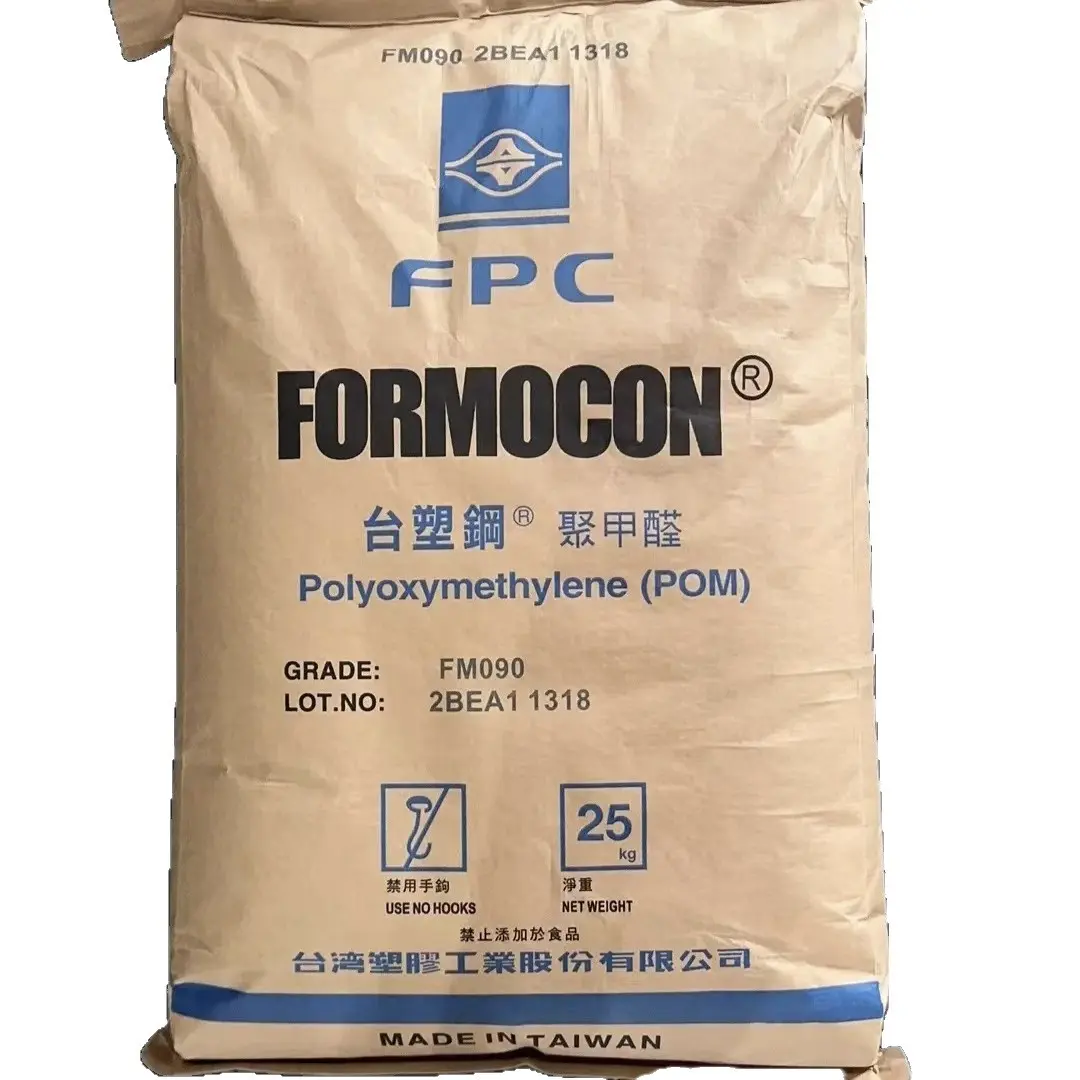
Quick answer: POM (polyoxymethylene, also known as acetal resin) is the third-largest general-purpose engineering plastic after PA and PC. Known as “the metal substitute,” it offers high rigidity, low friction, excellent wear resistance, and outstanding dimensional stability — making it the preferred material for precision gears, bearings, automotive fuel system parts, and other metal-replacement applications.
What Is POM (Polyoxymethylene / Acetal) Plastic?
POM (polyoxymethylene) is commonly called acetal or polyacetal in English; Delrin is the well-known DuPont brand name for homopolymer POM. It is a linear engineering thermoplastic with no side chains, high density, and high crystallinity.
Core value in one sentence: as hard, rigid, and wear-resistant as metal, yet lighter than metal, lubricant-free, and easy to mold — which is exactly why it is called “the metal substitute.”
Name reminder: POM / acetal / polyacetal / Delrin all refer to the same material family — simply distinguish them by grade and by homopolymer/copolymer type when sourcing.
POM Homopolymer vs Copolymer: What’s the Difference?
The first step in material selection is telling the two POM families apart:
| Aspect | Homopolymer POM (POM-H) | Copolymer POM (POM-C) |
|---|---|---|
| Representative brands | DuPont Delrin and similar | Tenac, Kepital, Duracon and similar |
| Strength / rigidity / wear resistance | Higher | Good |
| Heat-aging / alkali resistance | Fair | Better |
| Processing window | Narrow, prone to degradation | Wide |
| Typical uses | High-load gears, precision parts | Complex parts, water/alkali-exposed parts |
Related reading: Homopolymer Plastics vs. Copolymer Plastics: What’s the Difference? on this site explains the molecular structure and selection differences between homopolymer and copolymer materials.
POM Properties: Why It’s Called “The Metal Substitute”
| Property | Typical value / behavior |
|---|---|
| Density | Approx. 1.41 g/cm³ |
| Water absorption | Approx. 0.2% (extremely low — key to dimensional stability) |
| Heat deflection temperature (HDT) | Approx. 90–120°C |
| Coefficient of friction | Low, self-lubricating, can run without lubrication |
| Wear resistance | Excellent, better than most engineering plastics |
| Fatigue resistance | Excellent (spring clips, snap-fits) |
| Chemical resistance | Resistant to fuel, weak acids/alkalis, and solvents; not resistant to strong acids/alkalis |
Three reasons to choose it: ① low water absorption + high crystallinity → minimal dimensional drift in humid environments, first choice for precision parts; ② self-lubricating and wear-resistant → maintenance-free gears and bearings; ③ fatigue-resistant → long service life for snap-fits and fasteners under repeated flexing.
Known limitations: low flame rating (UL94 HB, not flame-retardant); poor UV resistance (outdoor use requires modification or an ASA-type material); not resistant to strong acids and alkalis; high mold shrinkage (1.5–2.2%) — mold design must allow for it.
POM vs Nylon (PA) vs Other Plastics: Which One to Choose?
The most common dilemma for procurement engineers is POM versus nylon (PA):
| Aspect | POM | PA6/PA66 (Nylon) | PBT | PEEK |
|---|---|---|---|---|
| Water absorption | ~0.2% (extremely low) | 1.5–3% (high) | Low | Extremely low |
| Dimensional stability | Excellent (winner in humid environments) | Poor (drifts after absorbing moisture) | Excellent | Excellent |
| Wear / self-lubrication | Excellent | Fair (needs lubrication design) | Good | Excellent |
| Heat resistance ceiling | Medium (approx. 100–120°C continuous) | Higher (PA66+GF even better) | Medium | Very high |
| Cost | Medium | Medium-low | Medium | High |
Decision rules:
- Humid environments, precision dimensions, gears and bearings → POM;
- Need higher impact or heat resistance and can accept moisture-induced deformation → PA66 (for nylon market trends, see this site’s 2026 Nylon Price Surge);
- Long-term high temperature / aggressive chemicals → PEEK (refer to this site’s Victrex 450G PEEK Guide).
Key Applications of POM Resin
- Precision gears / worm gears: printers, appliance drivetrains, automotive window and seat-adjustment mechanisms — POM’s most classic territory;
- Bearings / bushings / slides: self-lubricating and maintenance-free, replacing oil-impregnated bronze bushings;
- Automotive fuel systems: fuel pump impellers, lock cylinders, clips — fuel-resistant with stable dimensions;
- Medical: insulin pens, inhaler housings (medical-grade certified grades required);
- Fasteners and spring clips: fatigue-resistant, withstand repeated assembly/disassembly without breaking;
- Home appliances: coffee machines, washing machine transmission parts, vacuum cleaner rollers.
POM Injection Molding: Parameters & Best Practices
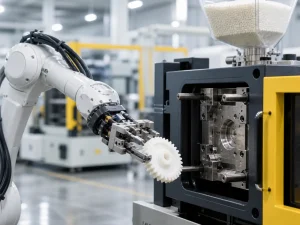
General reference (always follow the specific grade’s TDS):
- Drying: usually not required; if needed, dry at 80–100°C for 2–3 hours;
- Melt temperature: homopolymer 215–230°C / copolymer 190–210°C; above approximately 230°C POM degrades and releases formaldehyde gas — ensure proper venting around the molding area;
- Mold temperature: 60–120°C (commonly 80–90°C; higher mold temperature improves surface quality);
- Mold shrinkage: 1.5–2.2% (homopolymer tends toward the upper end, thicker walls shrink more) — mold design must allow for shrinkage.
Common defects: sink marks/warpage (uneven shrinkage), silver streaks (moisture or thermal degradation), mold sticking (excessive mold temperature or insufficient draft angle).
POM Resin Price & Buying Guide
Price drivers: ① feedstock costs (trioxane/formaldehyde); ② homopolymer vs copolymer price difference (homopolymer is usually more expensive); ③ brand and modification differences (glass-fiber reinforcement, lubricated grades, antistatic grades priced separately); ④ exchange rates and freight costs.
Buying checklist:
- Request TDS/MSDS/COA and verify the homopolymer/copolymer type and grade;
- Ask for sample trial molding to verify shrinkage and dimensional stability (especially critical for this high-shrinkage material);
- Confirm MOQ and lead time — start with a small batch to test the market;
- Clarify trade terms and moisture-proof packaging.
TaiKuo Plastics (TK Plastics) brings 10+ years of plastic raw material export experience, serving 50+ countries with 5,000+ tons delivered annually. We support flexible MOQs for small trial orders, custom coloring and compounding, independent quality inspection, and TDS-based material selection support. See our POM Resin product page for details.
FAQ
Q1: What is the melting point of POM?
A1: The crystalline melting point is about 165–175°C, with injection molding melt temperatures of 190–230°C (homopolymer at the higher end).
Q2: Are POM and Delrin the same material?
A2: Yes, they belong to the same family. POM is the generic name; Delrin is DuPont’s brand name for homopolymer POM.
Q3: Is POM food safe?
A3: Some grades carry FDA food-contact certification — you must specify a certified grade; general-purpose grades are not food-contact compliant.
Q4: Does POM absorb water?
A4: Water absorption is only about 0.2%, so dimensions barely change with humidity — its biggest advantage over nylon.
Q5: Can POM replace metal gears?
A5: Yes. For low-load, medium-temperature applications, POM gears are lubricant-free, low-noise, and fatigue-resistant — a mature metal-replacement solution; for high-load, high-temperature applications, evaluate PEEK instead.
Q6: What is the MOQ for POM resin?
A6: TaiKuo Plastics supports flexible MOQs — small trial orders are welcome.