Introduction
In 2026, the global polyamide (PA) market experienced an unprecedented price storm. From relative stability in January to a rapid surge in mid-March, and subsequent high-level fluctuations, the price volatility of polyamide far exceeded expectations. Based on latest market data, this article deeply analyzes the core driving forces behind this global nylon price surge and its impact on international buyers.
The “Three-Stage” Price Trend of PA in 2026
January–February: Low-Level Consolidation Phase
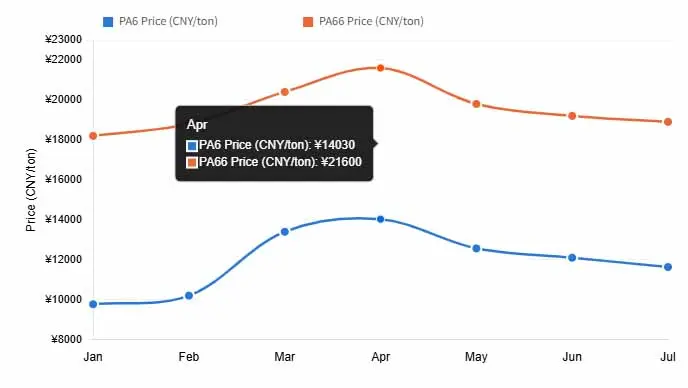
At the beginning of the year, the PA market remained relatively calm. The benchmark price of PA6 chips hovered between 9,770 and 10,200 RMB/ton, while PA66 maintained around 18,200 to 18,800 RMB/ton. During this period, global supply and demand for nylon were relatively balanced, and downstream sectors such as automotive and electrical were in their traditional off-season.
March–April: The Price Surge Storm
The turning point occurred in March when global chemical giants including BASF, Invista, Toray, and Celanese issued consecutive price hike letters. Within just one month, the PA6 raw material (caprolactam) skyrocketed to 14,030 RMB/ton, marking a 43% increase; PA66 broke through the 20,000 RMB/ton threshold, peaking at 21,600 RMB/ton and setting a record for the year. This price storm resulted from a perfect storm of rising raw material costs, supply chain tightening, and global geopolitical fluctuations.
May–July: High-Level Correction
After two months of overheating, the market began to cool down. May’s monthly report for PA66 showed a price drop as downstream demand failed to sustain high prices, and end-user procurement willingness noticeably softened. By early July, the reference price for PA6 was adjusted downward to 11,633 RMB/ton, retreating 19% from its April peak; PA66 also fell from its peak of 21,600 RMB to around 18,900 RMB/ton, though still up 3.8% from the beginning of the year.
Supply Chain Crisis: From Chinese Production Capacity to Global Shortage
The 2026 PA price surge was closely linked to deep-seated crises on the supply side. As a critical upstream raw material for PA66, hexamethylenediamine (HMD) faced severe market tightness. Although Invista’s China base expanded its PA66 capacity to 190,000 tons per year, global HMD production remained severely insufficient, putting pressure on the entire industrial chain. Meanwhile, affected by overall tightening in global raw material supply and phased unit maintenance, logistics across certain industry capacities experienced periodic constraints, driving up overall procurement costs and leaving international buyers facing localized tight-balance challenges in the supply chain.
The Cold Reality of Downstream Demand: Prices Cannot Rise Indefinitely
Despite immense pressure on the supply side, the demand side failed to effectively support high price levels. May data clearly indicated a significant decline in purchase volumes across core downstream industries like automotive and electrical. High prices stimulated cost anxiety among buyers, prompting some enterprises to seek alternative solutions or postpone purchasing plans. This contradiction between sharply rising supply and relatively sluggish demand ultimately triggered a continuous correction after April. Currently, the PA market has fallen into a typical “high-altitude vulnerability” dilemma.
Opportunity Window for Sustainable Nylon
Amid the intense fluctuations in the traditional PA market, recycled polyamide (rPA) has emerged as a new focal point of competition. In May, Michelin and startup Syntetica announced a strategic partnership to accelerate the industrialization of chemical recycling technology. Although the cost of rPA remains higher than virgin PA, the pricing power advantage for utilizing recycled materials is taking shape under the dual policy pressures of carbon tariffs and the European Union’s plastic tax. Forward-thinking supply chain managers should monitor this trend—green PA is not merely a policy symbol, but may become a new dimension of future cost competitiveness.
Conclusion
The 2026 PA market can be described as a “black swan” year—assailed by a global price surge, supply chain crisis, and weak demand that collectively broke the market’s existing equilibrium. For international buyers, opportunities and risks coexist:
- Short-term: Utilize the current correction window to lock in prices and build strategic inventory.
- Medium-term: Diversify procurement channels to reduce reliance on single sources.
- Long-term: Forward-deploy sustainable materials to capture the first-mover advantages of green transformation.