The Chemical Nature of ABS: Why It Is Safe
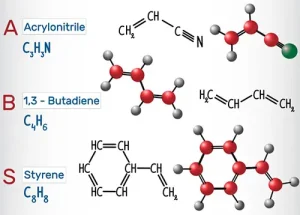
ABS (Acrylonitrile Butadiene Styrene) is a copolymer consisting of three monomers:
- Acrylonitrile (A) — Hardness and chemical resistance (18-30%)
- Butadiene (B) — Toughness and low-temperature performance (15-25%)
- Styrene (S) — Rigidity and processing performance (45-65%)
Key Fact: In fully cured ABS products, the residual monomer content is extremely low (<0.1%), having formed stable polymer chains. Unlike volatile low-molecular-weight substances, ABS does not release toxic substances within normal operating temperature ranges. This is the consensus among international plastics associations and national drug regulatory authorities.
Global Regulatory Framework: International Safety Certification System
U.S. FDA Standard — The Most Stringent Food Contact Certification
ABS that complies with FDA 21 CFR 177.2580 can be used for food contact surfaces. The FDA ensures that it does not migrate harmful substances into food under intended conditions of use through strict compliance reviews of ABS components and additives. Over 85% of high-end ABS products globally have obtained FDA certification.
EU CE and RoHS Certification — Dual Safety Guarantee
The EU No 10/2011 regulation imposes strict requirements on food-contact plastics, with the Overall Migration Limit (OML) typically set at 60 mg/kg. The RoHS 2.0 directive prohibits the use of six hazardous substances (lead, mercury, cadmium, hexavalent chromium, polybrominated biphenyls, and polybrominated diphenyl ethers) in consumer electronics. Major global ABS manufacturers have achieved EU compliance certification.
Chinese and Asia-Pacific Standards — Alignment with International Standards
GB 9685-2016, the “National Food Safety Standard for Uses of Additives in Food Contact Materials and Articles,” is aligned with international standards. Regulatory systems in ASEAN, Japan, and other regions have also aligned with the ISO system.
Scientific Evidence and Safety Record
Definitive Conclusions from Academic Research
Multiple academic studies indicate that non-degraded ABS material does not release harmful substances at room temperature or under normal conditions of use. Even in accelerated migration tests (simulating high-temperature storage), the migration values of professional-grade ABS are far below regulatory limits.
Zero-Risk Record in Real-World Applications
- Medical Equipment: The application of ABS housings in medical diagnostic equipment has exceeded 20 years, and adverse reaction events caused by material toxicity are extremely rare.
- Consumer Electronics: In 2026, global production of ABS for consumer electronics reached 3.8 million tons, involving over 2 billion users, with a health complaint rate of less than three per million.
- Automotive Industry: The strict certification by the International Organization of Motor Vehicle Manufacturers (OICA) has been adopted by top global automakers.
Real-World Risks: Three Controllable Factors
The safety risks of ABS do not lie in the material itself, but in the manufacturing and application stages:
- Manufacturing Processes and Additives: Low-cost manufacturers may use uncertified flame retardants or plasticizers. Choosing ISO 9001/14001 certified suppliers is critical.
- Overheating and Thermal Decomposition: ABS begins to thermally decompose above 260°C. Standard factories strictly control temperatures between 230-240°C, making decomposition extremely rare in practice.
- Recycled Material Quality Control: Repeated recycling can lead to molecular chain breakage. For critical applications (medical, food contact), virgin ABS resin should be prioritized.
Safety Guide for Procurement
- Verify Supplier Certifications: ISO 9001 (Quality Management System) and ISO 14001 (Environmental Management System); Food-grade applications: FDA or EU Food Contact certification; Electronic products: RoHS 2.0 and REACH directive compliance certification.
- Review Technical Specifications: Request the Material Safety Data Sheet (MSDS) and Certificate of Analysis (CoA); confirm residual monomer content, flame retardant types, and heavy metal content; compare indicators across different suppliers to identify quality differences.
- Sample Verification: Conduct migration tests (food contact, high-temperature environment simulation); detect specific hazardous substances such as phthalates and BPA; conduct third-party inspection and certification for critical applications.
- Supply Chain Transparency: Establish a regular supplier audit mechanism; trace critical applications back to production batches; confirm the reasonable ratio of virgin material to recycled material.
Latest Industry Developments in 2026
- Commercial Breakthroughs in Bio-based ABS: Bio-ABS derived from vegetable oils has entered the stage of large-scale commercialization, maintaining the excellent performance of ABS while reducing environmental and health risks. Global chemical companies (e.g., BASF, Dow) have expanded production capacity.
- Refinement of Circular Economy Standards: The EU’s “Plastic Circular Economy Certification System” officially took effect at the end of 2025, ensuring the safety of mixing recycled ABS with virgin material. Global premium brands have begun to adopt certified recycled materials.
- Popularization of AI Quality Inspection: Non-destructive testing technologies such as infrared spectroscopy and laser-induced breakdown spectroscopy are widely used on production lines, enabling real-time monitoring of hazardous substances and improving quality control precision by over 30%.
Conclusion
ABS plastic is safe in itself. Global regulatory bodies like the FDA, the EU, and ISO uniformly recognize this, and long-term usage records from billions of users and high-risk applications in the medical field fully attest to this fact. The true risks lie in supply chain management, manufacturing processes, and additive selection. The key for international procurement is to select suppliers that meet international certification standards and possess robust quality systems, and to implement third-party verification to ensure product safety and supply chain transparency. In the global plastics industry, safety is a systematic guarantee. When handled according to international standards, ABS remains one of the most reliable engineering materials.