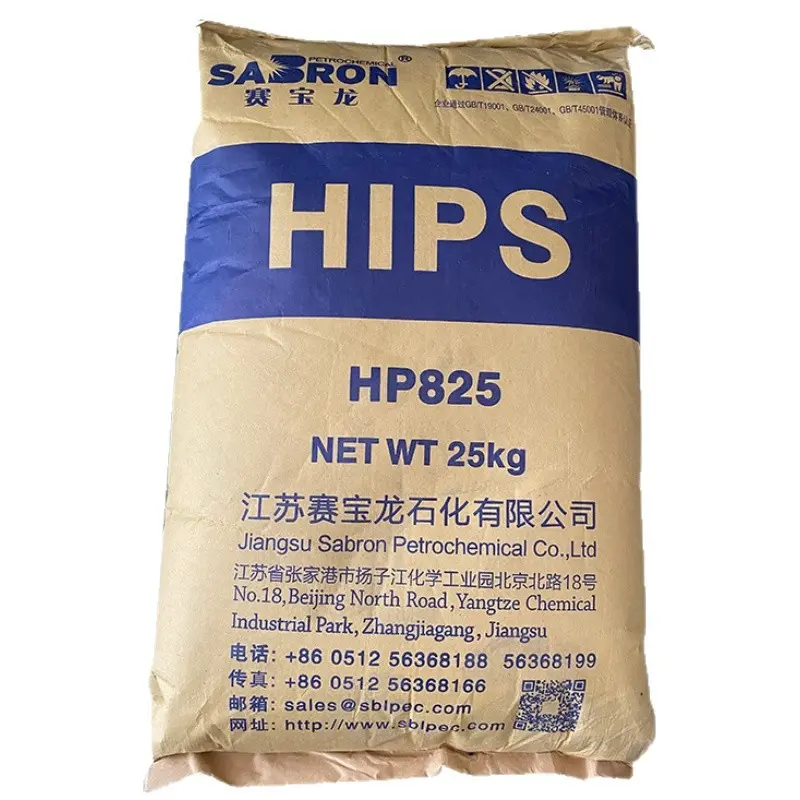
Product Overview & Key Features
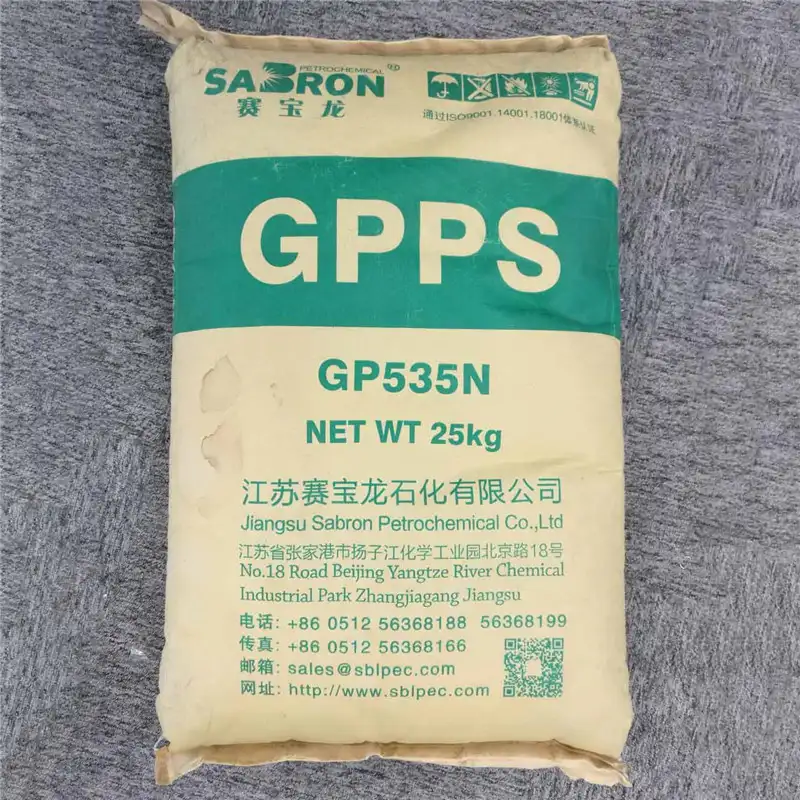
- Manufacturer: Sabron
- Grade: HP825
- Category: High Impact Polystyrene (HIPS)
- Appearance: Natural opaque pellets, injection molding grade thermoplastic resin.
Sabron HP825 is a general-purpose injection molding grade HIPS resin featuring medium melt flowability and high elongation modification. Through rubber-phase modification, this material overcomes the inherent brittleness of General Purpose Polystyrene (GPPS), delivering balanced impact toughness and tensile elongation properties. Featuring low moisture absorption, a stable mold shrinkage range, and a Vicat softening temperature of 94 ℃, HP825 satisfies the operating temperature requirements of conventional consumer goods, internal appliance components, and packaging products. Its moderate melt flow rate renders it well-suited for standard wall-thickness injection molding, making it a highly versatile HIPS raw material across consumer daily goods, packaging, and general electronic enclosures.
Technical Specifications
Physical Properties
| Property | Test Condition | Value | Unit | Test Standard |
| Water Absorption | — | <0.1% | — | ISO 62 |
| Melt Flow Rate (MFR) | 200 ℃ / 5 kg | 5.5 | g/10 min | ASTM D1238 |
| Density | — | 1.04 | g/cm³ | ISO 1183 |
| Mold Shrinkage | — | 0.4 ~ 0.7% | — | ISO 294 |
Mechanical Properties
| Property | Test Condition | Value | Unit | Test Standard |
| Tensile Stress at Yield | 23 ℃ | 25 | MPa | ASTM D638 |
| Tensile Stress at Break | 23 ℃ | 24 | MPa | ASTM D638 |
| Tensile Elongation at Break | 23 ℃ | 55% | — | ASTM D638 |
| Flexural Strength | 23 ℃ | 45 | MPa | ASTM D790 |
| Izod Notched Impact Strength | 23 ℃ | 92 | J/m | ASTM D256 |
Thermal Properties
| Property | Test Condition | Value | Unit | Test Standard |
| Vicat Softening Temperature | — | 94 | ℃ | ASTM D1525 |
Notice: The technical specifications for Sabron HP825 provided herein are compiled from data published by Sabron or certified third-party testing laboratories. While prepared with professional diligence, these values serve as reference guidelines rather than absolute performance guarantees. Because molding and processing conditions vary significantly across operational environments, we recommend performing trial runs with HP825 under your actual manufacturing conditions prior to final material selection and mass production.
Features & Benefits
- Low Moisture Absorption & Molded Part Stability: Displays water absorption under 0.1%, resisting ambient moisture absorption during standard storage. This reduces the risk of surface silver streaks and void defects during injection molding while minimizing reliance on pre-drying processes.
- High Elongation at Break & Tear Resistance: Delivers a 55% elongation at break, preventing premature brittle fracture under gradual deformation or compressive stress, making it ideal for enclosures and packaging items requiring flexible deformation tolerance.
- Medium Melt Flowability for Standard Wall Thicknesses: With an MFR of 5.5 g/10 min, it provides an optimal processing window that balances mold filling with internal stress control, facilitating mass production of parts with standard wall thicknesses between 1.5–4 mm.
- Consistent Mold Shrinkage & Dimensional Control: Maintains a mold shrinkage rate of 0.4–0.7%, resulting in minimal lot-to-lot dimensional variance to ensure stable high-cavity mold production and tight assembly tolerances.
- Balanced Thermal Performance: Features a Vicat softening temperature of 94 ℃, satisfying operating requirements for household appliances, daily necessities, and packaging components under ambient to moderate temperature conditions.
Applications & Processing Guidelines
Typical Applications
- Daily necessities, stationery enclosures, and general toy housings.
- Non-load-bearing internal appliance trims and electrical lining support frames.
- General packaging liners, disposable packaging accessories, and display stands.
- Standard industrial decorative covers and non-flame-retardant electronic equipment housings.
Processing Guidelines
- Drying: Pre-drying may be omitted under ambient manufacturing conditions. For high-humidity environments, high-gloss aesthetic parts, or post-painted components, pre-drying at 70–80 ℃ for 2–3 hours is recommended to eliminate surface imperfections.
- Barrel Temperature: The recommended barrel temperature range is 180–220 ℃. Due to its medium melt flowability, this grade is not recommended for long-flow-length, thin-walled parts under 1 mm wall thickness.
- Mold Temperature: Mold temperature should be set at 40–60 ℃. Higher mold temperatures help lower residual internal stress in molded parts, mitigating post-storage and post-painting cracking.
- Post-Processing: Compatible with screen printing, surface painting, and adhesive bonding. Molded parts should be allowed to age for 24 hours to relieve internal stress prior to secondary surface finishing.
Frequently Asked Questions (FAQs)
Q1: Is Sabron HP825 HIPS a flame-retardant grade?
A: HP825 is a general-purpose, non-flame-retardant HIPS grade without flame-retardant additives. It does not meet UL 94 flammability standards and must not be used in electrical safety components with mandatory flame-retardant requirements. Dedicated flame-retardant modified HIPS should be specified for such applications.
Q2: Can HP825 be blended with GPPS?
A: HP825 exhibits excellent compatibility with GPPS and can be melt-blended. Increasing the proportion of GPPS raises part rigidity while decreasing impact strength and elongation at break. Adjusting the blend ratio optimizes the balance between cost, stiffness, and toughness. Small-scale trial runs are recommended prior to full mass production.
Q3: With an MFR of 5.5, is HP825 suitable for sheet extrusion?
A: HP825 is designed primarily as an injection molding grade HIPS. Although it can be extruded into simple sheets at low speeds, it is not a dedicated extrusion grade. It exhibits a narrower processing window during extrusion and carries a higher risk of sheet surface defects. Dedicated low-MFR extrusion-grade HIPS should be selected for high-volume sheet extrusion.
Q4: Can RoHS compliance reports be provided upon purchasing HP825 raw materials?
A: Original manufacturer RoHS testing reports are available for export auditing. If specialized compliance certificates—such as food-contact or FDA standards—are required, please confirm and request the corresponding documentation prior to order placement.