Product Overview & Key Features
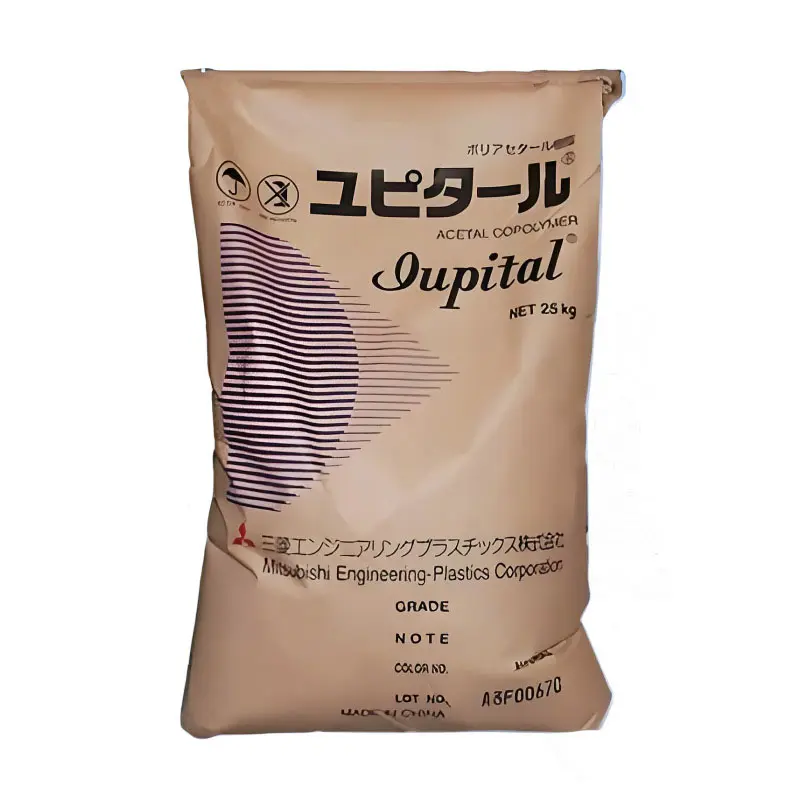
Iupital™ F10-02 is a polyoxymethylene copolymer (POM-C) injection-molding grade resin produced by Mitsubishi Engineering-Plastics Corporation (MEP). Featuring milky-white translucent to opaque pellets, it is a high-viscosity, high-rigidity, and high-toughness general copolymer grade with a melt flow rate (MFR) of 2.5 g/10 min (190 °C, 2.16 kg). Positioned as a high-viscosity standard grade within the Iupital™ series, F10-02 complements the medium-viscosity F20-03. Its higher molecular weight provides superior mechanical strength and toughness, featuring a tensile yield strength of 63.0 MPa, a flexural modulus of 2500 MPa, an unnotched Charpy impact strength of up to 280 kJ/m², and a heat deflection temperature (1.8 MPa) of 100 °C. Specifically designed for injection molding processes, this grade is particularly well-suited for thick-walled precision structural components that require high mechanical strength, toughness, and dimensional stability. It is widely applied across automotive, precision machinery, electrical and electronics, and industrial component sectors, making it one of the representative copolymer benchmark grades of Mitsubishi Engineering-Plastics in the global POM market.
Technical Specifications
Physical Properties
| Physical Properties | Test Value | Test Unit | Test Standard |
| Density | 1.41 | g/cm³ | ISO 1183 |
| Melt Index, Mass (190 °C, 2.16 kg) | 2.5 | g/10min | ISO 1133 |
| Melt Index, Volume (190 °C, 2.16 kg) | 2.2 | cm³/10 min | ISO 1133 |
| Mold Shrinkage, Parallel (3 mm) | 2.2 | % | ISO 294-4 |
| Water Absorption (23 °C, 60% RH) | 0.22 | % | ISO 62 |
Mechanical Properties
| Mechanical Properties | Test Value | Test Unit | Test Standard |
| Tensile Modulus | 2800 | MPa | ISO 527 |
| Tensile Strength, Yield | 63 | MPa | ISO 527-2/50 |
| Tensile Strain, Yield | 10 | % | ISO 527-2/50 |
| Tensile Strain, Break | 33 | % | ISO 527 |
| Flexural Modulus (2 mm/min) | 2500 | MPa | ISO 178 |
| Flexural Strength (2 mm/min) | 89 | MPa | ISO 178 |
| Charpy Impact Strength, Notched (23 °C) | 8 | kJ/m² | ISO 179 |
| Charpy Impact Strength, Unnotched (23 °C) | 280 | kJ/m² | ISO 179 |
Thermal Properties
| Thermal Properties | Test Value | Test Unit | Test Standard |
| Heat Deflection Temperature, Unannealed (0.45 MPa) | 156 | °C | ISO 75 |
| Heat Deflection Temperature, Unannealed (1.8 MPa) | 100 | °C | ISO 75 |
| Coefficient of Linear Thermal Expansion (CTE), Parallel | 1.10E-04 | cm/cm/°C | ISO 11359-2 |
| Coefficient of Linear Thermal Expansion (CTE), Transverse | 1.10E-04 | cm/cm/°C | ISO 11359-2 |
| Flammability Rating (0.8 mm) | HB | — | UL 94 |
Electrical Properties
| Electrical Properties | Test Value | Test Unit | Test Standard |
| Surface Resistivity | 1.00E+16 | ohms | IEC 60093 |
| Volume Resistivity | 1.00E+14 | ohms·cm | IEC 60093 |
| Dielectric Strength (1 mm) | 32 | kV/mm | IEC 60243-1 |
| Dielectric Strength (3 mm) | 19 | kV/mm | IEC 60243-1 |
| Dielectric Constant (1.0e+6 Hz) | 3.9 | — | IEC 60250 |
| Dielectric Constant (1.0e+8 Hz) | 3.9 | — | IEC 60250 |
| Dissipation Factor (1.0e+6 Hz) | 7.00E-03 | — | IEC 60250 |
| Dissipation Factor (1.0e+8 Hz) | 2.00E-03 | — | IEC 60250 |
| Comparative Tracking Index (CTI) | 600 | V | IEC 60112 |
Disclaimer: The technical specifications for Iupital™ F10-02 presented herein are derived from data issued by Mitsubishi Engineering-Plastics Corp. or certified third-party testing institutions. While we have made every effort to ensure the accuracy of the information provided, we assume no liability for any consequences arising from the use of F10-02 based on these data. Given the variables involved in processing conditions, we strongly recommend conducting thorough trials of F10-02 under your specific operational environment prior to final material selection.
Applications & Processing Guidelines
Recommended Applications
Leveraging its high rigidity, high toughness, excellent fatigue resistance, and dimensional stability, F10-02 is primarily targeted at the following application scenarios:
- Automotive Industry: Door lock mechanisms, window regulator components, seatbelt buckles, fuel system parts, transmission shift forks, and cooling system connectors—utilizing its high toughness, oil/water resistance, and long-term fatigue durability.
- Precision Machinery & Industry: Gears, worms, bearings, bushings, cams, sliders, pump impellers, and pneumatic connectors—its high viscosity-driven toughness effectively resists impact and fatigue fracture under dynamic loads.
- Electronics & Electrical: Connector housings, switch buttons, relay bases, and circuit breaker components—ensuring electrical safety backed by a CTI of 600 V and high volume resistivity (1.0E+14 Ω·cm).
- Consumer Goods & Home Appliances: Power tool housings, printer gears, appliance drive parts, and sanitary hardware (such as shower knobs and faucet valve cores)—where hot-water resistance, alkali resistance, and low friction suit water-contact environments.
Processing Guidelines
- Drying Pretreatment: POM exhibits low water absorption (equilibrium moisture absorption of 0.22%), but high-viscosity grades are more sensitive to trace moisture, which can cause silver streaks, bubbles, and molecular weight degradation. Hot-air circulation drying at 80–90 °C for 3–4 hours is recommended to ensure a moisture content of ≤ 0.1%. Store the material in a sealed container after drying to prevent secondary moisture absorption.
- Injection Molding Process: The recommended melt temperature is 190–210 °C. Temperatures exceeding 230 °C must be strictly avoided to prevent thermal decomposition of POM, which releases formaldehyde gas and causes severe performance degradation. Mold temperatures should be set at 60–100 °C (60–80 °C recommended); higher mold temperatures facilitate complete crystallization, reduce internal stress, and improve surface gloss. Because F10-02 is a high-viscosity grade (MFR 2.5), injection pressure should be appropriately increased (80–120 MPa), with holding pressure set at 60–80% of the injection pressure. Control screw speed at 50–80 rpm and back pressure at 0.5–1.0 MPa to avoid excessive shear heat.
- Post-Processing: For high-precision or thick-walled parts, annealing at 100–120 °C for 1–3 hours is recommended to relieve internal stress, stabilize dimensions, and reduce the risk of subsequent warpage or stress cracking.
Logistics, Packaging & Compliance
- Packaging Specifications: Standard packaging consists of 25 kg multi-layer composite paper bags or moisture-proof woven bags lined with polyethylene film, providing basic moisture protection. Ton bags (Big Bags, typically 500 kg or 1000 kg) are also available upon request to accommodate automated production line unpacking needs.
- Supply Attributes: F10-02 is classified as a non-hazardous chemical (Non-DG) and complies with general cargo transportation standards. It supports 20-foot full container load (FCL) and less than container load (LCL) ocean and land freight operations, requiring no special hazardous material transport qualifications or vehicles.
- Delivery Lead Time: Backed by regular stock maintained by TaiKuo New Materials across major ports and inland hubs, standard orders can be fulfilled rapidly. Specific delivery lead times depend on Incoterms and destination port logistics conditions, with dispatch generally arranged following order confirmation.
- Compliance & Documentation Support: Each batch of product is accompanied by a complete set of quality management documents, including a Technical Data Sheet (TDS), Material Safety Data Sheet (MSDS/SDS), and Certificate of Analysis (COA). The product complies with RoHS directive and REACH regulation restrictions on hazardous substances.
- ESG & Environmental Statement: As a thermoplastic engineering plastic, polyoxymethylene features physical recyclability and reuse properties. We support circular economy practices, encouraging customers to sort, recycle, and reprocess runner waste and unqualified parts during processing. Concurrently, we are committed to driving green supply chain transformation to ensure that the environmental impact across the product lifecycle remains controllable, aligning with global sustainable development trends.
Frequently Asked Questions (FAQs)
Q1: F10-02 has an MFR of 2.5 g/10 min, making it a high-viscosity grade. What precautions should be taken during processing?
A: High viscosity implies relatively lower melt fluidity, requiring higher injection pressures and optimized mold gate designs when filling thin-walled or complex cavities. Recommendations: ① Appropriately enlarge gate dimensions (to prevent premature freezing); ② Increase mold temperature to 80–100 °C to prolong melt flow time; ③ Utilize medium-to-fast injection speeds to ensure thorough cavity filling; ④ Prevent melt temperatures from exceeding 210 °C to prevent thermal degradation. For ultra-thin parts with a wall thickness < 1.5 mm, selecting a lower-viscosity grade (such as Iupital™ F20-03 with an MFR of 9 g/10 min) is recommended.
Q2: What are the selection differences between F10-02 (copolymer POM) and Hostaform® C 9021 (copolymer POM)?
A: Both are copolymer POMs with similar core performance, but they exhibit key differences: F10-02 has a higher viscosity (MFR 2.5 vs. 8.0 for C 9021), resulting in superior toughness (unnotched impact 280 vs. 220 kJ/m²), making it better suited for thick-walled parts and components subjected to high impact or fatigue loads. C 9021 offers better fluidity, making it ideal for thin-walled and complex precision parts. Selection principle: choose F10-02 for thick walls, high toughness, and high load-bearing; choose C 9021 for thin walls, precision, and high-speed injection molding.
Q3: What is the electrical performance of this grade? Is it suitable for high-voltage insulation applications?
A: F10-02 exhibits outstanding electrical insulation performance: surface resistivity of 1.0E+16 Ω, volume resistivity of 1.0E+14 Ω·cm, dielectric strength of 32 kV/mm (at 1 mm thickness), and a CTI of up to 600 V. These metrics indicate that the material is suitable for low-to-medium voltage electrical insulation components, such as connectors, switch housings, and relay bases. However, for high-voltage (>1 kV) or extreme damp-heat insulation applications, validation testing under specific operating conditions is recommended.