In polypropylene (PP) modification, the choice of toughening agent often affects the impact resistance, low-temperature performance, and cost of the final part more than the base resin grade itself. When facing the four common systems — POE, EPDM, EVA, and propylene-based elastomers (PBE) — overseas buyers and R&D engineers frequently face the same question: under a given set of operating conditions and cost constraints, which one should be chosen?
This article systematically reviews the differences among the four toughening/elastomer systems, covering molecular structure, performance mechanisms, a selection framework, and practical sourcing, to provide overseas B2B buyers with an objective and actionable reference. Performance figures cited herein are based on typical industry ranges and manufacturer-published information; actual selection should be based on the technical data sheet (TDS) of the specific grade and on validation under your own conditions.
Why Does PP Need Toughening Modification?
Polypropylene is one of the highest-volume commodity plastics, but homopolymer PP and some copolymer PP grades share an inherent shortcoming: low-temperature brittleness and notch sensitivity.
- Low-temperature brittleness: The glass transition temperature (Tg) of PP is around 0 °C (for homopolymer PP). At low temperatures, the mobility of molecular chain segments decreases, impact toughness drops sharply, and parts become prone to brittle fracture.
- Notch sensitivity: PP is highly sensitive to notch stress concentration. Even at room temperature, impact resistance can drop markedly once a part contains sharp corners, weld lines, or stress-concentration points.
The core objective of toughening modification is to improve the room- and low-temperature impact toughness of PP while sacrificing as little rigidity, strength, and flowability as possible. The essential means to achieve this is to introduce a well-dispersed elastomer phase into the PP matrix, so that the elastomer particles absorb impact energy and terminate or blunt crack propagation.
Therefore, the compatibility between the toughening agent and the PP matrix, its dispersion uniformity, and the elastomer’s own low-temperature toughness together determine the final toughening effect.
Basic Structure and Mechanism Differences of the Four Systems
The performance differences among the four toughening agents stem from their molecular structure and chemical composition.
1. POE (Polyolefin Elastomer, Ethylene-Octene Copolymer)
- Structure: A metallocene-catalyzed copolymer of ethylene and a higher alpha-olefin (mainly octene), with a saturated molecular chain and no polar groups.
- Characteristics: Low density (about 0.86–0.90 g/cm³) and a relatively high octene content, combining the processability of plastics with the elasticity of rubber. It offers excellent compatibility with PP and PE, disperses uniformly, and is not prone to blooming or exudation.
2. Propylene-Based Elastomer (PBE, e.g. Vistamaxx™-type)
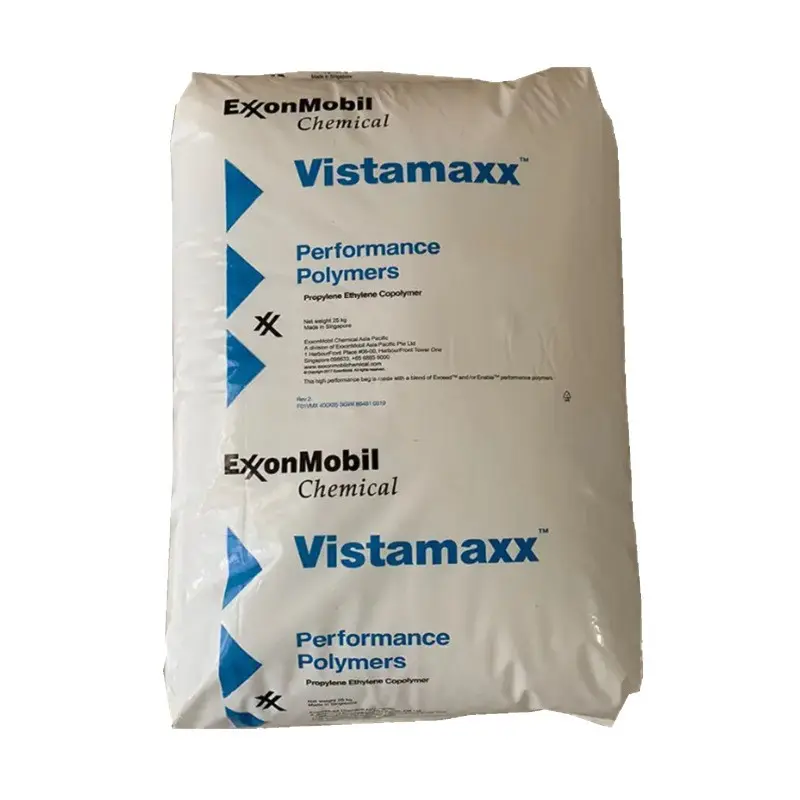
- Structure: A metallocene elastomer with an isotactic polypropylene backbone and randomly distributed ethylene comonomer units, classified as a propylene-based elastomer (PBE).
- Characteristics: Its crystallinity lies between that of amorphous elastomers and semi-crystalline PP, retaining part of PP’s rigidity and processability while providing rubber-like flexibility and resilience. It has excellent compatibility with PP, significantly improving impact toughness while also delivering a soft touch. A typical representative is ExxonMobil Vistamaxx™ 6202.
3. EPDM (Ethylene Propylene Diene Monomer)
- Structure: A terpolymer of ethylene, propylene, and a non-conjugated diene, with a small amount of unsaturated double bonds in the molecular chain.
- Characteristics: Excellent ozone, weathering, and aging resistance, together with good sealing and vibration-damping performance. However, conventional EPDM requires vulcanization, involves a complex processing flow, and its scrap is difficult to recycle directly; compatibility with PP generally relies on dynamic vulcanization (TPV) or compatibilization.
4. EVA (Ethylene-Vinyl Acetate Copolymer)
- Structure: A copolymer of ethylene and vinyl acetate (VA), containing polar acetate groups in the molecular chain; the VA content determines hardness and polarity.
- Characteristics: Low cost, abundant supply, and good foaming and bonding performance. However, its thermal stability and aging resistance are poor — it decomposes readily at high temperatures and yellows under prolonged sunlight — and its low-temperature toughening ability is weaker than that of POE.
Summary: POE and PBE are metallocene elastomers with saturated chains that can be processed directly by thermoplastic methods, offering clear advantages in processing and aging resistance; EPDM is a conventional rubber that requires vulcanization; EVA is a general-purpose copolymer with polar groups and a cost-first orientation. This structural difference directly determines the performance of the four systems in toughening efficiency, weathering, and processing.
Core Performance Comparison
The following is a horizontal comparison across six dimensions — toughening efficiency, low-temperature toughness, aging resistance, compatibility, recyclability, and cost (qualitative trend reference):
| Dimension | POE | Propylene-Based Elastomer (PBE) | EPDM | EVA |
| PP toughening efficiency | High | High (balanced rigidity and flexibility) | Medium (requires dynamic vulcanization) | Low |
| Low-temperature toughness | Excellent | Good | Good | Fair |
| Aging / weathering resistance | Excellent | Excellent | Excellent | Poor |
| Compatibility with PP | Excellent | Excellent | Requires compatibilization / vulcanization | Fair |
| Recyclability | Thermally recyclable | Thermally recyclable | Conventional: requires vulcanization, hard to recycle | Thermally recyclable |
| Relative cost | Medium | Medium | Medium-high | Low |
POE vs EPDM: The Essential Difference in Toughening Efficiency and Processability
POE and EPDM are both polyolefin-based elastomers, but their processing routes are entirely different. POE is supplied as free-flowing pellets that can be melt-blended directly with PP for uniform dispersion, offering short cycle times and recyclable scrap. Conventional EPDM, in contrast, requires mixing and vulcanization, a longer flow with higher energy consumption, and relies on dynamic vulcanization to form TPV when blended with PP. As a result, at the same loading, POE generally delivers higher PP toughening efficiency and more economical processing.
POE vs EVA: The Divide in Weathering and Low-Temperature Toughness
POE has a saturated molecular chain with no polar groups, so it resists yellowing and embrittlement under long-term outdoor exposure and offers excellent low-temperature toughness. EVA contains acetate groups and is prone to thermal decomposition and yellowing under high temperature and prolonged sunlight, with relatively limited low-temperature toughening ability. When a part requires long-term weathering or severe low-temperature impact, POE is clearly superior to EVA; EVA is cost-competitive only when cost is sensitive and weathering requirements are low.
POE vs PBE: Differentiating Two Metallocene Elastomers
POE and PBE both belong to metallocene-catalyzed elastomers, but their backbone structures differ. POE is ethylene-based, with stronger flexibility and low-temperature toughness; PBE has an isotactic PP backbone, delivering toughening while retaining higher rigidity, heat resistance, and a balanced soft touch, making it especially suited to injection-molded parts that require a combination of “toughening + soft touch + thin-wall high flow.”
Selection Framework for Different Operating Conditions
1. Low-Temperature Impact as the Priority
When parts must withstand impact in severely cold environments (e.g. automotive exteriors, cold-chain packaging, outdoor installations), prioritize POE grades with excellent low-temperature toughness, using high-octene-content grades to boost low-temperature impact strength.
2. Balanced Room- and Low-Temperature Performance + Thin-Wall High Flow
When parts have thin walls, long flow lengths, and require fast filling, together with soft touch and resilience, prioritize medium-high-flow propylene-based elastomers (PBE) (e.g. Vistamaxx™ 6202, with a melt index of about 20 g/10 min at 230 °C / 2.16 kg), balancing flow, softness, and toughening.
3. Toughening Polar Substrates (PA/ABS)
POE and PBE have saturated molecular chains and extremely low polarity, so they cannot directly toughen polar engineering plastics such as PA and ABS. Maleic anhydride grafting (e.g. POE-g-MAH) is required to introduce polar groups and achieve interfacial compatibility and effective toughening.
4. Cost-Sensitive Scenarios
When cost is the primary constraint and the part has low weathering and low-temperature requirements, EVA may be evaluated — but its limitations in aging resistance and low-temperature toughness must be recognized, and it should not be used to replace POE in outdoor or low-temperature applications.
Practical Processing and Sourcing Considerations
1. Melt Index and Dispersion
The melt flow rate of the toughening agent directly affects its dispersion uniformity in the PP matrix. Higher-melt-index grades promote rapid dispersion and shorten compounding time, but attention must be paid to the flash tendency that accompanies high flow; lower-melt-index grades offer higher melt strength and are better suited to extrusion profiles. Selection should be based on the target molding process (injection molding or extrusion) and the mold structure.
2. Loading Ratio and Cost Estimation
The loading ratio of elastomer for PP toughening is typically in the 10%–30% range: 5%–12% for room-temperature toughening alone, and 12%–20% or higher for demanding low-temperature impact conditions. The final ratio should be determined through small-batch trial molding based on target impact metrics and cost budget.
3. Supplier Screening and Compliance
Overseas buyers should focus on: ① whether complete technical documents such as original TDS, MSDS, and batch COA are available; ② whether the material meets substance-restriction requirements such as EU REACH and RoHS; ③ whether batch traceability is in place. Small-sample validation of dispersion uniformity and final mechanical performance is recommended before bulk purchasing.
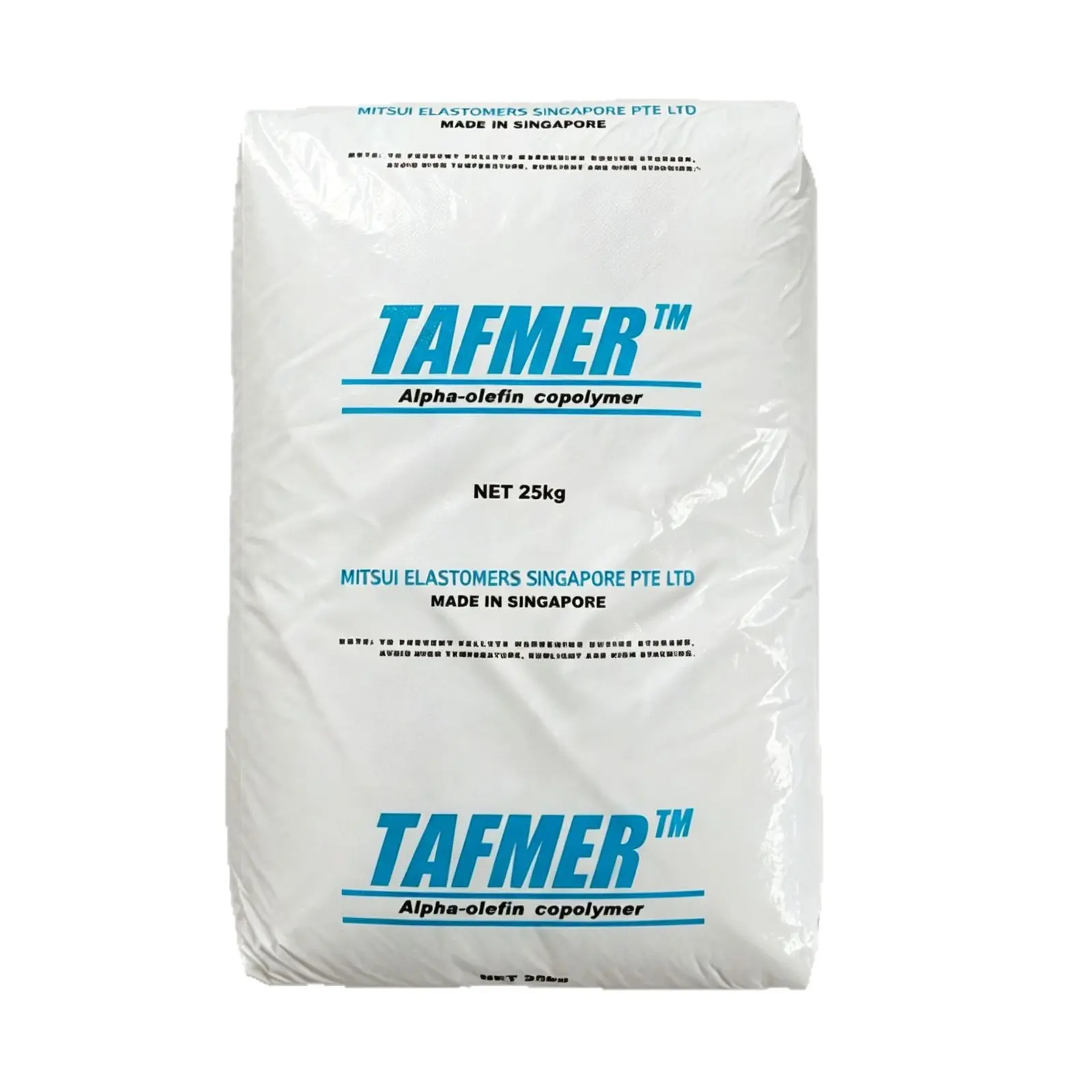
TaiKuo New Materials has long supplied the full range of POE polyolefin elastomers, covering mainstream products such as ExxonMobil Vistamaxx™, Mitsui TAFMER™, LG Chem Lucene™, and Dow Engage®, and provides one-stop selection support for polypropylene (PP) and elastomers & TPE materials.
Frequently Asked Questions (FAQ)
Q1: Can POE directly toughen PA or ABS?
A: No. POE has a saturated molecular chain and extremely low polarity, so it is poorly compatible with polar engineering plastics such as PA and ABS, and direct blending cannot form an effective interfacial bond. Maleic anhydride grafting (e.g. POE-g-MAH) is required first to introduce polar groups before interfacial compatibility and effective toughening can be achieved.
Q2: How should I choose between POE and propylene-based elastomer (PBE)?
A: Both are metallocene elastomers with different positioning. If low-temperature impact toughness is the primary goal and high flexibility is required, choose POE. If you need to retain higher rigidity, heat resistance, and a soft touch while toughening, and the part is a thin-wall, high-flow injection-molded component, choose a propylene-based elastomer (PBE) such as the Vistamaxx™ series.
Q3: How much rigidity and strength will be sacrificed by adding elastomer for toughening?
A: While improving impact toughness, elastomer toughening usually reduces the flexural modulus, tensile strength, and heat resistance of the part to some extent. The extent of the sacrifice depends on the elastomer type, loading ratio, and dispersion state. A balance between “toughening target” and “rigidity retention” must therefore be struck by adjusting the loading ratio (10%–30%) and grade matching.
Q4: Does the toughening agent require drying? How can dispersion be verified?
A: Polyolefin-based elastomers such as POE and PBE have extremely low moisture absorption and generally require no forced drying; however, after high-humidity or prolonged storage, drying at 60–80 °C for 2–4 hours is recommended. Dispersion can be verified by observing whether elastomer agglomeration appears on the part surface and by testing the batch-to-batch stability of impact strength, with scanning electron microscopy (SEM) observation of the dispersed-phase morphology as an optional supplementary check.