Introduction
Polyethylene (PE) is the world’s most consumed thermoplastic resin, categorized into three main types: LLDPE, HDPE, and LDPE. It is widely used in packaging films, pipes, agricultural films, and injection-molded containers. Global PE spot, FOB/CIF prices remain in a state of high volatility, with raw material costs accounting for over 60% of the total cost of downstream products. Price fluctuations directly impact the procurement margins of global plastic processors and traders. Relying on public data from the IEA, S&P Commodity Insights, and international petrochemical industry associations, this article objectively breaks down the core variables driving PE price changes, outlines the underlying logic of market operations for global foreign trade buyers, and ensures content is data-traceable, neutral, and objective, in accordance with Google’s E-E-A-T professional content standards.
Upstream Raw Material Costs: Determining the Long-term Price Anchor
PE monomer ethylene is generated through the cracking of three types of raw materials: crude oil, ethane, and coal. Cost transmission has a strong linear correlation and serves as the core underlying driver of prices.
International Crude Oil and Naphtha Route
The transmission path of the oil-based PE industry chain is: Crude Oil → Naphtha → Ethylene → PE, with a price correlation coefficient as high as 0.87. As the core production region for global crude oil and naphtha, the Strait of Hormuz handles over 20% of global oil and gas shipping. Geopolitical conflicts can rapidly drive up crude oil risk premiums, leading to a synchronous rise in global PE prices. Conversely, after geopolitical tensions ease, the retreat of crude oil prices quickly releases cost-side pressure, causing PE prices to decline simultaneously.
Ethane Light Hydrocarbon Route (Middle East, North America)
The production costs for ethane from North American shale gas and Middle Eastern associated gas are significantly lower than those for naphtha. The ex-factory price of PE via this route is consistently 35%-40% lower than oil-based PE, making it the primary source of low-cost supply globally. Disruptions in ethane export shipping or planned maintenance at gas fields can directly tighten the supply of low-cost overseas PE, driving up CFR import quotes across various global regions.
Coal-to-Olefins Route (China’s Regional Characteristic Capacity)
China possesses the world’s largest coal-to-olefins production capacity cluster. The production cost of this route is directly linked to thermal coal prices, forming a cost-hedging logic independent of international crude oil. During periods of sharp increases in international crude oil, Chinese coal-based PE supply can mitigate the extent of spot price hikes in the Asia-Pacific region; if thermal coal prices rise, the overall cost support for PE in the Asia-Pacific region will increase synchronously.
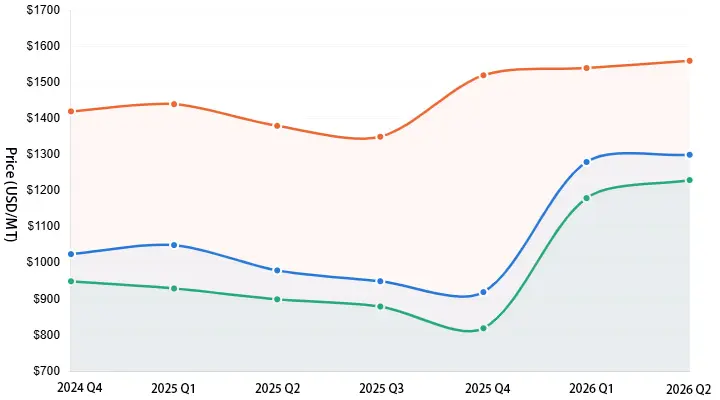
Global Supply and Demand Pattern: The Core Variable for Mid-to-Long Term Price Trends
By 2026, total global PE capacity surpassed 135 million tons, with approximately 8-9 million tons of new capacity added throughout the year. New capacity is concentrated in China’s integrated refining and chemical bases and Middle Eastern export-oriented units, shifting the market overall from a tight supply-demand balance to structural easing.
Supply-side Factors
- Centralized Maintenance: Annual planned maintenance of global crackers and PE polymerization units can periodically contract circulating supply, driving up spot prices in the short term; after the maintenance cycle ends and supply recovers, prices face pressure to decline.
- Pace of New Capacity Launch: During periods when new units in China and the Middle East are launched, global circulating supply exceeds demand, leading to long-term price weakness; if the ramp-up of capacity slows down, it provides support for regional quotes.
- Regional Trade Flows: Low-cost PE from the Middle East is exported to Southeast Asian and European markets over the long term; as China’s domestic capacity self-sufficiency continues to improve, the increase in domestic PE exports diversifies overseas import demand, suppressing regional CFR import quotes.
Demand Seasonality and Industry Differentiation
- Agricultural Film Demand: In the fourth quarter of each year, the peak preparation season for agricultural film in Southeast Asia and East Asia leads to a concentrated release of LLDPE demand, causing prices to rise periodically; during the summer off-season for agricultural film, demand weakens, and prices decline accordingly.
- Rigid Demand for Packaging and Pipes: Food packaging film and HDPE water supply pipes are constant, rigid demands, with price volatility lower than that of agricultural film categories; during off-seasons for consumption or manufacturing slowdown cycles, downstream processing plants only maintain small-batch, on-demand procurement, resulting in sluggish market transactions and weakening prices.
Inventory Levels
Factory inventory of petrochemical producers, port import transit inventory, and downstream processor raw material inventory collectively influence market trading sentiment. During periods of high inventory, traders take the initiative to lower prices to clear stock; when inventory is low, small amounts of concentrated replenishment can drive a short-term price rebound.
Geopolitics, Logistics, and Trade Policy: The Fuse for Short-term Violent Fluctuations
These factors do not change the long-term price anchor, but they are highly likely to cause sharp, large-scale increases or decreases in prices within a single day or week, making them the most critical unexpected variables for global foreign trade buyers to monitor.
Geopolitical Disturbances
Attacks on Middle Eastern oil and gas facilities, regional trade sanctions, or the blockade of core shipping lanes can directly trigger market supply panic, temporarily driving up risk premiums by 30%-50%; after conflicts subside, the premiums dissipate, and prices decline rapidly.
Global Shipping and Logistics Costs
Global PE cross-border trade relies entirely on ocean shipping. Congestion on shipping routes, container shortages, and shipping restrictions in the Red Sea/Persian Gulf can prolong cargo arrival cycles, causing localized spot shortages and driving up local spot prices; significant increases in shipping costs also directly raise the overall CFR import cost in all regions.
Tariffs and Import/Export Controls
Adjustments in national import and export tariffs, controls on recycled plastics, and petrochemical product export quota policies can alter regional supply-demand balances, causing cross-regional price gaps to widen continuously.
Differentiation Rules for Categories and Grades
There is no unified global market price for LLDPE, HDPE, LDPE, and Metallocene PE. The price difference between different categories remains at hundreds to thousands of dollars per ton all year round, with fixed differentiation logic:
LDPE, due to its unique long-chain branching structure, provides products with excellent processing performance and high transparency, making it irreplaceable in high-end film applications. Market prices are influenced by its supply-demand match and downstream application value, often creating a differentiated price gap with LLDPE;
HDPE is subdivided into hollow, drawing, pipe, and injection molding special materials. Pipe-grade PE100, due to its stringent performance standards, is priced higher than general-purpose drawing grades;
Metallocene PE is a high-end modified raw material. Some high-end grades have a high proportion of overseas supply, and prices are significantly higher than ordinary LLDPE;
Within the same category, there are fixed price differences between brand-new virgin pellets, off-grade materials, and recycled blends. Buyers can match corresponding raw materials according to the compliance requirements of terminal products to control production costs.
Overall Characteristics of the 2026 Global PE Market
Normalization of Cost-side Volatility: A parallel multi-raw material production system involving crude oil, ethane, and coal, with overlapping variables shortening the price fluctuation cycle;
Structural Easing of Capacity: Global new capacity is continuously released, with regional supply shortages only occurring during the peak season for agricultural film and periods of centralized maintenance;
Long-term Existence of Regional Price Gaps: Low-cost ethane-based materials from the Middle East, coal-based materials from China, and high-cost oil-based materials from Europe and the US form a three-tier cost ladder, providing global buyers with diversified source options;
Cautious Downstream Procurement: Global manufacturing profits are under pressure, and downstream enterprises generally abandon large-scale long-term stockpiling. On-demand, just-in-time procurement has become the mainstream, weakening the sustainability of unilateral, sharp price increases.
Reference Points for Cost Risk Control for Global Foreign Trade Buyers
Long-term Order Planning: Anchor to the long-term contract prices of crude oil and ethane, sign quarterly long-term orders, and avoid short-term monthly price fluctuations;
Seasonal Inventory Planning: Avoid high-price intervals during the agricultural film peak season, stock up appropriately during the off-season of demand, and reduce unit raw material procurement costs;
Diversification of Supply Channels: Simultaneously connect to supply sources from the Middle East, China, and North America, and use regional price gaps to hedge against the risk of price hikes in a single production area;
Grade Substitution Assessment: Within the scope allowed by product performance standards, select generic, affordable grades with matching performance to optimize procurement expenditure.