PA6 vs PA66 : Properties, Processing and Application Selection
Wang Mingjian
Two Nylons, One Family: How Chemistry Sets the Performance Divide
PA6 and PA66 are both semi-crystalline engineering nylons, but they are built along completely different polymerisation routes.
PA6 (nylon 6): produced by ring-opening polymerisation of caprolactam — a single monomer. The repeat unit contains six carbon atoms, and the amide groups along the chain are comparatively loosely arranged.
PA66 (nylon 66): produced by first forming a salt from adipic acid and hexamethylenediamine, then polycondensing it — a two-monomer system. Each repeat unit carries six carbon atoms on either side of the amide group, giving a more regular chain and a higher density of hydrogen bonding between adjacent chains.
Two consequences follow, and they underpin every difference discussed below:
Higher crystallinity and faster crystallisation (PA66) → higher strength, stiffness, melting point and heat resistance;
The denser hydrogen bonding also gives PA66 a comparatively lower tendency to absorb moisture and better dimensional stability, while PA6’s more mobile chain segments deliver better toughness (especially low-temperature impact) and a wider processing window.
Core Property Comparison (Dry vs Conditioned)
Nylon properties are highly sensitive to moisture content, so any comparison must state the test condition:
Dry as moulded (DAM): the state after moulding and drying;
Conditioned: equilibrium at 23 °C / 50 % RH, or the state reached after accelerated conditioning to ISO 1110.
PA6 vs PA66 — typical key properties
Property
PA6
PA66
Engineering implication
Melting point
approx. 215–225 °C
approx. 255–265 °C
Sets the short-term heat ceiling and melt processing window
Crystallinity / crystallisation speed
lower / slower
higher / faster
Affects the strength-stiffness ceiling and cycle time
Density
approx. 1.13 g/cm³
approx. 1.14 g/cm³
Comparable; similar lightweighting potential
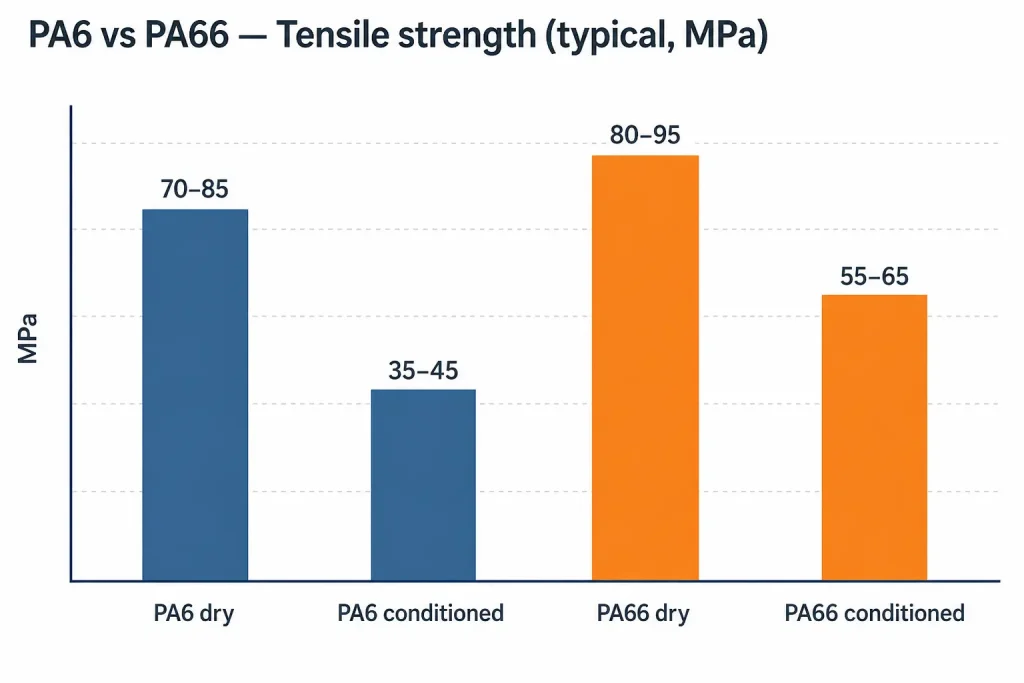
Tensile strength (dry)
approx. 70–85 MPa
approx. 80–95 MPa
PA66 is stronger in the dry state
Tensile strength (conditioned)
approx. 35–45 MPa
approx. 55–65 MPa
The gap widens after conditioning
Notched impact toughness
higher; advantage grows at low temperature
lower
Choose PA6 for impact-dominated loads
Rockwell hardness
approx. M80–85
approx. M85–90
PA66 generally offers better wear performance
Equilibrium moisture absorption (23 °C / 50 % RH)
approx. 2.5–3.0 %
approx. 1.5–2.5 %
The core variable for dimensional and property stability
Heat deflection temperature (unfilled)
lower
higher
High-temperature structural parts favour PA66
Chemical resistance
Neither resists strong acids, strong bases or certain phenolic media; differences come mainly from the grade system (e.g. hydrolysis- or alcohol-resistant modifications)
Verify case by case against the specific medium
Values above are typical industry ranges, given to convey trend and order of magnitude. Actual selection must be based on the specific grade’s technical data sheet (TDS) and on data measured under the applicable test standards.
Moisture: The First Variable in Nylon Selection
In nylon systems, moisture content often influences performance more than the difference between grades.
Mechanism: water molecules form hydrogen bonds with amide groups and act as a plasticiser — stiffness and strength fall, toughness and dimensions rise.
Uptake difference: PA6 absorbs markedly more moisture than PA66 (typically 2.5–3.0 % vs 1.5–2.5 % at 23 °C / 50 % RH).
Dimensional change: each 1 % of absorbed moisture grows dimensions by roughly 0.2–0.3 % — a magnitude that cannot be ignored in precision fits.
Property reversal: in the dry state PA66 leads clearly on strength and stiffness; after conditioning, PA6’s toughness advantage narrows and its stiffness drops further, while PA66 retains relatively higher strength and stiffness.
Engineering implication: for humid environments or tight dimensional requirements, design against conditioned data; where PA6 must be used in high humidity, evaluate low-absorption grades or compensate for swelling through part design.
Processing Window Differences
Melt temperature: PA6 typically around 230–260 °C; PA66 typically around 280–300 °C; glass-fibre grades generally run at the upper end (PA66-GF can reach about 285–305 °C). PA66 is more sensitive to barrel temperature and residence time and degrades more readily when overheated (follow the grade TDS).
Drying: both must be dried to below 0.1 % moisture before moulding (some grades specify < 0.15 %), and the requirement for PA66 is usually stricter. Drying temperature and dew-point control (typically −20 °C or lower) directly determine part appearance and mechanical performance.
Mould temperature and crystallisation: mould temperature governs crystallinity and post-mould shrinkage. PA6 typically runs at about 80–90 °C and PA66 at about 80–100 °C, with glass-fibre grades raised to 100–120 °C. PA66 crystallises faster, so cycle times are usually shorter.
Shrinkage: unfilled PA6 about 0.8–1.5 %, unfilled PA66 about 1.0–2.0 %; glass-fibre reinforcement reduces this to roughly 0.3–0.8 % in the flow direction while introducing anisotropic shrinkage and warpage — part design must follow the flow direction.
Regrind: repeated recycling lowers molecular weight and impact performance; control the regrind ratio and verify properties batch by batch.
Grade Differences Often Outweigh Resin Differences
For a real project, “PA6 or PA66” is only the first decision — the reinforcement and modification system is frequently the decisive second one.
Typical values for 30 % glass-fibre grades
Property
PA6-GF30
PA66-GF30
Tensile strength
approx. 160–190 MPa
approx. 180–210 MPa
Heat deflection temperature (1.82 MPa)
approx. 200–220 °C
approx. 250–255 °C
PA66’s heat advantage is amplified further by glass-fibre reinforcement; 50 % glass-fibre grades can exceed 200 MPa in tensile strength.
Common modification directions: impact modification (low-temperature toughness), flame retardancy (UL 94 V-0, halogenated and halogen-free systems), hydrolysis and alcohol resistance, weathering (UV stabilisation), heat stabilisation (long-term high temperature) and food-contact grades (subject to the applicable regulations and certifications).
Conclusion: start from the grade data sheet, not from typical values for the PA6/PA66 base resins.
Application Mapping and Substitution Logic
Typical PA6 applications: gears, bearing cages, cable ties, films and monofilament, power-tool housings and consumer goods — the advantage lies in toughness, wear behaviour and cost efficiency.
Temperature: PA66’s long-term heat ceiling is typically around 15–20 °C higher than PA6’s; where continuous service temperature approaches or exceeds the PA6 limit, substitution is not advisable;
Humidity and dimensional precision: in humid conditions with tight fits, PA6’s moisture-related swelling is the main risk;
Load and creep: for continuously loaded, stiffness-critical structures, evaluate conditioned creep data;
Certification inheritance: where UL Yellow Card, food-contact or similar approvals apply, a material change requires re-confirming the scope of the certificate.
PA6 is often the economical alternative to PA66 where humidity is controlled, temperatures are moderate and cost matters (for example certain gears, cable ties and housings); for high-temperature structural parts, connectors and precision parts in humid environments, PA66 — usually a glass-fibre grade — remains the more reliable choice.
Selection Checklist
Service environment: peak and continuous temperature, humidity, contact media, outdoor exposure;
Validation: comparative mechanical and thermal testing to ISO/ASTM, together with UL certification and ageing, hydrolysis and heat-ageing trials;
Mould trials and batch consistency: verify shrinkage, warpage and batch-to-batch variation.
FAQ
1. Is PA66 always stronger than PA6?
On dry-state strength, stiffness and heat resistance, PA66 is usually higher. On impact toughness — especially at low temperature and after conditioning — and on processing tolerance, PA6 often wins. The answer depends on the property and the test state; there is no single “stronger” material.
2. Can PA6 and PA66 be swapped directly?
Not without validation. Melting point, moisture absorption, shrinkage and certification coverage all differ. Substitution requires re-assessing tooling and process windows and confirming approval inheritance (for example UL Yellow Cards).
3. Which absorbs more moisture?
PA6 has the higher equilibrium moisture absorption (typically 2.5–3.0 % vs 1.5–2.5 %), so dimensional change and stiffness loss are usually more pronounced. PA66 offers better dimensional stability in humid conditions.
4. Do these differences still matter with glass fibre? Yes — and some are amplified. For example, PA66-GF30 has a substantially higher heat deflection temperature than PA6-GF30. Glass-fibre orientation also introduces anisotropic shrinkage and warpage, so parts must be designed along the flow direction.
5. Where does the cost difference come from?
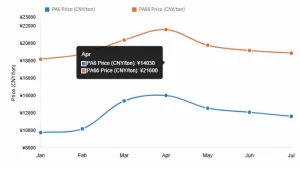
Mainly the monomer supply structure: PA6 is produced from a single raw-material route (caprolactam) with a shorter process chain, while PA66 requires two systems — adipic acid and hexamethylenediamine — with less supply flexibility and typically greater price volatility. As a result, PA66 usually sits above PA6 on price; the actual spread varies with the market cycle and should be assessed against current quotations.
Conclusion
Choosing between PA6 and PA66 is essentially a trade-off between heat resistance and stiffness (PA66) on one side, and toughness, processing tolerance and cost efficiency (PA6) on the other — with moisture absorption the variable that amplifies or narrows that trade-off. In engineering practice the sequence is consistent: define the service environment (temperature, humidity, media) and load case first, screen the feasible grade range using conditioned data, then lock the final grade through mould trials and batch validation.
I’m Wang Mingjian, a product specialist at TK Plastics. I bridge the gap between global manufacturers and premium resin supplies. With deep industry insights and a robust supply chain, I help you overcome sourcing challenges and optimize costs. My goal here is to provide transparent market intelligence to support your key commercial decisions.
Finding the right polymer or plastic resin supplier?
Looking for plastic polymer or plastic resin from top polymer companies? As a reliable distributor, we offer a wide range of branded polymer to meet your needs. Share your requirements (material type, brand, quantity, packaging), and we’ll provide a fast, competitive quote.
Looking for specific polymer grades, compounding, or tailored shipping terms? Send us your requirements and uploaded files, and let our product experts handle the rest.