Product Overview & Key Features
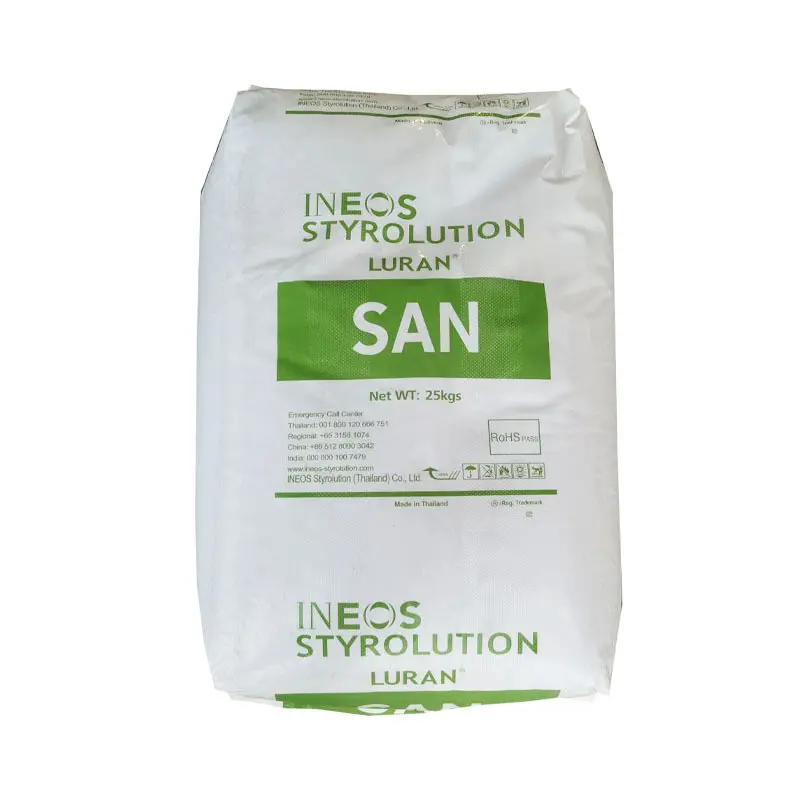
- Manufacturer: INEOS Styrolution
- Grade: C552485
- Category: SAN (Styrene-Acrylonitrile Copolymer)
- Appearance: Transparent / Pale amber pellets, rigid, high surface gloss, delivering clear optical transparency.
INEOS Styrolution C552485 is a purpose-built, injection molding grade SAN homogeneous copolymer. Compared to general-purpose PS (GPPS), the incorporation of acrylonitrile units in SAN significantly enhances rigidity, chemical resistance, and thermal stability; compared to ABS, the absence of the butadiene rubber phase delivers higher transparency and superior surface hardness, albeit at the expense of lower notched impact strength. Featuring a tensile stress at yield of 68 MPa, flexural modulus of 3,800 MPa, and Rockwell hardness of R 126, C552485 represents a benchmark high-rigidity transparent engineering thermoplastic.
Within INEOS Styrolution’s SAN product matrix, C552485 is tailored for injection molding applications demanding aesthetic clarity, dimensional precision, and resistance to household chemicals, where extreme impact resistance is not required. For purchasing agents and structural engineers, its value proposition centers on fully traceable technical data, a stable processing window, and consistent lot-to-lot quality, enabling standardized mass production across transparent daily housewares, laboratory consumables, and clear appliance components.
Technical Specifications
Physical Properties
| Property | Test Condition | Value / Unit | Test Standard |
| Melt Volume-Flow Rate (MVR) | 220 ℃, 10 kg | 23 cm³/10 min | ISO 1133 |
| Rockwell Hardness | R Scale | 126 | ISO 2039-2 |
Mechanical Properties
| Property | Test Condition | Value / Unit | Test Standard |
| Tensile Stress at Yield | — | 68 MPa | ISO 527 |
| Tensile Modulus | — | 3,700 MPa | ISO 527 |
| Flexural Modulus | — | 3,800 MPa | ISO 178 |
| Izod Impact Strength, Notched | 23 ℃ | 2 kJ/m² | ISO 180/A |
| Tensile Strain at Break | — | 3.2 % | ISO 527 |
| Flexural Strength | — | 111 MPa | ISO 178 |
Thermal Properties
| Property | Test Condition | Value / Unit | Test Standard |
| Vicat Softening Temperature | 50 N, 50 ℃/h (VST/B/50) | 102 ℃ | ISO 306 |
| Deflection Temperature Under Load (HDT) | 1.80 MPa, unannealed | 96 ℃ | ISO 75 |
Notice: The technical specifications for INEOS Styrolution C552485 provided herein are compiled from data published by INEOS Styrolution or certified third-party testing laboratories. While prepared with professional diligence, these values serve as reference guidelines rather than absolute performance guarantees. Because molding and processing conditions vary significantly across operational environments, we recommend performing trial runs with C552485 under your actual manufacturing conditions prior to final material selection and mass production.
Features & Benefits
- High Transparency & High Surface Hardness: Inherent light transmittance superior to ABS paired with a Rockwell hardness of R 126 provides molded parts with a crystal-clear aesthetic and light scratch resistance, ideal for visual structural elements and aesthetic covers.
- High Rigidity & Dimensional Stability: Tensile modulus of 3,700 MPa and flexural modulus of 3,800 MPa ensure excellent part stiffness and low creep, maintaining tight dimensional tolerances in thin-walled and precision parts.
- Superior Chemical Resistance vs. PS: Acrylonitrile content improves resistance to oils, greases, detergents, and weak polar solvents, making it suitable for kitchen, bathroom, laboratory, and appliance contact environments.
- Moderate Processing Flowability (23 cm³/10min): Well-defined melt volume rate enables stable mold filling and predictable demolding performance for multi-cavity and medium-complexity injection molds.
- Thermal Performance Superior to General-Purpose PS: Balanced rigidity and heat resistance withstand temperature rises within home appliance housings while maintaining structural stability under non-prolonged elevated temperatures.
Typical Applications
- Household & Kitchen Appliances: Transparent measuring cups, seasoning jars, blender jugs, coffee maker/water dispenser clear components—leveraging clarity, detergent resistance, and high stiffness.
- Laboratory & Medical Consumables: Test tube racks, reagent bottles, petri dish housings, and non-sterile observation parts (subject to manufacturer compliance documentation).
- Appliances & Consumer Electronics: Shaver clear guards, toothbrush handle transparent grips, small appliance control panels, instrument display windows, and button faceplates.
- Office & Industrial Products: Clear binder components, stationery casings, equipment viewing windows, and low-voltage non-load-bearing transparent covers.
- Packaging & Displays: Cosmetic container liners, retail display props, and lightweight transparent packaging containers.
Frequently Asked Questions (FAQs)
Q1: Is pre-drying mandatory before processing C552485? What happens if it is not dried?
A1: Pre-drying is recommended. Although SAN is not as moisture-sensitive as PA or PET, residual moisture vaporizes under high-barrel shear, causing silver streaks, bubbles, surface haze, or micro-degradation. Inadequate drying primarily impairs visual clarity and surface finish while causing a slight rise in reject rates, even if impact on mechanical rigidity is minimal.
Q2: How do I select between C552485 (SAN), ABS, and PMMA?
A2:
- vs. ABS: SAN is clearer, harder, and more chemically resistant, but has significantly lower notched impact strength; ABS is preferred for impact-loaded structural parts, whereas SAN is suited for clear rigid shells and aesthetic components.
- vs. PMMA: PMMA offers superior light transmittance and weatherability but is more brittle with a narrower processing window; SAN is easier to injection mold and more cost-effective for general transparent rigid parts.
- Selection Logic: Choose SAN for clarity + hardness + ease of processing; choose ABS for impact resistance; choose PMMA for optical-grade transparency + outdoor weatherability.
Further reading: the SAN vs ABS vs PMMA injection molding comparison — a side-by-side table of transparency, impact, chemical and heat resistance, three material selection rules, five application scenarios, and the cost gap behind each choice.
Q3: Can this grade be used for food contact or medical applications?
A3: C552485 is a standard injection molding grade SAN and does not carry default food contact or medical certifications. If the end application involves food/beverage contact or medical devices, relevant regulatory compliance statements (such as FDA, EU 10/2011, USP) must be requested from the manufacturer, and migration testing on final molded articles must be completed. Material transparency alone does not imply regulatory compliance.