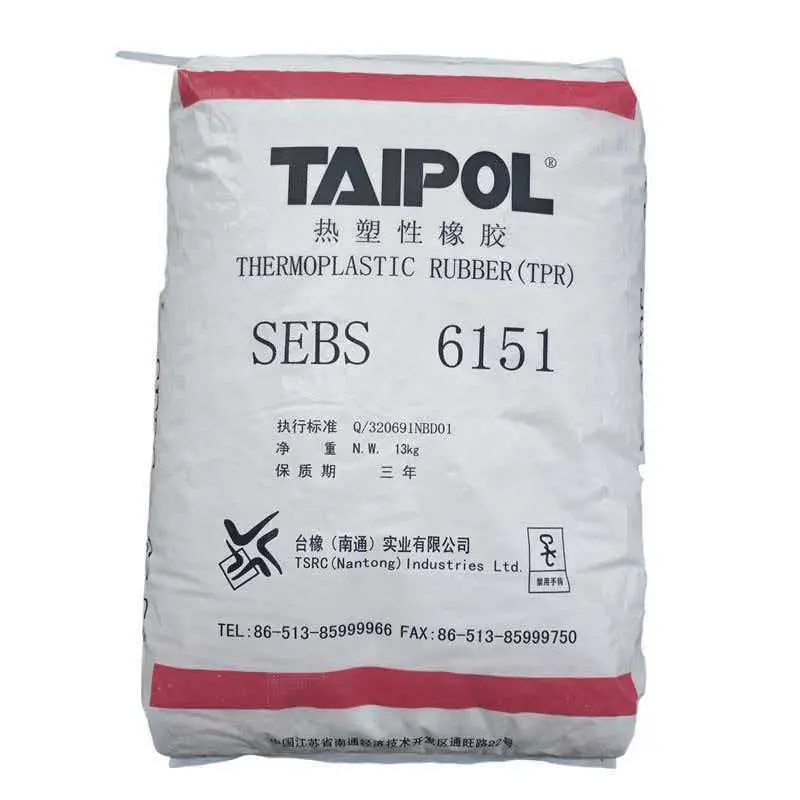
Product Overview & Key Features
Manufacturer: TSRC Corporation (Taipei/Kaohsiung, Taiwan; production sites in Taiwan and Nantong, China)
Product Series: TAIPOL® SEBS hydrogenated styrenic block copolymer series, part of the Elastomers & TPE material family supplied by TaiKuo and listed under the SEBS resin category
Material Classification: TAIPOL® SEBS 6151 (official designation: TAIPOL SEBS-6151) is a linear styrene-ethylene/butylene-styrene block copolymer produced by solution polymerization. Its mid-block is fully hydrogenated and the polymer chain contains no unsaturated double bonds, which is the structural reason this grade differs from conventional SBS thermoplastic elastomers in weathering and heat-ageing behaviour. Bound styrene content is 31–34%, placing the grade in the higher-styrene, high-molecular-weight segment of the TAIPOL SEBS series. The stabilizer system is non-staining, and specific gravity is approximately 0.91 (ASTM D-792, typical).
Core Performance Advantages
- Weathering and heat-ageing resistance: The fully saturated, hydrogenated backbone resists UV, ozone and thermal-oxidative ageing, making the grade suitable for long-term outdoor exposure and continuously heated service conditions.
- Structural strength and durability: The high molecular weight delivers high melt strength and tensile strength, together with elastic recovery and tear resistance under load, which suits formulations requiring cohesive strength.
- Compatibility with polyolefins: Good compatibility with polyolefin matrices such as PP and PE allows use as a plastic modifier and compatibilizer to improve impact toughness and low-temperature performance of the base resin.
- Oil absorption and oil-extension capability: High absorption capacity for naphthenic and paraffinic process oils allows hardness and flow behaviour to be adjusted flexibly through oil extension.
- Purity and exudation control: Volatile matter ≤0.5%, ash (w/o AB) ≤0.2% and gel ≤0.1% help control processing odour and surface exudation risk.
- Processing stability: The hydrogenated SEBS structure remains stable at processing temperatures up to 250 ℃, compatible with conventional thermoplastic melt-processing routes.
Main Compatible Processing Methods: Solvent dissolution (solvent-based adhesive preparation), hot-melt coating, twin-screw compounding and pelletizing, extrusion, and injection moulding.
Technical Specifications
General Information
| Item | Description |
|---|---|
| Polymerization System | Solution polymerization; styrene ethylene/butylene block copolymer |
| Stabilizer | Non-staining |
| Structure | Linear / high molecular weight |
Polymer Properties
| Property | Unit | Min | Max | Typical | Test Method |
|---|---|---|---|---|---|
| Bound Styrene | % | 31 | 34 | — | TDM-02 |
| YI | — | — | 4.0 | — | TDM-04 |
| Volatile Matter | % | — | 0.5 | — | TDM-03 |
| Ash (w/o AB) | % | — | 0.2 | — | ASTM D-5667 |
| Ash (w/AB) | % | — | 1.0 | — | ASTM D-5667 |
| Gel | % | — | 0.1 | — | TDM-05 |
| Toluene Sol. Vis. (10 wt%, 25 ℃) | cP | — | — | 1700 | TDM-06 |
| Specific Gravity | — | — | — | 0.91 | ASTM D-792 |
Note on flow behaviour: The official TSRC data sheet specifies toluene solution viscosity (10 wt% in toluene at 25 ℃, typical 1700 cP) as the flow-control parameter for this grade, and does not list a melt flow rate (MFI) value. TSRC states in its SBC grade handbook that melt flow for the TAIPOL range is measured at 190 ℃ / 5 kg; please confirm the current value against the latest original TDS. For downstream formulation work, solution viscosity is therefore recommended as the primary indicator of batch-to-batch consistency.
Notice The technical specifications for TSRC Taipol® SEBS 6151 provided herein are compiled from data published by TSRC Corporation or certified third-party testing laboratories. While prepared with professional diligence, these values serve as reference guidelines rather than absolute performance guarantees. Because molding and processing conditions vary significantly across operational environments, we recommend performing trial runs with SEBS 6151 under your actual manufacturing conditions prior to final material selection and mass production.
Applications & Processing Guidelines
Typical Applications
- Plastic modification (toughening and compatibilization): Used as a modifying component in PP resin and PE matrices to improve impact toughness, low-temperature toughness and weathering resistance and to correct brittleness defects. It also acts as a compatibilizer between polyolefins and polystyrene-based or engineering thermoplastics in blend systems. Typical output: modified pellets for appliance parts, automotive interior components and tool housings.
- Hot-melt adhesives and HMPSA: Acts as the base polymer in hot-melt systems, contributing cohesive strength and heat-resistant creep performance for tape coating, packaging hot melts and assembly adhesives. The high melt strength resulting from the high molecular weight is the key value point in this application.
- Elastomeric compounds (TPE compounds): Oil-extended for soft-touch products, grips, sleeves and gasket-type elastic parts, balancing elastic recovery, compression set performance and surface feel.
- Sports goods and other compounding products: TSRC’s earlier technical documentation also lists sports goods and other compounding products among the intended uses of this grade.
Processing Key Points
- Drying: SEBS has low moisture absorption, so virgin material in unopened factory packaging normally requires no pre-drying. If material has been stored open, shows condensation or has visibly absorbed moisture, drying at 80–90 ℃ for 2–4 hours is recommended to reduce bubbles, silver streaks or poor bonding. Confirm actual drying parameters against local humidity and equipment conditions.
- Processing temperature: Hydrogenated SEBS is stable at processing temperatures of 250 ℃; a range of 190–250 ℃ is recommended. Because 6151 is a high-molecular-weight grade, its melt viscosity is comparatively high. Take the upper part of the temperature range and improve flow through appropriate oil extension or screw design rather than relying on temperature alone, which increases the risk of thermal degradation.
- Screw and shear control: In twin-screw compounding, a medium-to-high screw speed with moderate back pressure supports uniform dispersion. Avoid prolonged combined temperature and shear loading, which degrades the polymer chain; establish a stable process window through gradient trials.
- Oil extension and filling: The grade absorbs oil readily; naphthenic or paraffinic process oils can be used to reduce system hardness and improve processing flow, and compatibility with mineral fillers is good. Oil ratio and filler loading must be determined by gradient trials to avoid mechanical loss or surface exudation caused by over-filling.
- Formulating hot-melt adhesives: The high molecular weight provides high cohesive strength together with high melt viscosity. For high-speed coating or low-viscosity application requirements, the grade is normally blended with a lower-molecular-weight grade or oil-extended to balance coatability against cohesion.
- Trial before mass production: Equipment, temperature parameters and formulation ratios all significantly affect finished-part performance. Complete a small-batch trial run before formal mass production to verify mechanical properties, appearance and batch stability.
Grade Comparison & Selection Guide
Comparison Within the TAIPOL SEBS Series
The table below is likewise compiled from TSRC official grade data sheets and shows where each grade sits in the TAIPOL SEBS performance matrix.
| Parameter | TAIPOL SEBS 6151 | TAIPOL SEBS 6154 | TAIPOL SEBS 6150 | TAIPOL SEBS 6152 |
|---|---|---|---|---|
| Bound Styrene (%) | 31–34 | 31–34 | 27.5–30.5 | 27.5–30.5 |
| Molecular Weight Level | High | Medium | Medium | Low |
| Toluene Sol. Vis. (10 wt%, 25 ℃) | 1700 cP (typical) | Not listed in TDS | Not listed in TDS | Not listed in TDS |
| Specific Gravity | 0.91 | 0.91 | 0.91 | 0.91 |
| Hardness / modulus tendency | Higher | Higher | Lower | Lower |
| Flow and processability tendency | Lower | Medium | Medium | High |
| Cohesive strength and creep resistance tendency | High | Medium-high | Medium | Lower |
| Officially specified applications | Plastic modification, hot-melt adhesives (HMA), elastomeric compounds | Plastic modification, asphalt modification, toys, industrial and sports compounding goods | Plastic modification, asphalt modification, toys, industrial and sports compounding goods | Plastic modification, hot-melt adhesives (HMA), elastomeric compounds |
Note: “hardness / modulus tendency”, “flow tendency” and “cohesive strength tendency” are relative directional judgements derived from the styrene-content / molecular-weight versus property relationships stated in TSRC’s SBC technical literature (higher styrene content raises hardness, tensile properties and compression set while reducing softness and processability; higher molecular weight raises high-temperature performance, tensile properties and melt strength while reducing processability and transparency). They are not measured values and are intended for selection direction only.
Position of 6151 in the matrix: Among the four established grades 6150 / 6151 / 6152 / 6154, 6151 combines high molecular weight with higher styrene content. It therefore occupies the “strength and durability first” end of the series: cohesive strength, creep resistance and heat performance are at the high end, at the cost of the lowest flow. 6152 occupies the opposite “flow and processability first” end, while 6150 and 6154 sit in between. 6154 shares 6151’s styrene content but has a medium molecular weight, making it the easier-processing alternative at the same hardness level.
Cross-Brand Reference
A cross-brand benchmark among hydrogenated SEBS grades is Kraton KRATON® G1650 E SEBS: also a linear hydrogenated SEBS with 28–31% styrene content and a medium-high molecular weight position, oriented similarly to 6151 toward strength and weathering performance. Note in particular that the two solution-viscosity figures are measured on different bases — 6151 at 10 wt% in toluene and G1650 E at 20 wt% in toluene — so the values cannot be compared directly; re-test on a common basis before drawing conclusions.
Selection Guidance for Engineers
- By wall thickness and flow length: Thin-wall parts, long flow paths, multi-cavity tools or restricted gate sizes make flow the primary constraint — evaluate 6152 (low molecular weight) or 6150 / 6154 (medium molecular weight) first. Thick-wall parts are less flow-sensitive and can treat 6151 as a first choice.
- By mechanical load requirement: For long-term load-bearing, creep-resistant and tear-resistant parts (load-bearing elastomeric components, soft structural parts under dynamic fatigue), the high molecular weight of 6151 translates directly into advantage. For soft-touch parts with modest load requirements, 6150 / 6152 give better cost and processing control.
- By heat resistance and compression set requirement: Where higher service temperature or lower compression set is required, the high-molecular-weight, higher-styrene direction of 6151 is preferable. Where low-temperature softness and elastic recovery matter more, consider the lower-styrene 6150 / 6152.
- By process route: Where solvent-based adhesives or hot melts are the primary route, compare solution viscosity and melt viscosity above all. 6151 suits systems demanding high adhesive-layer cohesion and can be blended with 6152 to balance coatability. Where TPE parts are moulded directly by injection or extrusion, trial grades from highest to lowest flow first, then lock the grade against measured mechanical data.
- By formulation headroom: Formulations requiring heavy oil extension or high filler loading should retain a flow margin — avoid starting from a grade whose flow is already tight and then losing all adjustment room.
- General principle: Before locking any grade, complete a small-batch trial on your own equipment and tooling, and use measured mechanical properties, appearance and process stability as the final criteria.
FAQs
Q1: Does TAIPOL SEBS 6151 require drying before processing?
A: SEBS has low moisture absorption. Virgin material in unopened 25 kg factory packaging can normally be fed directly without pre-drying. Drying is recommended only where material has been stored open for a long period, has condensed during transport, or is visibly damp — for example 80–90 ℃ for 2–4 hours — to remove adsorbed moisture and prevent bubbles and silver streaks. Whether to dry should be decided against local humidity, silo conditions and part appearance requirements.
Q2: How do I choose between 6151, 6154, 6150 and 6152?
A: The differences come down to styrene content and molecular weight level. 6151 and 6154 share a bound styrene content of 31–34%, so their hardness and modulus direction is similar, but 6151 is high molecular weight and 6154 is medium, giving 6151 higher cohesive and melt strength with lower flow, and 6154 easier processing. 6150 and 6152 have lower styrene content (27.5–30.5%), producing a softer, more elastic system, with 6152 at low molecular weight offering the best flow. In short: strength and heat resistance first — 6151; processing ease at the same hardness level — 6154; softness and flow — 6150 / 6152.
Q3: Why does the official TDS specify solution viscosity rather than a melt index, and how should processing be adjusted accordingly?
A: Molecular weight in SEBS is usually characterised indirectly through solution viscosity. The official control parameter for this grade is toluene solution viscosity (10 wt%, 25 ℃, typical 1700 cP), which reflects the molecular weight level and batch consistency of a high-molecular-weight elastomer more meaningfully than melt flow rate. TSRC separately states in its grade handbook that melt flow for the TAIPOL range is measured at 190 ℃ / 5 kg; confirm the current value against the latest original TDS. For processing: a batch with higher solution viscosity will normally also show higher melt viscosity — improve flow by raising barrel temperature (within the 250 ℃ ceiling), moderate oil extension, and optimised screw configuration and back pressure, rather than by large temperature increases alone.
Q4: Can you supply the compliance documents required for export, and are there use restrictions?
A: The original manufacturer’s technical data sheet (TDS) and safety data sheet (SDS) are supplied with the material, and a certificate of analysis (COA) is available per batch for customer factory audits, export clearance and incoming inspection. On use restrictions, note that TSRC states explicitly in its product data sheet that it does not recommend or endorse the use of this product in any medical application, and that the buyer may not use or resell the product for medical-related purposes without the manufacturer’s prior written acknowledgement. Where end products fall under specific compliance requirements such as food contact, dedicated testing and certification of the finished article must be completed separately — raw material documentation cannot substitute for finished-product certification.