Product Overview & Key Features
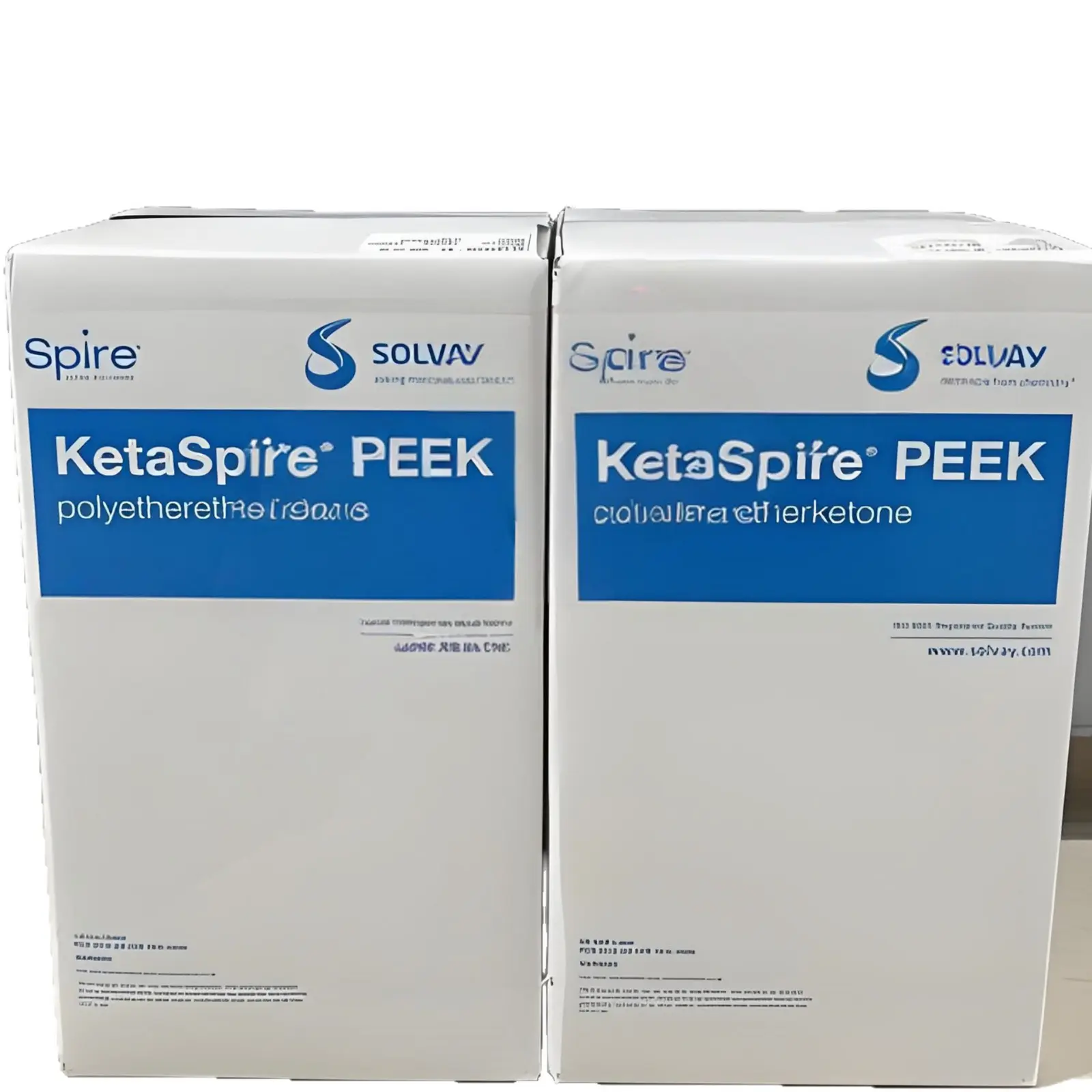
Manufacturer: Syensqo (formerly Solvay Specialty Polymers)
Product series: KetaSpire® PEEK
Material basics: polyetheretherketone (PEEK), 30% glass-fiber reinforced (by weight), semi-crystalline thermoplastic engineering plastic, pellet form.
Appearance: light beige (BG 20) / black (BK 95)
Recommended processing: injection molding, profile extrusion, machining (secondary processing of rod and plate)
KetaSpire® KT-880 GF30 is positioned within the KetaSpire® PEEK portfolio as the “high-flow + 30% glass-fiber reinforced” grade. As the high-stiffness structural option in the PEEK (polyetheretherketone) family, it retains the base resin’s heat resistance, chemical resistance and high purity while using 30% glass fiber to lift tensile modulus to the 10800 MPa (ASTM D638) level and raise the heat deflection temperature at 1.8 MPa to 315 °C (ASTM D648, annealed) — so parts can still carry structural loads at service temperatures approaching 300 °C. Compared with the lower-flow KT-820 GF30 in the same series, this grade offers a melt mass-flow rate roughly 20 times higher, giving a wider process window for thin-wall parts, long flow paths and molds that are sensitive to fill pressure.
Key Performance Advantages
- High stiffness and strength: tensile modulus 10800 MPa (ASTM D638) / 11200 MPa (ISO), flexural modulus 10500 MPa (ASTM D790), flexural strength 260 MPa, compressive strength 183 MPa, shear strength 94.4 MPa and Rockwell hardness M 105; surface wear resistance is better than that of unreinforced PEEK.
- Outstanding heat resistance: glass transition temperature 147 °C and peak melting temperature 343 °C (ASTM D3418); heat deflection temperature 315 °C (1.8 MPa, annealed, ASTM D648) — about 155 °C higher than unreinforced PEEK (160 °C). This is what qualifies the grade for the heat-resistant engineering plastics selection ladder (high-temperature structural parts and aerospace applications).
- High flow: melt mass-flow rate 14 g/10 min (400 °C/2.16 kg) and melt viscosity 350 Pa·s (400 °C, 1000 s⁻¹) — a high-flow level among 30% glass-fiber reinforced PEEK grades (KT-820 GF30 in the same series: 0.70 g/10 min and 850 Pa·s), suited to thin-wall and long-flow-path injection molding.
- Low expansion and dimensional stability: coefficient of linear thermal expansion (CLTE) in the parallel direction (-50 to 50 °C) of 1.9E-5 cm/cm/°C (ASTM E831); 24-hour water absorption 0.1% (ASTM D570); as a glass-fiber grade it is radiotranslucent, which suits parts that must be inspected by X-ray or CT.
- Chemical resistance and sterilizability: good tolerance to organics, acids and bases, with official features covering hydrolysis resistance, steam resistance, fuel and oil resistance and resistance to sour gas media; withstands autoclave (steam), ethylene oxide, e-beam and gamma irradiation sterilization.
- Flame retardancy and electrical performance: UL 94 V-0 at both 0.8 mm and 1.6 mm wall thickness; passes the 60-second vertical burn, smoke density and toxicity requirements of FAR 25.853a Appendix 1; volume resistivity 3.8E+17 Ω·cm and dielectric strength 16 kV/mm (3.00 mm).
- Compliance basis: RoHS compliant and halogen-free; holds food contact listings (confirm the specific application with the manufacturer); ISO 10993 biocompatibility testing covers only the BG 20 beige color.
Technical Specifications
Physical Properties
| Physical Properties | Test Value | Test Unit | Test Standard |
|---|---|---|---|
| Density | 1.53 | g/cm³ | ASTM D792 |
| Melt Mass-Flow Rate (400 °C, 2.16 kg) | 14 | g/10min | ASTM D1238 |
| Molding Shrinkage, Parallel (3.18 mm, 5″x0.5″x0.125″) | 0.1-0.3 | % | ASTM D955 |
| Molding Shrinkage, Transverse (3.18 mm, 5″x0.5″x0.125″) | 1.3-1.5 | % | ASTM D955 |
| Water Absorption (24 h) | 0.1 | % | ASTM D570 |
| Rockwell Hardness, M Scale | 105 | — | ASTM D785 |
Mechanical Properties
| Mechanical Properties | Test Value | Test Unit | Test Standard |
|---|---|---|---|
| Tensile Modulus (5 mm/min) | 10800 | MPa | ASTM D638 |
| Tensile Modulus | 11200 | MPa | ISO 527-1/1A/1 |
| Tensile Strength, Yield | 174 | MPa | ISO 527-2/1A/5 |
| Tensile Stress | 162 | MPa | ASTM D638 |
| Tensile Strain at Break (5 mm/min, crystallized) | 3.1 | % | ASTM D638 |
| Tensile Strain at Break | 3.1 | % | ISO 527-2/1A/5 |
| Flexural Modulus | 10500 | MPa | ASTM D790 |
| Flexural Modulus | 10600 | MPa | ISO 178 |
| Flexural Strength | 260 | MPa | ASTM D790 |
| Flexural Strength | 239 | MPa | ISO 178 |
| Compressive Strength | 183 | MPa | ASTM D695 |
| Shear Strength | 94.4 | MPa | ASTM D732 |
| Izod Impact Strength, Notched | 69 | J/m | ASTM D256 |
| Izod Impact Strength, Notched | 11 | kJ/m² | ISO 180 |
| Izod Impact Strength, Unnotched | 850 | J/m | ASTM D4812 |
| Izod Impact Strength, Unnotched | 62 | kJ/m² | ISO 180 |
Thermal Properties
| Thermal Properties | Test Value | Test Unit | Test Standard |
|---|---|---|---|
| Heat Deflection Temperature (1.8 MPa) | 315 | °C | ASTM D648 |
| Glass Transition Temperature (Tg) | 147 | °C | ASTM D3418 |
| Peak Melting Temperature | 343 | °C | ASTM D3418 |
| Coefficient of Linear Thermal Expansion (CLTE), Parallel (-50 – 50 °C) | 1.9E-5 | cm/cm/°C | ASTM E831 |
| Specific Heat (50 °C) | 1280 | J/kg/°C | DSC |
| Specific Heat (200 °C) | 1700 | J/kg/°C | DSC |
| Thermal Conductivity | 0.3 | W/m-K | ASTM E1530 |
| Flame Rating (0.8 mm) | V-0 | — | UL 94 |
| Flame Rating (1.6 mm) | V-0 | — | UL 94 |
Electrical Properties
| Electrical Properties | Test Value | Test Unit | Test Standard |
|---|---|---|---|
| Surface Resistivity | > 1.9E+17 | ohms | ASTM D257 |
| Volume Resistivity | 3.8E+17 | ohms·cm | ASTM D257 |
| Dielectric Strength (3.00 mm) | 16 | kV/mm | ASTM D149 |
| Dielectric Constant (60 Hz) | 3.53 | — | ASTM D150 |
| Dielectric Constant (1 kHz) | 3.53 | — | ASTM D150 |
| Dielectric Constant (1 MHz) | 3.49 | — | ASTM D150 |
| Dissipation Factor (60 Hz) | 2.0E-3 | — | ASTM D150 |
| Dissipation Factor (1 kHz) | 2.0E-3 | — | ASTM D150 |
| Dissipation Factor (1 MHz) | 4.0E-3 | — | ASTM D150 |
Other Properties
| Other Properties | Test Value | Test Unit | Test Standard |
|---|---|---|---|
| Melt Viscosity (400 °C, 1.0e+3 sec^-1) | 350 | Pa·s | ASTM D3835 |
Notice: The technical specifications for Syensqo KetaSpire® KT-880 GF30 provided herein are compiled from data published by Syensqo or certified third-party testing laboratories. While prepared with professional diligence, these values serve as reference guidelines rather than absolute performance guarantees. Because molding and processing conditions vary significantly across operational environments, we recommend performing trial runs with KetaSpire® KT-880 GF30 under your actual manufacturing conditions prior to final material selection and mass production.
Applications & Processing Guidelines
Recommended Applications
Aircraft Interiors and Onboard Systems Passes the 60-second vertical burn, smoke density and toxicity requirements of FAR 25.853a Appendix 1; combined with a heat deflection temperature of 315 °C, the grade suits interior brackets, structural fittings, wire harness clamps and hydraulic and fluid system parts. Being radiotranslucent, it also allows non-destructive inspection after assembly.
Electrical and Electronic UL 94 V-0 is achieved at 0.8 mm wall thickness, which directly supports the thin-wall design of UL94 V-0 electrical and electronic parts; volume resistivity of 3.8E+17 Ω·cm and dielectric strength of 16 kV/mm cover connectors, relay bobbins, terminal insulators, SMT fixtures and coil formers.
Medical and Hospital Goods Withstands autoclave (steam), ethylene oxide, e-beam and gamma irradiation sterilization, making it suitable for surgical instrument handles, dental instrument parts, sterilization trays and hospital durables. Selection note: biocompatibility testing covers only the BG 20 beige color, so human-contact applications must obtain documentation for the specific color.
Oil & Gas and Chemical Processing Resists hydrolysis, steam, acids, bases and sour gas media — suited to pump parts, seals, valve seats and downhole tool components that must resist corrosion and wear.
Industrial Machinery and Wear Parts Rockwell hardness M 105, compressive strength 183 MPa and shear strength 94.4 MPa provide a solid data basis for wear-resistant plastics for gears and bearings; typical parts include wear bushings, bearing cages, gears and compressor valve plates.
Extruded Profiles and Machined Parts The manufacturer’s recommended processing methods include profile extrusion and machining, so rod and plate can be extruded and then turned or milled into precision parts — practical for prototyping and high-mix, low-volume production.
Processing Essentials
Drying The manufacturer recommends 150 °C × 4.0 hr. Use a desiccant dryer and keep the hopper covered and insulated to prevent re-absorption of moisture; batches that have been open for a long time or stored in humid conditions should have drying effectiveness re-checked before molding.
Temperature Settings (manufacturer-recommended injection profile)
| Zone | Rear | Middle | Front | Nozzle | Mold |
|---|---|---|---|---|---|
| Temperature | 365 °C | 371 °C | 377 °C | 382 °C | 177–204 °C |
Melt Flow Characteristics and Process Adjustment: With a melt mass-flow rate of 14 g/10 min (400 °C/2.16 kg) and melt viscosity of 350 Pa·s (400 °C, 1000 s⁻¹), fill resistance is clearly lower than that of KT-820 GF30 in the same series, enabling lower injection pressure and shorter fill time — well suited to thin-wall and long-flow-path parts. A starting process of “medium-to-high injection speed with staged hold pressure” is recommended, and the effect of glass-fiber orientation on shrinkage directionality under high-speed injection should be kept in mind.
Mold Temperature Is the Critical Variable:The manufacturer recommends 177–204 °C, far above conventional engineering plastics. A high mold temperature is the precondition for full crystallinity, stable mechanical properties and dimensional accuracy; it requires an oil temperature controller and thermal insulation of the mold. Insufficient mold temperature shows up simultaneously as poor surface gloss, unstable dimensions and substandard mechanical performance. For drying, mold temperature and annealing logic in PEEK injection molding process control, a technical article on our site covers the subject in more detail.
Equipment and Regrind: The manufacturer recommends a screw compression ratio of 2.5:1.0–3.5:1.0 and a “fast” injection rate. Glass-fiber reinforced compounds wear screws and non-return valves noticeably, so wear-resistant screw components are advisable and residence time in the barrel should be controlled; using regrind is not recommended for first production, and where it is unavoidable the proportion must be strictly limited and performance validated.
Shrinkage and Notch Sensitivity: Molding shrinkage is 0.1–0.3% in the parallel direction and 1.3–1.5% in the transverse direction — a difference of roughly five times. Warpage risk stems mainly from uneven glass-fiber orientation, so gates should be arranged symmetrically along the long axis of the part, and parts with tight tolerances should undergo mold flow analysis before the tool is cut. Notched Izod impact is 69 J/m (ASTM D256) versus 850 J/m unnotched (ASTM D4812), indicating sensitivity to sharp notches; designs should therefore avoid sharp corners, abrupt section changes and stress concentration at thread roots.
Grade Comparison & Selection Guide
Comparison Across the Series
| Comparison | KT-880 GF30 (this grade) | KT-820 GF30 | KT-880 (unreinforced) |
|---|---|---|---|
| Reinforcement | 30% glass fiber | 30% glass fiber | Unfilled |
| Flow positioning | High flow | Medium flow | High flow |
| Melt mass-flow rate (400 °C/2.16 kg) | 14 g/10 min | 0.70 g/10 min | 36 g/10 min |
| Melt viscosity (400 °C, 1000 s⁻¹) | 350 Pa·s | 850 Pa·s | 150 Pa·s |
| Density | 1.53 g/cm³ | 1.53 g/cm³ | 1.30 g/cm³ |
| Tensile modulus (ASTM / ISO) | 10800 / 11200 MPa | 10500 / 11400 MPa | 3700 / 4000 MPa |
| Tensile strength, yield (ISO 527-2/1A/5) | 174 MPa | 165 MPa | 102 MPa |
| Tensile strain at break | 3.1 % | 3.1 % | 10–20 % |
| Flexural modulus (ASTM / ISO) | 10500 / 10600 MPa | 10300 / 10700 MPa | 3800 / 3900 MPa |
| Flexural strength (ASTM / ISO) | 260 / 239 MPa | 271 / 246 MPa | 153 / 134 MPa |
| Notched Izod impact (ASTM / ISO) | 69 J/m / 11 kJ/m² | 110 J/m / 13 kJ/m² | 53 J/m / 4.9 kJ/m² |
| Unnotched Izod impact (ASTM / ISO) | 850 J/m / 62 kJ/m² | 960 J/m / 56 kJ/m² | No Break |
| Heat deflection temperature (1.8 MPa, annealed) | 315 °C | 315 °C | 160 °C |
| Tg / peak melting temperature | 147 / 343 °C | 150 / 340 °C | 147 / 343 °C |
| CLTE (parallel) | 1.9E-5 | 1.7E-5 | 5.0E-5 cm/cm/°C |
| Molding shrinkage (parallel / transverse) | 0.1–0.3 / 1.3–1.5 % | 0.20–0.40 / 1.4–1.6 % | 1.4–1.6 / 1.5–1.7 % |
| UL 94 flame rating | V-0 (0.8 / 1.6 mm) | V-0 (1.6 / 20.3 mm) | V-0 (> 3.0 mm, natural) |
| Recommended processing | Injection molding, machining, profile extrusion | Injection molding, machining, profile extrusion | Injection molding, extrusion blow molding, film/fiber/wire & cable extrusion, thermoforming, machining |
| Supplied colors | BG 20 / BK 95 | BG 20 / BK 95 | NT / BK 95 |
Positioning in the Matrix
- Against unreinforced KT-880: flow (36 → 14 g/10 min) and ductility (strain at break 10–20% → 3.1%) are traded for an order-of-magnitude gain in stiffness and heat resistance — flexural modulus up about 2.7 times and heat deflection temperature up about 155 °C. The trade-off is essentially “ductility first” versus “load-bearing and heat resistance first”.
- Against KT-820 GF30: reinforcement type and mechanical level are close; the difference lies in flow (this grade is roughly 20 times higher) and toughness (its notched impact is 1.6 times this grade’s). The former suits thin-wall, long-flow-path injection-molded structural parts at low fill pressure; the latter suits thick-wall, highly loaded applications that demand better resistance to notch cracking and lower warpage.
- Where the highest stiffness and the lowest CLTE in the family are required, the 30% carbon-fiber reinforced KetaSpire® KT-820 CF30 can be evaluated; its radiolucency differs from that of glass-fiber grades, so non-destructive inspection or medical imaging requirements must be confirmed with the manufacturer, and its material cost is higher than that of glass-fiber grades.
Selection Guidance for Engineers
| Part and Service Conditions | Recommended Grade | Data Basis |
|---|---|---|
| Thin-wall parts (approx. < 1.5 mm), long flow paths | KT-880 GF30 | Melt viscosity 350 Pa·s — low fill resistance, lower short-shot risk |
| Medium-wall load-bearing structural parts | KT-880 GF30 | Flexural modulus 10500 MPa, HDT 315 °C |
| Thick-wall parts (approx. > 6 mm), large wall-thickness variation | KT-820 GF30 | MFR 0.70 g/10 min — avoids overly fast fill and internal voids in thick sections |
| Parts with impact, snap-fit or threaded features | KT-820 GF30 | Notched impact 110 J/m (this grade: 69 J/m) |
| Continuous load above 200 °C | Any glass-fiber grade | HDT 315 °C (unreinforced: 160 °C) |
| Weight reduction first, with ductility needed | Unreinforced KT-880 | Density 1.30 g/cm³, strain at break 10–20% |
| Very low thermal expansion, precision fit with metal | KT-820 CF30 | Lowest CLTE in the family (confirm radiolucency requirement) |
Gate and Flow Design: shrinkage anisotropy in glass-fiber grades cannot be eliminated by the material itself — it can only be controlled through gate position, flow direction and mold temperature uniformity, and should be evaluated together with mold design at the selection stage. Multi-gate molds and long runners favor KT-880 GF30; molds where gates cannot be arranged symmetrically and warpage risk is high favor KT-820 GF30, supported by mold flow analysis.
Cost Ranking: provided the performance threshold is met, unit material cost generally rises with the reinforcement system (unreinforced < glass fiber < carbon fiber). The correct order is to screen for qualified grades using service conditions and compliance requirements first, and only then compare cost within that qualified set.
FAQs
Q1: Does the material need drying before molding, and how should it be dried?
A1: Yes. Although PEEK pellets absorb little moisture (0.1% at 24 hours, ASTM D570), the pellet surface still adsorbs moisture during transport and storage, and residual moisture in a melt above 370 °C causes hydrolytic degradation, showing up as silver streaks, bubbles or reduced mechanical performance. The manufacturer recommends 150 °C × 4.0 hours; use a desiccant dryer rather than an ordinary hot-air dryer, and keep the hopper covered and insulated to prevent re-absorption. Residence time in the barrel should also be controlled to avoid degradation during prolonged high-temperature dwell.
Q2: How do I choose between KT-880 GF30, KT-820 GF30 and unreinforced KT-880?
A2: The core difference between the three is where they sit on the balance between flow and toughness:
| Selection Scenario | Recommended | Key Data |
|---|---|---|
| Thin wall, long flow path, low injection pressure needed | KT-880 GF30 | MFR 14 g/10 min, viscosity 350 Pa·s |
| Thick wall, avoid overly fast fill and voids | KT-820 GF30 | MFR 0.70 g/10 min, viscosity 850 Pa·s |
| Impact, snap-fit or threaded features | KT-820 GF30 | Notched impact 110 J/m (vs 69 J/m) |
| Structural parts where stiffness, compression and wear dominate | KT-880 GF30 | Flexural modulus 10500 MPa, compressive strength 183 MPa |
| Continuous load above 200 °C | Any glass-fiber grade | HDT 315 °C (unreinforced 160 °C) |
| Weight reduction first, higher elongation needed | Unreinforced KT-880 | Density 1.30 g/cm³, strain at break 10–20% |
Note that KT-880 GF30 and KT-820 GF30 have identical glass-fiber content and comparable mechanical performance; in many cases the practical difference comes down to “can the mold fill and can warpage be controlled”. Small-batch mold trials in the actual tool are recommended before final selection.
Q3: What do the melt flow rate and melt viscosity figures mean in practice?
A3: With a melt mass-flow rate of 14 g/10 min (400 °C/2.16 kg) and melt viscosity of 350 Pa·s (400 °C, 1000 s⁻¹), KT-880 GF30 is a high-flow grade among 30% glass-fiber reinforced PEEK materials (KT-820 GF30 in the same series: 0.70 g/10 min, 850 Pa·s). This has three practical implications:
- Easier filling: lower injection pressure and shorter fill time, suited to thin-wall and long-flow-path parts and to production on smaller-tonnage machines.
- Hold and cooling strategy must be reset: good flow means more effective hold-pressure transmission, so staged hold pressure helps reduce sink marks; mold temperature must be maintained at 177–204 °C, otherwise glass-fiber reinforced parts tend to show fiber show-through, weak weld lines and unstable dimensions.
- Glass-fiber orientation control matters more: high flow intensifies fiber orientation at the flow front, and this grade’s parallel and transverse shrinkage differ by roughly five times. Gate position, flow balance and mold temperature uniformity therefore determine warpage more than a higher injection speed alone.
In addition, the wide gap between unnotched impact (850 J/m) and notched impact (69 J/m) shows the material is sensitive to sharp notches, so part designs should avoid sharp corners and abrupt section changes.
Q4: What compliance documents come with the grade, and what should buyers watch for?
A4: Compliance and certifications: UL 94 V-0 at 0.8 mm and 1.6 mm wall thickness — request the UL Yellow Card from the manufacturer to confirm the file number and thickness class; passes the 60-second vertical burn, smoke density and toxicity requirements of FAR 25.853a Appendix 1; RoHS compliant and halogen-free; holds food contact listings, with applicability for a specific application to be confirmed by the manufacturer; ISO 10993 biocompatibility testing covers only the BG 20 beige color — BK 95 has no such record, and the grade is not part of an implantable-grade material family.
Purchasing notes: first, color is tied to certification — BG 20 and BK 95 share the same property data but differ in certification coverage, so the color and end use must be specified on the order; second, obtain original documents — request the manufacturer’s TDS, SDS, batch COA and declaration of conformity together, and verify re-testable indicators such as density (1.53 g/cm³) and MFR (14 g/10 min); third, keep batches traceable — pellet form, packaging labels and batch numbers should be complete; fourth, run trials before mass production — because tooling and molding conditions have a significant effect on final performance, validation under actual production conditions should be completed before a volume commitment.