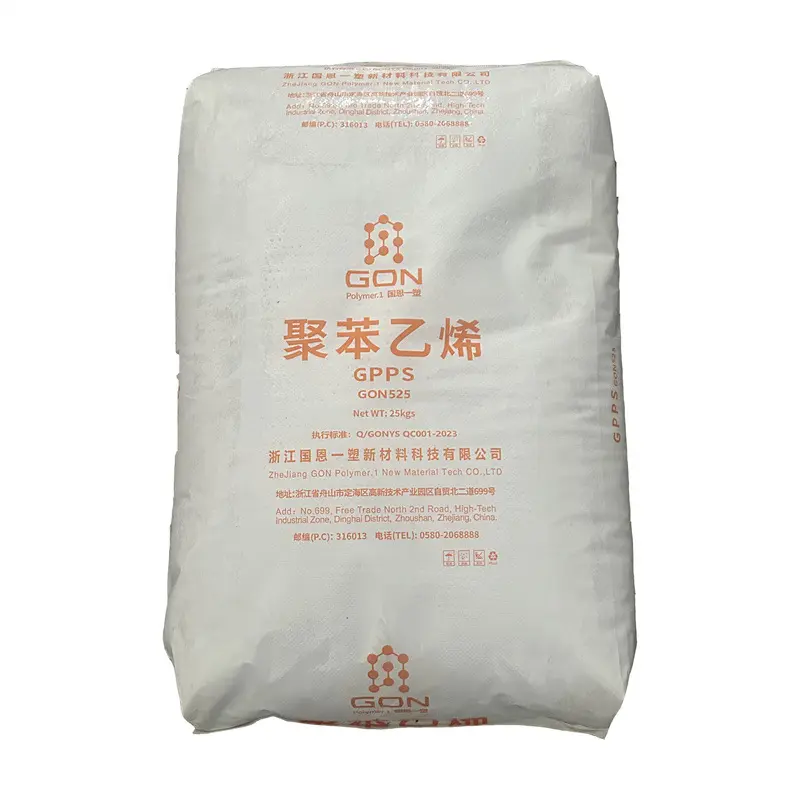
Product Overview & Key Features
Zhejiang Yisu GPPS GON525 is a general-purpose polystyrene (GPPS) injection molding grade from the GON series produced by Zhejiang Yisu. Positioned around high transparency, excellent mechanical and thermal performance, easy processability, and short molding cycles, this grade targets transparent injection-molded applications that simultaneously demand optical aesthetics, structural rigidity, and molding efficiency.
Basic Material Properties
- Chemical Composition: An amorphous thermoplastic resin synthesized by polymerizing styrene monomer, belonging to the styrene homopolymer family.
- Appearance: Natural transparent cylindrical granules, unreinforced and unfilled.
Technical Specifications
Physical Properties
| Property | Test Condition | Value | Unit | Test Method |
| Melt Volume Rate (MVR) | 200 °C/5 kg | 6–10 | cm³/10 min | GB/T 3682.1-2018 |
| Residual Styrene Content | — | ≤700 | ppm | GB/T 16867-1997 |
Mechanical Properties
| Property | Test Condition | Value | Unit | Test Method |
| Tensile Yield Strength | — | ≥45 | MPa | GB/T 1040.2-2006 |
| Charpy Unnotched Impact Strength | — | 10.6 | kJ/m² | GB/T 1043.1 |
Thermal Properties
| Property | Test Condition | Value | Unit | Test Method |
| Vicat Softening Temperature | — | 90–94 | °C | GB/T 1633-2000 |
| Heat Deflection Temperature (HDT) | 0.45 MPa | 83.3 | °C | GB/T 1634.2 |
Optical Properties
| Property | Test Condition | Value | Unit | Test Method |
| Luminous Transmittance | — | 89.7 | % | GB/T 2410 |
| Yellowness Index (YI) | — | −5 | — | ASTM E313 |
Processing Parameters
| Property | Test Condition | Value | Unit | Test Method |
| Injection Temperature | — | 180–240 | °C | — |
| Mold Temperature | — | 40–70 | °C | — |
Notice: The technical specifications for Zhejiang Yisu GON525 provided herein are compiled from data published by Zhejiang Yisu or certified third-party testing laboratories. While prepared with professional diligence, these values serve as reference guidelines rather than absolute performance guarantees. Because molding and processing conditions vary significantly across operational environments, we recommend performing trial runs with GON525 under your actual manufacturing conditions prior to final material selection and mass production.
Features & Benefits
- High Transparency & Low Yellowing Tendency (Feature): Luminous transmittance reaches 89.7% with a yellowness index of −5, producing crystal-clear molded parts with color-neutral aesthetics. (Benefit): Ideal for visible components such as refrigerator crisper drawers, transparent containers, and lamp covers without requiring extra clarifying agents, while reducing long-term yellowing perception differences.
- High Rigidity & Good Dimensional Stability (Feature): Tensile yield strength ≥45 MPa and Charpy unnotched impact strength of 10.6 kJ/m², showcasing outstanding material stiffness. (Benefit): Well-suited for thin-walled or structural transparent parts, resisting post-molding warpage and ensuring tight assembly tolerances to minimize fitting variations and rework rates.
- Note: GPPS is inherently a rigid, non-toughened polymer matrix; if the end product must withstand repeated impact or low-temperature drops, evaluating HIPS or styrene copolymer/blend systems is recommended.
- Thermal Resistance Suited for Standard Operations (Feature): Vicat softening point of 90–94 °C and heat deflection temperature (0.45 MPa) of 83.3 °C. (Benefit): Satisfies dimensional integrity requirements for home appliance interior parts, kitchenware, and daily consumer goods under typical operating conditions and brief thermal spikes.
- Low Residual Monomer & Low Odor (Feature): Residual styrene content controlled at ≤700 ppm. (Benefit): Provides better initial odor control, making it favorable for food packaging, catering containers, and personal care packaging that are sensitive to odor and migration.
- Easy Processing & Short Molding Cycles (Feature): MVR of 6–10 cm³/10 min (200 °C/5 kg) with an injection temperature window of 180–240 °C and mold temperature of 40–70 °C, offering excellent melt flowability. (Benefit): Ensures smooth mold filling and easy demolding, enabling stable mass production with shortened cooling times to boost hourly press output and lower unit energy consumption.
Applications & Processing Guidelines
Recommended Applications & End Products
- Home Appliance Transparent Components: Refrigerator crisper boxes, baffles, shelving, freezer transparent components, trays, etc.
- Food Contact Products: Food packaging containers, lunch boxes, kitchen containers, disposable tableware.
- Foamed Products (PSP/XPS): Foam containers, label substrates, and profiles requiring physical or chemical foaming.
- Daily Consumer Goods: Cosmetic and personal care bottles/caps, stationery and office supplies, toys, CD/DVD cases, and other transparent rigid parts.
- Optical & Instrument Parts: Lamp shades, light-transmitting panels, instrument lenses, and other components requiring high light transmission and surface appearance.
Practical Processing Guidelines
- Melt Index Characteristics & Processing Selection: Featuring an MVR of 6–10 cm³/10 min (200 °C/5 kg), this grade sits in the medium-flowability range, balancing thin-wall filling ability and melt strength. For deep-cavity or long-flow thin-walled parts, barrel temperatures can be slightly increased; for thick-walled parts, lower melt temperatures and packing pressures to minimize internal stress and post-molding warpage.
- Temperature Profile Settings:
- Injection Temperature: 180–240 °C (gradual heating profile from rear → middle → front → nozzle, setting front zone and nozzle toward the mid-to-upper end to assist cavity filling).
- Mold Temperature: 40–70 °C (lower mold temperatures yield better transparency and surface gloss; higher mold temperatures help relieve internal stress and improve surface appearance uniformity on thick parts).
- Screw Speed & Pressure Adjustment:
- Moderate-to-low screw rotation speeds paired with moderate back pressure are recommended to prevent localized overheating and thermal degradation caused by high shear.
- Use multi-stage injection: complete primary filling at medium speed, then decelerate near the end before switching to holding pressure to suppress jetting lines and stress concentration near the gate.
- Holding pressure should not be excessive and must switch to the cooling phase as soon as gate freeze-off occurs to avoid excessive residual stress leading to part cracking.
- Drying Recommendation: GPPS is a non-hygroscopic resin; under intact packaging and dry storage conditions, pellets can be processed directly without pre-drying. If bags are damaged, stored under high humidity for prolonged periods, or show surface condensation, drying at 70–80 °C for ~2–3 hours is recommended. Keep the hopper sealed to prevent re-absorption; improper drying may cause silver streaks, bubbles, or surface haze.
- Storage & Handling: Supplied as cylindrical pellets, store in original packaging in a cool, dry area away from direct sunlight, or store in sealed silos.
Material Selection & Working Environment Considerations
- Chemical Resistance (General GPPS Characteristic): GPPS is stable against water, inorganic acids, alkalis, and alcohols, suitable for humid environments or contact with water-based cleaners; however, it has weak resistance against aromatic hydrocarbons, ketones, esters, and organic solvents, which may cause swelling, dissolution, or environmental stress cracking (ESC) upon long-term exposure.
- If parts will come into prolonged contact with oils, fragrances, or organic solvents (such as cosmetic contents, solvent-based cleaners, or greasy foods), perform soak and stress-crack evaluations first, or switch to more chemical-resistant materials like HIPS, AS(SAN), or PC.
- Chemical resistance depends on chemical concentration, contact temperature, exposure time, and residual stress levels in the part; practical verification under actual working conditions is recommended.
Frequently Asked Questions (FAQs)
Q1: Does GON525 require drying before injection molding?
A1: Generally, no. GPPS is non-hygroscopic, with moisture residing mostly on the pellet surface. Under intact packaging and dry storage conditions, it can be fed directly into the hopper.
Drying is only recommended if the packaging is damaged, stored in high-humidity environments for long periods, or exposed to surface condensation after cold transit. In such cases, hot-air drying at 70–80 °C for ~2–3 hours is sufficient. Keep the hopper sealed to avoid re-absorbing moisture. Inadequate drying may cause silver streaks, air bubbles, or surface hazing on molded parts.
Q2: What does MVR 6–10 cm³/10 min represent? How should temperature and RPM be adjusted?
A2: MVR (Melt Volume-Flow Rate, 200 °C/5 kg) reflects melt flowability, where higher values indicate easier flow. An MVR of 6–10 cm³/10 min falls into the medium flowability range:
- Flowability Interpretation: Capable of filling cavities with standard wall thicknesses and medium flow lengths while retaining sufficient melt strength to prevent drooling or uneven filling.
- Temperature Fine-tuning: Start near the midpoint of the injection temperature window (180–240 °C) and adjust based on cavity fill. If short shots occur, prioritize increasing front-zone and nozzle temperatures rather than blindly raising injection pressure.
- Screw Speed & Back Pressure: Maintain moderate-to-low screw speeds and moderate back pressure to avoid shear degradation and yellowing (yellowness index is −5; if noticeable yellowing occurs during molding, check barrel temperature and residence time).
- Note on Regrind: When using regrind, control the blend ratio and slightly increase the upper temperature limit, as accumulated thermal history reduces melt stability.
Q3: What is the practical significance of residual styrene ≤700 ppm? Can food contact compliance documents be provided?
A3: Practical Significance: Lower residual styrene monomer content results in lower initial odor and reduced chemical volatility and migration risks, making low-residual grades well-suited for food-contact and personal care packaging. GON525 maintains residual styrene at ≤700 ppm.
Compliance Documentation: Food contact compliance (such as FDA, EU 10/2011, GB 4806, etc.) depends on final part geometry, processing conditions, and contact media, and cannot be determined solely from base resin datasheets. We recommend requesting batch TDS, SDS, COA, and formal regulatory compliance statements prior to material selection. We can provide batch test reports and regulatory documentation support upon request.