Product Overview & Key Features
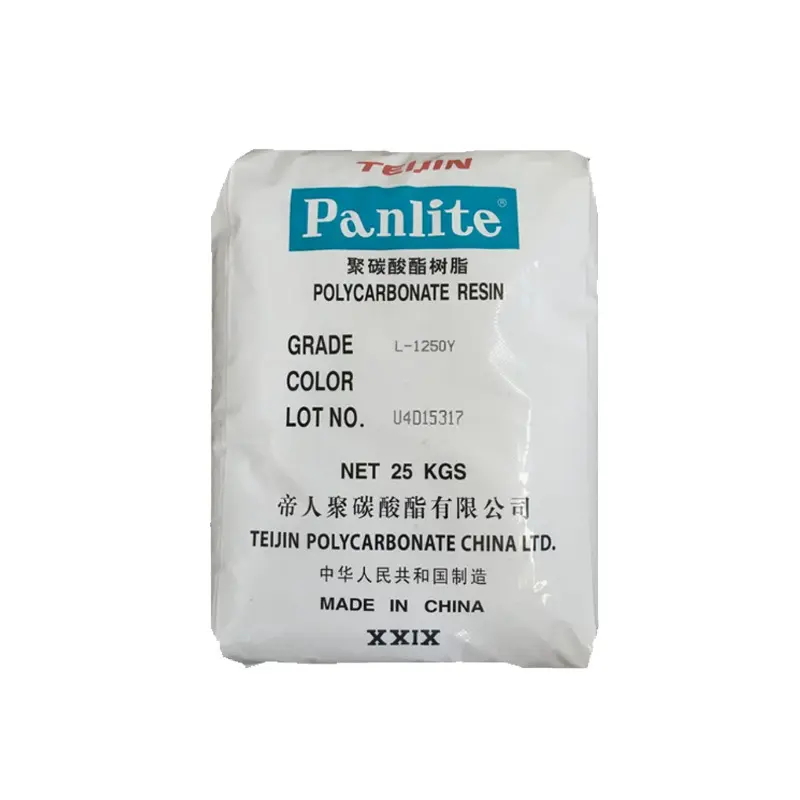
- Manufacturer: Teijin
- Product Series: Panlite® Polycarbonate (PC) General Injection Molding Series
- Category: Bisphenol A Polycarbonate (PC), Medium Viscosity, Transparent Grade
- Appearance: Colorless transparent pellets
Teijin Panlite® L-1250Y is a general-purpose injection molding transparent PC grade within the Teijin Panlite® series. Based on bisphenol A polycarbonate, its formulation incorporates an internal mold release agent. Featuring medium melt viscosity, it balances high impact toughness, optical clarity, and dimensional stability. Compatible with standard injection molding processes, it is widely utilized in global PC molding applications requiring a combination of transparency, mechanical strength, and electrical insulation properties.
Technical Specifications
Physical Properties
| Property | Test Condition | Value / Unit | Test Method |
| Density | – | 1.20 g/cm³ | ISO 1183 |
| Melt Volume-Flow Rate (MVR) | 300 ℃, 1.2 kg | 8.0 cm³/10 min | ISO 1133 |
| Mold Shrinkage, Normal | 4 mm | 0.5-0.7 % | Internal Method |
| Mold Shrinkage, Parallel | 4 mm | 0.5-0.7 % | Internal Method |
| Water Absorption | 24 h, 23 ℃ | 0.2 % | ISO 62 |
Mechanical Properties
| Property | Test Condition | Value / Unit | Test Method |
| Tensile Modulus | – | 2400 MPa | ISO 527-2/1 |
| Tensile Stress, Yield | – | 61 MPa | ISO 527-2/50 |
| Tensile Strain, Yield | – | 6.0 % | ISO 527-2/50 |
| Nominal Tensile Strain, Break | – | > 50 % | ISO 527-2/50 |
| Flexural Modulus | 2 mm/min | 2300 MPa | ISO 178 |
| Flexural Strength | 2 mm/min | 91 MPa | ISO 178 |
| Charpy Notched Impact Strength | – | 76 kJ/m² | ISO 179 |
| Charpy Unnotched Impact Strength | – | No Break | ISO 179 |
Thermal Properties
| Property | Test Condition | Value / Unit | Test Method |
| Deflection Temperature Under Load, Unannealed | 1.8 MPa | 129 ℃ | ISO 75-2/A |
| Vicat Softening Temperature | – | 149 ℃ | ISO 306/B50 |
| Coefficient of Linear Thermal Expansion (CLTE), Parallel | – | 7.0E-5 cm/cm/℃ | ISO 11359-2 |
| Coefficient of Linear Thermal Expansion (CLTE), Normal | – | 7.0E-5 cm/cm/℃ | ISO 11359-2 |
| Relative Thermal Index (RTI), Electrical | 0.75 mm | 125 ℃ | UL 746 |
| Relative Thermal Index (RTI), Impact | 0.75 mm | 115 ℃ | UL 746 |
| Relative Thermal Index (RTI), Strength | 0.75 mm | 125 ℃ | UL 746 |
| Flammability Rating | 1.5 mm | HB | UL 94 |
| Flammability Rating | 0.4 mm | V-2 | UL 94 |
| Glow Wire Flammability Index (GWFI) | 1.5 mm | 850 ℃ | IEC 60695-2-12 |
| Glow Wire Flammability Index (GWFI) | 3 mm | 960 ℃ | IEC 60695-2-12 |
| Glow Wire Ignition Temperature (GWIT) | 1.5 mm | 875 ℃ | IEC 60695-2-13 |
| Glow Wire Ignition Temperature (GWIT) | 3 mm | 875 ℃ | IEC 60695-2-13 |
Electrical Properties
| Property | Test Condition | Value / Unit | Test Method |
| Surface Resistivity | – | > 1.0E+15 Ohms | IEC 60093 |
| Volume Resistivity | – | > 1.0E+15 Ohms·cm | IEC 60093 |
| Electric Strength, Short Time | – | 30 kV/mm | IEC 60243-1 |
| Relative Permittivity | 100 Hz | 3.1 | IEC 60250 |
| Relative Permittivity | 1.0e+6 Hz | 3 | IEC 60250 |
| Dissipation Factor | 100 Hz | 1.0E-3 | IEC 60250 |
| Dissipation Factor | 1.0e+6 Hz | 9.0E-3 | IEC 60250 |
| Comparative Tracking Index (CTI) | – | 250 V | IEC 60112 |
Optical Properties
| Property | Test Condition | Value / Unit | Test Method |
| Refractive Index | – | 1.585 | ASTM D542 |
| Luminous Transmittance | 3 mm | 88 % | ASTM D1003 |
Notice: The technical specifications for Panlite® L-1250Y PC provided herein are compiled from data published by Teijin or certified third-party testing laboratories. While prepared with professional diligence, these values serve as reference guidelines rather than absolute performance guarantees. Because molding and processing conditions vary significantly across operational environments, we recommend performing trial runs with Panlite® L-1250Y under your actual manufacturing conditions prior to final material selection and mass production.
Features & Benefits
- Good Transparency (88% Transmittance at 3mm): Satisfies light transmission needs for general transparent display windows and housing components, featuring a stable refractive index and clear appearance.
- Medium Melt Viscosity (MVR 8.0 cm³/10min): Offers balanced mold filling capability for standard wall-thickness injection molded parts, combining ease of processing with impact toughness.
- Outstanding Impact Performance (76 kJ/m² Notched Charpy, No Break Unnotched): Resists shattering under external impact, enhancing end-product safety and structural reliability.
- Excellent Dimensional Stability (0.5–0.7% Mold Shrinkage): Exhibits low dimensional fluctuation post-molding, making part tolerance control easier during mass production, suitable for precision assembly components.
- Superior Electrical Insulation (High Volume Resistivity, High Electric Strength, Low Dissipation Factor): Ideal for electrical components requiring reliable insulation performance, maintaining stability under long-term high-temperature operating conditions.
Applications & Processing Guidelines
Recommended Applications
Transparent home appliance housings and display windows, lighting covers, instrument protective covers, consumer electronics transparent structural parts, industrial equipment observation windows, electrical insulating components, and transparent protective covers.
Key Processing Tips
- Drying: PC resin is moisture-sensitive and must be dehumidified prior to injection molding. Recommended conditions: 120°C for 4–6 hours with a tray depth not exceeding 3 cm. Target moisture content should be controlled below 0.02% to avoid silver streaks, bubbles, or hydrolytic degradation.
- Injection Temperature: Recommended barrel temperature ranges from 260°C to 300°C, with a recommended mold temperature of 80°C to 105°C. Higher mold temperatures help reduce internal stress and prevent post-molding stress cracking.
- Screw & Injection Speed: Use a low-shear screw and control screw RPM to avoid yellowing from prolonged high-temperature thermal degradation. Increase injection speed for thin-walled parts and decrease it for thick-walled parts to minimize internal stress.
- Mold Release Agent Notice: This grade contains an internal mold release additive. If secondary surface operations such as screen printing, bonding, or vacuum plating are required, note that release agent migration may affect surface adhesion. Surface activation treatment is recommended.
Frequently Asked Questions (FAQs)
Q1: Is drying mandatory before molding Panlite L-1250Y? What are the drying conditions?
A: Yes. Polycarbonate resin absorbs moisture, which leads to hydrolysis during high-temperature injection molding, resulting in silver streaks, bubbles, reduced transparency, and lower impact strength. A desiccant dryer is recommended at 120°C for 4–6 hours to reduce moisture content below 0.02%.
Q2: What is the flammability rating of L-1250Y? Can it be used in products requiring a V-0 rating?
A: It achieves a UL94 HB rating at 1.5mm thickness and V-2 at 0.4mm. If your end product strictly requires a V-0 rating, this grade is not suitable; consider choosing flame-retardant PC grades from Teijin’s Panlite® series.
Q3: How is the melt fluidity of L-1250Y? Is it suitable for thin-walled parts?
A: With an MVR of 8.0 cm³/10min (300°C/1.2kg), it is a medium-viscosity resin suitable for transparent injection molded parts with standard wall thicknesses and moderate flow-length ratios. For ultra-thin-walled or long-flow-path products, higher-MVR PC grades are recommended. For thick-walled parts requiring high impact resistance, lower-MVR (higher viscosity) grades are preferred.
Q4: Does the internal mold release agent affect subsequent printing or bonding?
A: Internal mold release additives migrate to the surface and can adversely affect secondary processing like screen printing, adhesive bonding, or vacuum deposition. If these secondary operations are needed, consider using non-mold-release PC grades from Teijin or apply surface activation processes (e.g., plasma or flame treatment) post-molding.