Product Overview & Key Features
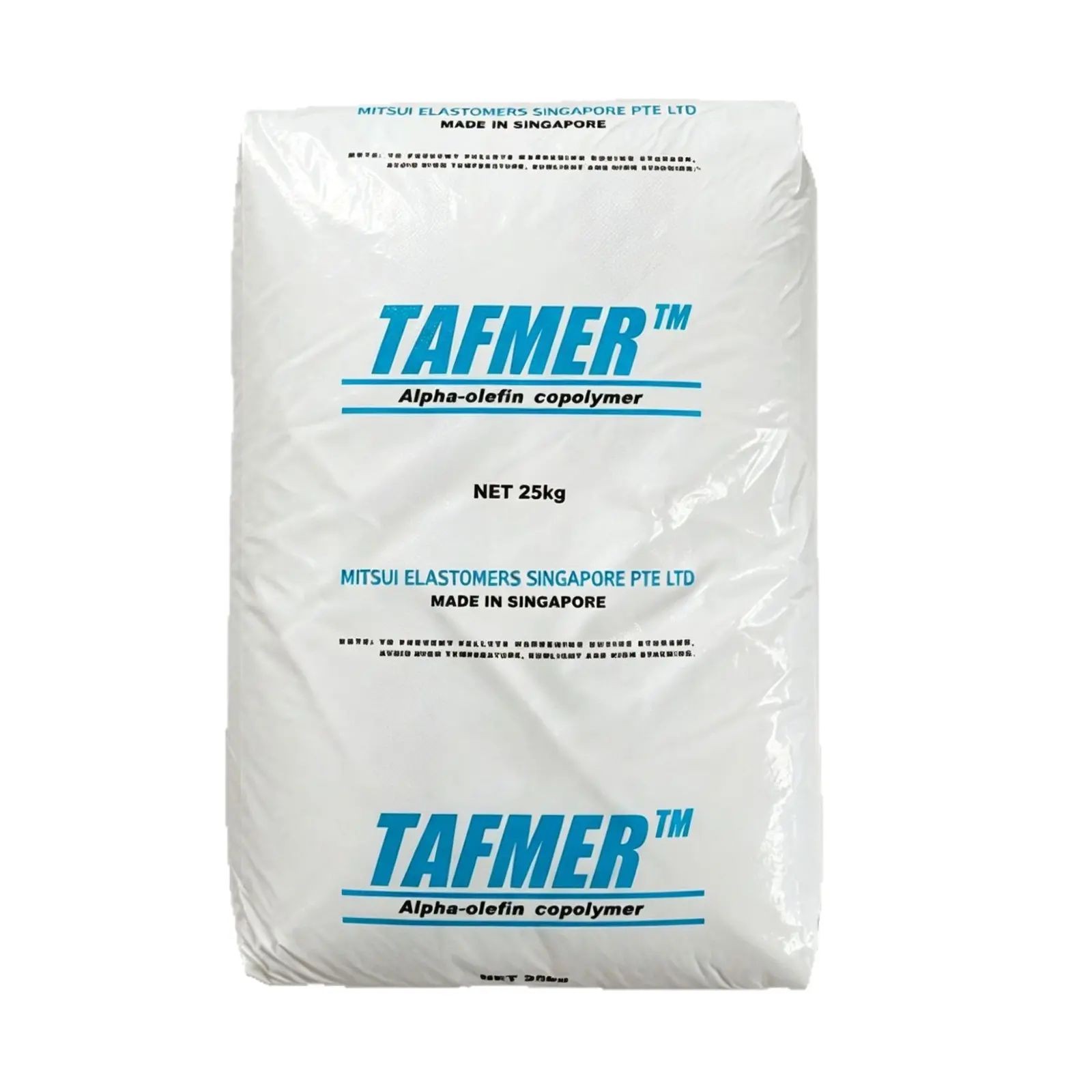
- Manufacturer & Product Series: This product is produced by Mitsui Chemicals and belongs to its signature TAFMER™ high-performance polyolefin elastomer (POE) series.
- Basic Material Properties: TAFMER™ DF840 is an advanced alpha-olefin copolymer elastomer synthesized based on metallocene catalysis technology. It features a density of 0.885 g/cm³ and a Shore A hardness of 86, exhibiting exceptional flexibility and elastic recovery.
- Core Performance Advantages:
- Balance of Mechanical Strength and Rigidity: It provides a higher tensile strength at break (> 22 MPa) and good torsional modulus (9 MPa), effectively maintaining the rigid structure of the matrix material while delivering efficient toughening.
- Outstanding Low-Temperature Impact Resistance: With a brittleness temperature below -70 °C, it maintains stable impact and drop resistance under severe and extreme low-temperature working conditions.
- Excellent Blending Compatibility: It possesses superb compatibility with polyolefin matrices (such as PP and PE), improving the micro-dispersion structure of the material.
- Adapted Mainstream Processing Technologies: It exhibits dynamic melt flow rates (MFR of 3.6 g/10 min at 190°C and 6.7 g/10 min at 191°C) and excellent rheological properties, making it suitable for various mainstream plastic molding processes including injection molding, extrusion, blow molding, and calendering.
Technical Specifications
Physical Properties
| Property | Testing Condition | Value | Unit | Test Method |
| Melt Flow Rate (MFR) | 190°C | 3.6 | g/10 min | ASTM D1238 |
| Melt Flow Rate (MFR) | 191°C | 6.7 | g/10 min | ASTM D1239 |
| Density | — | 0.885 | g/cm³ | ASTM D1505 |
Mechanical Properties
| Property | Testing Condition | Value | Unit | Test Method |
| Shore Hardness (Shore A) | Shore A | 86 | — | JIS K6253 |
| Tensile Strength at Break | — | > 22 | MPa | JIS K7113 |
| Torsional Modulus | — | 9 | MPa | ASTM D1043 |
| Elongation at Break | — | > 800 | % | JIS K7114 |
Thermal Properties
| Property | Testing Condition | Value | Unit | Test Method |
| Brittleness Temperature | — | < -70 | °C | ASTM D748 |
| Melting Point | — | 66 | °C | ASTM D2117 |
| Vicat Softening Point | — | 55 | °C | ASTM D1525 |
Disclaimer: The technical specifications for Mitsui Chemicals TAFMER™ DF840 POE material from Mitsui Chemicals corporation presented herein are derived from data issued by Mitsui Chemicals or certified third-party testing institutions. While we have made every effort to ensure the accuracy of the information provided, we assume no liability for any consequences arising from the use of DF840 based on these data. Given the variables involved in processing conditions, we strongly recommend conducting thorough trials of DF840 under your specific operational environment prior to final material selection.
Applications & Processing Guidelines
- Recommended Applications & End Products:
- Automotive Industry: Widely used for automotive bumpers, side skirts, interior components, and engineering plastic (such as PP) modification to enhance impact strength and weather resistance.
- Industrial & Consumer Goods: Suitable for high-performance cable insulation sheaths, industrial sealing strips, high-strength plastic pallets, and bend-resistant hoses.
- Polymer Blending Modification: Acts as a high-efficiency impact modifier for polyolefins to improve the balance between low-temperature flexibility and rigidity in finished products.
- Processing Practical Tips:
- MFR and Fluidity Regulation: DF840 features dual-test-condition MFR characteristics (3.6 g/10 min at 190°C, 6.7 g/10 min at 191°C). During processing, shear rate and extrusion stability can be optimized by fine-tuning the barrel temperature (suggested range between 180°C – 220°C, depending on the specific matrix resin).
- Drying Treatment Tips: Since POE is a non-polar polyolefin with extremely low moisture absorption, it can typically be fed directly into production when the original packaging remains well-sealed. If stored in humid or rainy seasons or opened for extended periods, hot-air circulation drying at 70°C – 80°C for 1-2 hours is recommended to eliminate surface condensation defects (such as flow lines and silver streaks) on products.
Logistics, Packaging & Compliance
- Packaging Specifications: Packaged in standard industrial moisture-proof paper-plastic composite bags with a net weight of 25 kg/bag, and can be palletized and wrapped with stretch film upon international client requests to accommodate long-distance container ocean shipping.
- Hazardous Material Status & Lead Time: Classified as a non-hazardous material, regular spot orders are generally dispatched within 3-7 business days after payment confirmation; custom or bulk orders follow the production scheduling of Mitsui Chemicals plants.
- LCL/FCL Shipping Instructions: Supports 20ft/40ft Full Container Load (FCL) ocean shipping, as well as Less than Container Load (LCL) consolidation with other chemical raw materials. Avoid exposure to direct sunlight, rain, and puncture by sharp objects during loading.
- Compliance Certification & ESG Support:
- Provides complete official Technical Data Sheets (TDS), Material Safety Data Sheets (MSDS), and Certificates of Analysis (COA).
- Complies with the substance restriction requirements of the European Union REACH regulation and RoHS directive, supporting green manufacturing (ESG) compliance audits across global supply chains.
Frequently Asked Questions (FAQs)
Q1: Is pre-drying required for TAFMER™ DF840 before injection molding or extrusion?
A1: Typically no. Due to its ultra-low moisture absorption characteristics, it can be fed directly after opening the original sealed packaging. However, when stored in high-humidity environments for prolonged periods, a simple drying process at 70°C for 1-2 hours is recommended to ensure product surface quality.
Q2: What are the core differences in material selection between DF840 and lower-hardness POEs like DF710?
A2: DF840 has a Shore A hardness of 86, a density of 0.885 g/cm³, and a tensile strength at break greater than 22 MPa; whereas DF710 features lower hardness (Shore A 73) and lower density (0.870 g/cm³). DF840 focuses more on maintaining higher mechanical strength and tensile properties while providing excellent toughening, making it suitable for modification scenarios requiring slightly higher rigidity and load-bearing capacity.
Q3: How can I request laboratory test samples for this grade?
A3: TaiKuo New Materials regularly stocks standard sample quantities (typically 1kg-5kg specifications) of TAFMER™ DF840. You can submit your corporate credentials and testing requirements directly through our website’s inquiry form or by contacting our sales representatives, and we will provide genuine traceable samples along with matching TDS/MSDS support.