Product Overview & Key Features
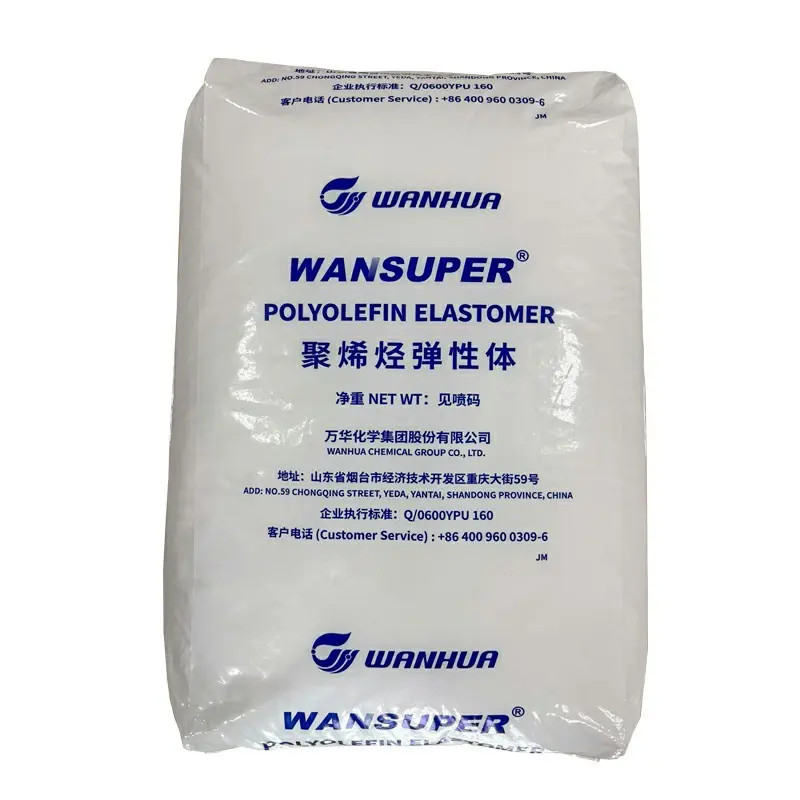
Wanhua Chemical WANSUPER® 5017 is a high-performance ethylene-octene copolymer polyolefin elastomer (POE) developed and produced by Wanhua Chemical. Supplied as uniform pellets, this material combines the rubber-like elasticity with the processing convenience of thermoplastics.
Featuring a low density of 0.87 g/cm³ and an extremely low glass transition temperature (Tg of -52.0 °C), WANSUPER® 5017 maintains outstanding toughness and flexibility even under severe low-temperature environments. With a Mooney viscosity ML(1+4)@100°C of 23 MU and a melt mass-flow rate (MFR) of 1 g/10 min (190 °C, 2.16 kg), it can be used directly as a base elastomer for molding or as a highly efficient impact modifier melt-blended with polypropylene (PP) and polyethylene (PE).
This grade offers excellent chemical resistance, weatherability, and a high elongation at break (800%), making it broadly adaptable to mainstream polymer processing techniques, including injection molding, extrusion, and calendering/pelletizing.
Technical Specifications
Physical Properties
| Physical Properties | Test Conditions | Property Values / Units | Test Standards |
| Mooney Viscosity, ML | ML(1+4)@100°C | 23 MU | ASTM D1646 |
| Density | — | 0.87 g/cm³ | ASTM D792 |
| Melt Mass-Flow Rate | 190 °C, 2.16 kg | 1 g/10 min | ASTM D1238 |
| Shore Hardness A | — | 73 | ASTM D2240 |
| Shore Hardness D | — | 22 | ASTM D2240 |
Mechanical Properties
| Mechanical Properties | Test Conditions | Property Values / Units | Test Standards |
| Tensile Strength at Break | 500 mm/min | 9.5 MPa | ASTM D638 |
| Tensile Modulus | 500 mm/min, 100% Secant | 2.9 MPa | ASTM D638 |
| Tensile Strain at Break | 500 mm/min | 800 % | ASTM D638 |
| Flexural Modulus | 1% Secant | 13.7 MPa | ASTM D790 |
| Tear Strength | — | 40.0 kN/m | ASTM D624 |
Thermal Properties
| Thermal Properties | Test Conditions | Property Values / Units | Test Standards |
| Melting Temperature | — | 62 °C | — |
| Glass Transition Temperature (Tg) | — | -52.0 °C | — |
Notice: The technical specifications for Wanhua Chemical WANSUPER® 5017 POE provided herein are compiled from data published by Wanhua Chemical or certified third-party testing laboratories. While prepared with professional diligence, these values serve as reference guidelines rather than absolute performance guarantees. Because molding and processing conditions vary significantly across operational environments, we recommend performing trial runs with WANSUPER® 5017 under your actual manufacturing conditions prior to final material selection and mass production.
Features & Benefits
- Exceptional Low-Temperature Impact Resistance: Boasts a low glass transition temperature (Tg of -52.0 °C), providing significant toughening modification in freezing conditions and greatly reducing the risk of low-temperature brittle fracture in end products.
- High Tensile Deformation & Tear Resistance: Features an elongation at break of 800% and a tear strength of 40.0 kN/m, imparting superior resistance to physical damage and high tensile endurance to molded items.
- Low Density Lightweight Advantage: The low density of 0.87 g/cm³ helps reduce part weight per unit volume, meeting lightweight design requirements in sectors such as automotive and consumer electronics.
- Excellent Interfacial Compatibility & Blendability: As an octene copolymer, it exhibits good compatibility with polyolefin matrices like PP and PE, achieving uniform dispersion during compounding and enhancing the mechanical balance of modified materials.
- Stable Thermoplastic Processing: Demonstrates moderate Mooney viscosity (23 MU) and melt flow rate (1 g/10 min), offering high melt strength during extrusion compounding and injection molding to minimize flash and flow mark defects.
Applications & Processing Guidelines
Typical Applications
- Automotive Industry: Modified automotive bumper compounds, instrument panel skins, interior door panels, mudguards, and other modified PP/PE parts requiring low-temperature impact endurance.
- Footwear & Foaming: EVA/POE cross-linked foam soles and high-rebound athletic midsoles, providing good anti-slip performance, resiliency, and compression set resistance.
- Wire & Cable: Halogen-free flame-retardant (HFFR) cable sheath modification, providing good flexibility and oil-extended filler acceptance.
- Compounding & Masterbatch: General-purpose PP toughening masterbatches, TPO (Thermoplastic Polyolefin) compounding, and film modification additives.
- Extrusion & Pipe: High-toughness polyolefin pipes, extruded profiles, and impact-resistant packaging films.
Processing Guidelines
- Drying Treatment: POE inherently absorbs negligible moisture and typically requires no pre-drying. If stored in high-humidity environments or if packaging is compromised, pre-drying at 70–80 °C for 1–2 hours in a desiccant dryer is recommended to prevent melt air entrapment.
- Processing Temperatures:
- Barrel Temperatures (Injection/Extrusion): 160 °C – 200 °C (avoid prolonged melt temperatures above 230 °C to prevent thermal degradation).
- Mold Temperature: 20 °C – 40 °C (proper mold temperature aids surface finish and mold release).
- Melt Shear Control: When compounding PP/POE melt modifications, high-shear twin-screw extruders are recommended to ensure optimal domain dispersion size (micron-scale) of POE within the polypropylene matrix.
Frequently Asked Questions (FAQs)
Q1: Is forced pre-drying required for WANSUPER® 5017 POE prior to injection molding?
A1: As a polyolefin elastomer, WANSUPER® 5017 lacks hydrophilic functional groups and has extremely low moisture absorption. When stored in intact packaging under dry conditions, it can be processed directly. If the resin is exposed to high humidity after opening or used in high-surface-quality injection parts (free of moisture splay or silver streaks), pre-drying at 70–80 °C for 1–2 hours is recommended to eliminate surface moisture.
Q2: What is the practical impact of a 1 g/10 min Melt Flow Rate (MFR) on PP toughening modification?
A2: An MFR of 1 g/10 min (190 °C, 2.16 kg) indicates a lower melt flow, higher molecular weight POE grade. Its higher melt strength and viscosity provide better viscosity matching when blended with lower-MFR PP (such as pipe-grade or extrusion-grade PP), yielding substantial improvements in impact toughness; in high-flow injection-grade PP, it also acts as an efficient modified phase to enhance notched impact strength.
Q3: What are the temperature requirements for WANSUPER® 5017 given its low density (0.87 g/cm³)?
A3: A density of 0.87 g/cm³ indicates a high octene content and relatively low crystallinity, resulting in a melting temperature of approximately 62 °C. If the end product needs to withstand structural loads under continuous high-temperature environments above 70 °C, it is recommended to blend it as a modifier with higher-crystallinity PP or PE (leveraging the matrix for structural support) or to apply cross-linking processes to improve heat resistance.
Q4: Does WANSUPER® 5017 comply with environmental and chemical regulatory standards?
A4: WANSUPER® 5017 produced by Wanhua Chemical is a high-purity polyolefin polymer free of phthalate plasticizers and heavy metals, fully complying with EU RoHS (Directive 2011/65/EU) and REACH regulations. Batch-specific compliance statements and MSDS documentation are available upon request from our technical sales team.