Product Overview & Key Features
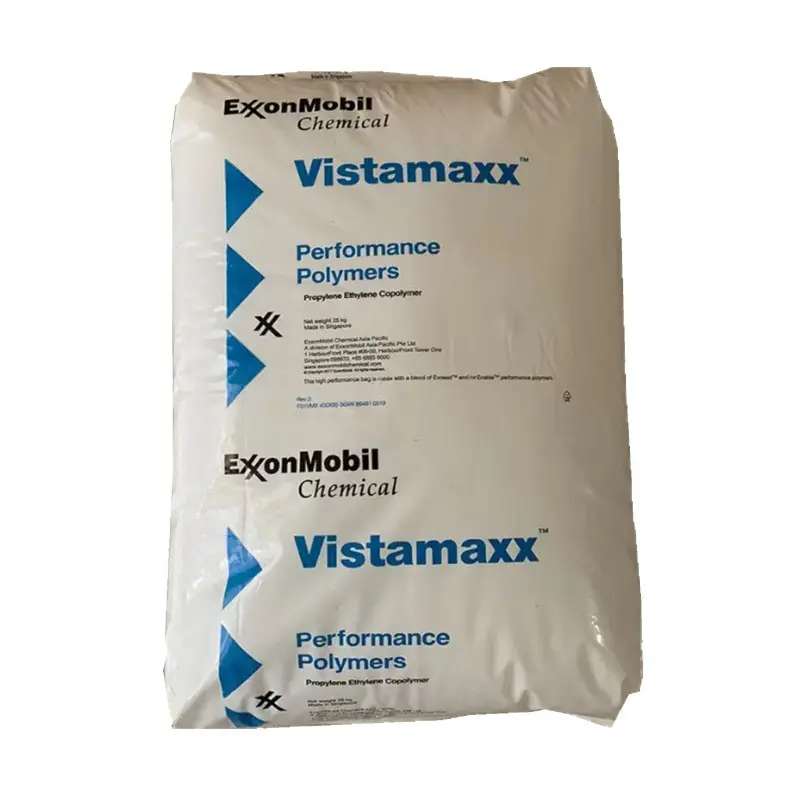
ExxonMobil Vistamaxx™ 6202 is a propylene-based elastomer (PBE) within ExxonMobil’s Vistamaxx™ series, a high-performance polyolefin elastomer synthesized using Exxpol™ metallocene catalyst technology. The material uses isotactic polypropylene as its backbone, with crystallinity tuned by the comonomer content, so that it retains part of the processability and rigidity of polypropylene (PP) while imparting rubber-like flexibility and resilience to finished parts. It is one of the core grades supplied within TaiKuo’s elastomer portfolio.
Basic Material Properties
- Manufacturer: ExxonMobil
- Product Series: Vistamaxx™ propylene-based elastomer (PBE)
- Catalyst Technology: Exxpol™ metallocene catalysis
- Density: 0.863 g/cm³ — a low-density polyolefin elastomer offering cost-per-volume advantages and lightweighting potential
- Flowability: A medium-high-flow grade with a melt index of 20 g/10 min (2.16 kg, 230 °C), favorable for filling thin-wall parts and long-flow-length molds
- Hardness: Shore A hardness of 66 (15-second reading), positioned between flexible TPE and rigid polypropylene, classified as a soft, semi-flexible grade
Core Performance Advantages
- Chemical Resistance: As a polyolefin-based elastomer, it offers good resistance to acids, alkalis, alcohols, and most polar solvents, with water and weathering resistance superior to most styrenic elastomers (SBS/SEBS)
- Structural Durability: Tensile permanent set of 18% indicates good resilience and dimensional retention, with limited deformation accumulation after repeated loading
- Mechanical Strength: Tensile stress of 1.9 MPa at 100% strain and 2.1 MPa at 300% strain combines a soft feel with the necessary load-bearing capacity; a tear strength of 33 kN/m provides excellent tear resistance
- Processing Adaptability: A broad processing window suitable for injection molding, extrusion, and compounding, and compatible for blending with polypropylene (PP) and other polyolefin matrices
Suitable Mainstream Processing Methods
- Injection Molding
- Extrusion
- Thermoplastic Elastomer Compounding
- Film / Sheet Extrusion & Casting
Technical Specifications
Physical Properties
| Physical Properties | Test Value | Test Unit | Test Standard |
| Density | 0.863 | g/cm³ | ASTM D1505 |
| Melt Index, Mass (2.16 kg, 230 °C) | 20 | g/10min | ExxonMobil Method |
| Melt Index, Mass (2.16 kg, 190 °C) | 9.1 | g/10min | ExxonMobil Method |
| Shore Hardness A (Time 15 sec) | 66 | — | ASTM D2240 |
Mechanical Properties
| Mechanical Properties | Test Value | Test Unit | Test Standard |
| Tensile Stress (Strain 100 %) | 1.9 | MPa | ASTM D412 |
| Tensile Stress (Strain 300 %) | 2.1 | MPa | ASTM D412 |
| Flexural Modulus, 1% Secant | 12.3 | MPa | ASTM D790 |
| Tear Strength | 33 | kN/m | ASTM D624C |
| Tensile Permanent Set | 18 | % | ASTM D412 |
Thermal Properties
| Thermal Properties | Test Value | Test Unit | Test Standard |
| Vicat Softening Point | 47.1 | °C | ASTM D1525 |
Notice: The technical specifications for ExxonMobil Vistamaxx™ 6202 provided herein are compiled from data published by ExxonMobil or certified third-party testing laboratories. While prepared with professional diligence, these values serve as reference guidelines rather than absolute performance guarantees. Because molding and processing conditions vary significantly across operational environments, we recommend performing trial runs with Vistamaxx™ 6202 under your actual manufacturing conditions prior to final material selection and mass production.
Applications & Processing Guidelines
Recommended Applications & End Products
- Consumer Goods: Soft-touch grips, over-molded tool handles, seals, and bottle-cap liners — soft feel, good resilience, and chemical resistance
- Automotive Interior / Components: Soft-touch interior cladding, cushioning pads, and anti-slip mats — low odor tendency, weather resistance, and low density for weight reduction
- Packaging & Films: High-toughness packaging film, stretch film, and heat-seal layer modification — good compatibility with PP for improved film flexibility and heat-seal performance
- Compounding & Modification: PP toughening, PP/elastomer blends, and masterbatch carriers — medium-high melt index for good dispersion as a PP impact modifier
Practical Processing Guidelines
- Melt Index & Flowability: With a melt index of 20 g/10 min (230 °C / 2.16 kg), this is a medium-high-flow grade. Adjust injection speed and pressure accordingly to avoid flash at high speed, while benefiting thin-wall parts and multi-cavity molds
- Temperature Window: With a Vicat softening point of only 47.1 °C, this is a low-softening-point elastomer. Barrel and die temperatures for extrusion and injection molding should be kept within the conventional range for polyolefin elastomers to avoid degradation from overheating; specific process temperatures should be confirmed through trial molding based on equipment and part design
- Screw Speed & Shear: As a metallocene propylene-based elastomer, it is relatively insensitive to shear. Medium-to-low screw speeds are recommended for twin-screw compounding to balance dispersion and avoid shear-induced overheating
- Drying Guidance: As a polyolefin-based material, it has extremely low moisture absorption and generally requires no forced drying. However, after high-humidity or prolonged storage, drying at 60–80 °C for 2–4 hours is recommended to ensure surface quality
- Blending Recommendation: Blending with homopolymer or copolymer PP can significantly improve impact toughness. Optimize the blend ratio based on the target balance between hardness and toughness, and verify dispersion through trial molding
Grade Comparison & Selection Guide
Comprehensive Comparison of Same-Series / Comparable Grades
The Vistamaxx™ series spans a full grade matrix — from low-hardness flexibility to high-rigidity semi-crystalline materials — by tuning comonomer content and molecular structure. The following core grades are compared for reference (data based on ExxonMobil published information):
| Grade | Melt Index (230°C, 2.16kg) | Hardness (Shore) | Positioning Characteristics | Typical Applications |
| Vistamaxx™ 6102 | ~3 g/10min (lower flow) | ~66 A | Low flow, high molecular weight, outstanding toughness | Extrusion profiles, high-toughness compounding |
| Vistamaxx™ 6202 | 20 g/10min | 66 A | Medium-high flow, balancing flow and softness | Soft injection-molded parts, thin-wall parts, PP toughening |
| Vistamaxx™ 3980FL | ~8 g/10min | ~90 A (harder) | Higher rigidity, higher semi-crystallinity | Over-molding and films requiring higher hardness |
| Vistamaxx™ 3020FL | ~1 g/10min (low flow) | Softer | Low flow, high flexibility | High-toughness films and specialty compounding |
| Vistamaxx™ 8880 | Medium-high flow | Higher hardness | High strength, high rigidity orientation | Structural part modification, high-rigidity elastomer applications |
Note: The melt index and hardness values for the compared grades above are qualitative references for series positioning; refer to the official ExxonMobil grade data sheets (TDS) for specifics. For a cross-reference within the same polyolefin elastomer category, see TaiKuo’s Mitsui Chemicals TAFMER™ DF840 POE.
Position of Vistamaxx™ 6202 within the matrix: This grade sits at the intersection of “medium-high flow + medium softness (66 A)” in the Vistamaxx™ series, serving as a general-purpose, well-balanced grade for soft/semi-soft injection-molded parts and PP toughening. Compared with the lower-flow 6102/3020FL, it is better suited to thin-wall, multi-cavity, and long-flow-length injection molding; compared with the harder 3980FL, it delivers a softer feel and better resilience.
Engineer Selection Guide
- By Wall Thickness & Flow Length: For parts with thinner walls (< 1.5 mm) or longer flow lengths with restricted gates, prefer the higher-flow 6202 for better mold filling; for thicker walls or extrusion scenarios requiring higher melt strength, consider the lower-flow 6102 or 3020FL
- By Mold Gate Design: For small, pin-point, or multi-point gates, the high-flow 6202 fills more uniformly, reducing short shots and weld lines. Note, however, the flash tendency that accompanies high flow — gate and parting-line fit accuracy should be correspondingly improved
- By Mechanical Load Requirements: If a part must withstand sustained tensile/compressive deformation while targeting low permanent set, the 18% tensile permanent set and 33 kN/m tear strength of 6202 satisfy most soft seal and cushioning requirements; for higher rigidity and creep resistance, choose the more semi-crystalline 3980FL or blend with PP to increase modulus
- Compounding Scenarios: When using 6202 as a PP impact modifier, its higher melt index promotes rapid dispersion in the matrix and shortens compounding time; the balance between target impact strength and rigidity can be adjusted via the 6202 addition ratio (typically 10%–30%) together with the PP base grade
Frequently Asked Questions (FAQs)
Q1: Does Vistamaxx™ 6202 require drying before processing?
A: Generally no. As a polyolefin-based propylene-based elastomer, Vistamaxx™ 6202 has extremely low moisture absorption and can be processed directly under normal conditions. However, after high-humidity storage or prolonged exposure of opened packaging, drying at 60–80 °C for 2–4 hours is recommended to avoid surface defects such as silver streaks and splay. If a part requires very high transparency or surface quality, the drying time may be appropriately extended.
Q2: What is the difference between Vistamaxx™ 6202 and 6102, and how should I choose?
A: Both grades have similar hardness (about 66 A), with the main difference in flowability: 6202 has a melt index of about 20 g/10 min (230 °C / 2.16 kg), a medium-high flow suited to thin-wall injection-molded parts, multi-cavity molds, and fast-filling scenarios; 6102 has lower flow and higher molecular weight, offering better toughness and melt strength, and is better suited to extrusion and high-toughness compounding. As a simple rule of thumb: choose 6202 for thin-wall soft injection-molded parts, and 6102 for extrusion profiles or high-toughness modification.
Q3: Given the relatively high melt index of 6202, how can flash and degradation be avoided during injection molding?
A: The main risks of a high melt index are flash and shear/thermal degradation. Practical recommendations: ① moderately reduce injection pressure and injection speed; ② improve the fit accuracy of the mold parting line and gates; ③ control barrel and nozzle temperatures within the recommended range for polyolefin elastomers to avoid prolonged overheating; ④ minimize plasticizing and holding time to prevent degradation from material residence in the barrel.
Q4: Can 6202 be blended with polypropylene (PP)?
A: Yes, and this is a common practice. As a propylene-based elastomer within the Elastomers & TPE material category, Vistamaxx™ 6202 has good compatibility with PP. As a PP impact modifier, it can significantly improve the low-temperature impact resistance and flexibility of PP while retaining good flowability. The blend ratio should be determined based on the target balance between impact strength and rigidity — typically 10%–30% — with trial molding recommended to verify dispersion uniformity and final mechanical performance.